
Official statement
What you need to understand
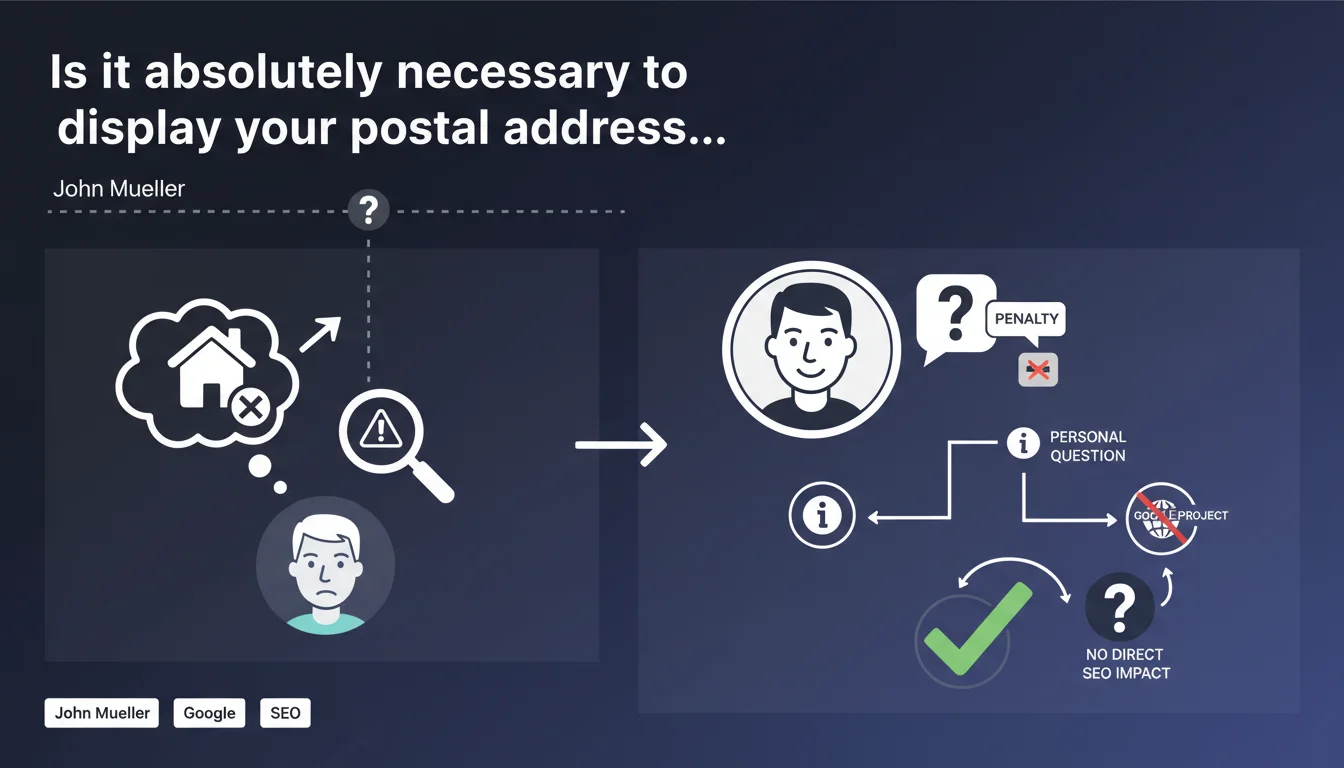
John Mueller created a small stir in the SEO community by publicly questioning on Twitter the absence of postal addresses on certain SEO professionals' sites. This intervention was quickly interpreted as a warning sign of a future ranking criterion or a possible penalty, causing legitimate concerns among professionals.
Important clarification: Mueller subsequently clarified that this was a personal reflection unrelated to any internal project at Google. This statement therefore confirms that postal address is not a direct ranking factor in Google's algorithm.
Nevertheless, this intervention raises relevant questions about website credibility and trust. The key points to remember:
- Postal address is not a confirmed SEO ranking criterion by Google
- There are legal obligations in many countries (notably in France with legal notices)
- Transparency remains a trust signal for users and potentially for E-E-A-T algorithms
- The absence of an address can negatively impact visitor conversion and trust
SEO Expert opinion
This statement is consistent with what we observe in the field: postal address itself is not a direct ranking factor. Tests conducted by the SEO community show that a site can rank perfectly well without displaying a physical address. However, the important nuance lies in the indirect signals of trust and authority.
Within the framework of E-E-A-T (Experience, Expertise, Authoritativeness, Trustworthiness) criteria, transparency plays a crucial role, particularly for YMYL (Your Money Your Life) sites. A site that clearly displays its identity, address and contact details sends legitimacy signals that can positively influence user behavior: reduced bounce rate, extended visit time, better conversion rate. These behavioral metrics do have an impact on SEO.
Practical impact and recommendations
Recommended actions following this clarification:
- Check your legal compliance: Ensure your legal notices include the postal address in accordance with your country's obligations
- Optimize the contact page: Create a dedicated page with complete address, phone number, email and possibly a form
- Integrate the address in the footer: Display at minimum the city and country in the footer, with a link to complete legal notices
- Use Schema.org markup: Implement LocalBusiness or Organization structured data with the address to reinforce information consistency
- Multi-platform consistency: Ensure the address is identical on Google Business Profile, social networks and directories
- Don't panic: If you cannot display an address (pure online business, sensitive domiciliation), focus on other trust signals
- Prioritize other factors: The address will never replace quality content, relevant backlinks and good user experience
💬 Comments (0)
Be the first to comment.