
Official statement
Other statements from this video 19 ▾
- 2:17 Comment empêcher les URLs de login de polluer vos sitelinks dans Google ?
- 6:49 Pourquoi Google ignore-t-il parfois vos balises canonical ?
- 9:43 Pourquoi les URLs avec session ID mettent-elles jusqu'à un an à disparaître de l'index ?
- 10:33 Faut-il vraiment utiliser rel=canonical vers le bureau pour vos pages mobiles séparées ?
- 11:59 Hreflang et ciblage géographique : confondez-vous encore langue et région ?
- 14:52 Désactiver le géociblage dans Search Console : erreur tactique ou stratégie gagnante ?
- 17:38 La personnalisation du contenu selon les données démographiques nuit-elle au crawl Google ?
- 22:14 Pourquoi Google met-il jusqu'à un an à traiter toutes les redirections après une migration de domaine ?
- 26:31 Faut-il vraiment s'inquiéter des erreurs 'not-followed' dans Search Console ?
- 29:30 La balise meta NOODP doit-elle encore être respectée par Google ?
- 31:57 Pourquoi Google ignore-t-il des URLs présentes dans votre sitemap XML ?
- 43:38 Le support If-Modified-Since est-il vraiment universel sur tous les serveurs ?
- 46:53 Faut-il vraiment supprimer le JSON-LD des pages en NOINDEX ?
- 55:41 Pourquoi l'indexation des images SVG prend-elle plus de temps que celle des pages Web ?
- 62:36 Faut-il vraiment indexer vos pages de recherche interne et de tags ?
- 62:57 Rel 'next' et 'prev' : pourquoi Google les ignore-t-il vraiment aujourd'hui ?
- 71:08 L'outil de soumission d'URL accélère-t-il vraiment le classement de vos pages ?
- 78:26 Faut-il vraiment fusionner vos microsites locaux pour éviter la cannibalisation SEO ?
- 83:59 Comment Google traite-t-il vraiment les sites piratés dans ses résultats de recherche ?
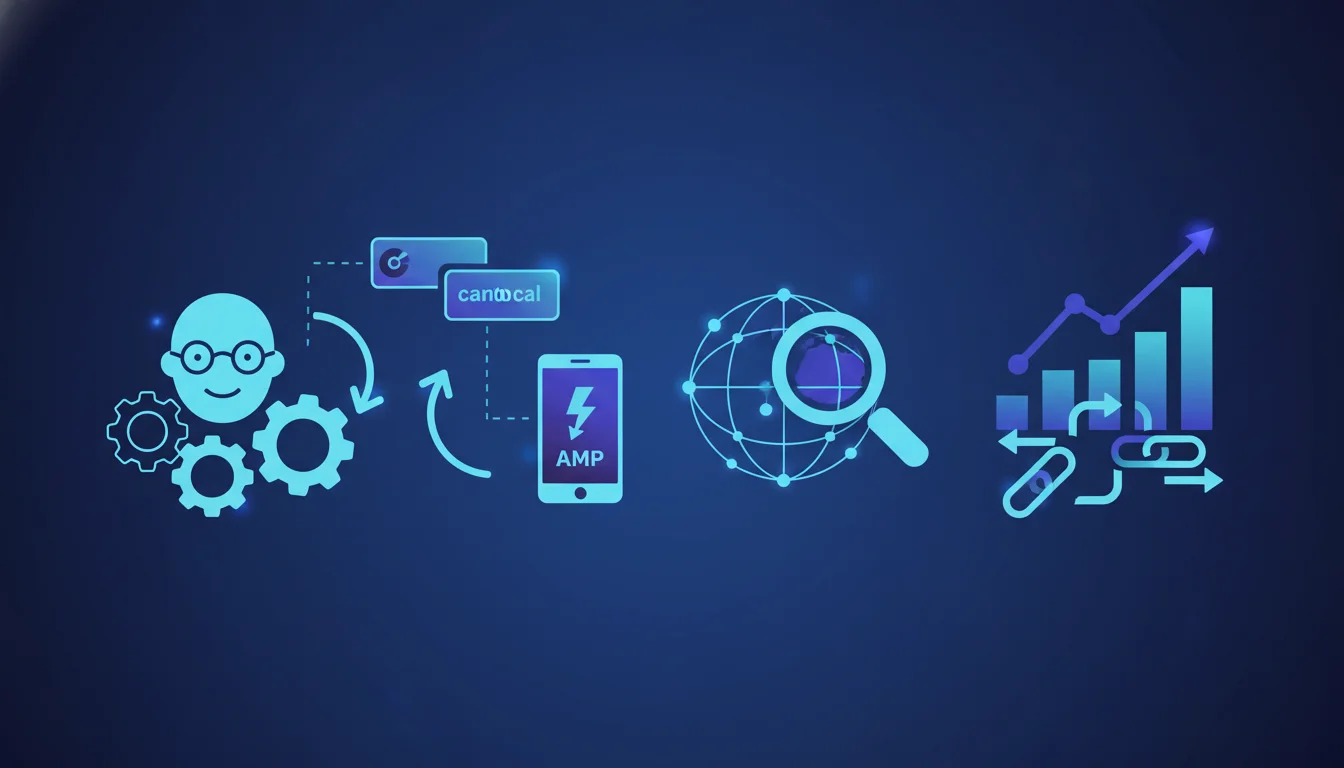
Google claims that signals and links pointing to an AMP URL are automatically transferred to the canonical page via the rel=canonical. In practice, a backlink acquired on your AMP counts for your main page. This statement reassures about the consolidation of PageRank, but raises questions about the actual traceability of these transfers and their timing.
What you need to understand
Why did Google clarify this about AMP pages?
AMP (Accelerated Mobile Pages) have long caused confusion among practitioners. When a site publishes an AMP version hosted on cdn.ampproject.org, the URL differs from the main page. As a result, there is a legitimate fear that backlinks acquired on this AMP URL do not benefit the originating domain.
Mueller confirms here that the rel=canonical mechanism plays its role thoroughly. All signals — inbound links, authority, engagement metrics — are redirected to the page designated as canonical. Technically, Google treats AMP as a technical variation of the main page, not as distinct content.
How does this transfer of signals actually work?
The rel=canonical tells Google which URL should receive the credit. On an AMP page, this tag points to the standard HTML version. Google then consolidates the metrics: a link gained on the AMP is counted as a link to the canonical.
This transfer concerns all ranking signals: PageRank distributed by backlinks, but also potentially behavioral signals if Google aggregates them at the canonical level. It avoids authority dilution between two URLs serving the same content.
What are the implications for managing your backlinks?
First consequence: you do not have to fear losing link value obtained through your AMP. If a third-party site cites your AMP article, that link benefits your main page. No theoretical loss.
Secondly: this consolidation simplifies the audit of link profiles. You can analyze the backlinks of the canonical without worrying about separately tracking those of the AMP. Google does the job internally. Just make sure your analysis tools (Ahrefs, Majestic, etc.) accurately reflect this reality.
- The rel=canonical on AMP pages transfers all signals to the declared main page.
- Backlinks acquired on the AMP URL count for the authority of the canonical page, without dilution.
- No specific action is needed on the SEO side if your AMP implementation is correct.
- Third-party tools (crawlers, backlink analyzers) might show discrepancies, but Google consolidates internally.
- This mechanism also applies to other cases of canonicalization (HTTP/HTTPS, www/non-www, URL parameters).
SEO Expert opinion
Is this statement consistent with field observations?
Yes, in most observed cases. Well-implemented AMP sites do not suffer from authority cannibalization between the AMP version and the standard version. Tests show that canonical pages maintain their ranking even if the AMP receives direct links.
However, a nuance must be noted. Some backlink analysis tools display AMP links separately, which creates confusion in reporting. It is not Google that is mistaken; it is your third-party crawler that does not aggregate as Google does. Clearly distinguish what your tool sees from what Google actually counts.
What uncertainties remain regarding this claim?
Mueller does not specify the transfer delay. Is it instantaneous? Must you wait for a complete recrawl? In practice, a link to an AMP takes a few days to reflect in the perceived authority of the canonical, according to observations. No official figures, just empirical observation.
Another point: what happens if the rel=canonical is misconfigured or absent on the AMP? Google can choose the canonical itself, but there is no guarantee it selects the correct one. Result: potential dilution if Google indexes the AMP as the main version. [To be verified]: the exact impact of concurrent canonicalization between AMP and HTML in current SERPs, given that Google has removed the AMP requirement from the Top Stories carousel.
In what cases might this rule not apply?
If your AMP is hosted on a distinct subdomain without a correctly configured rel=canonical, Google may treat the two URLs as separate entities. This occurs with poorly implemented setups where the canonical link points to itself (a classic template error).
Another scenario: standalone AMP pages (without a classic HTML equivalent). In this case, there is no external canonical, so links remain on the AMP. But this situation is rare, as AMP is generally a technical layer over existing content. Finally, if you remove your AMPs without 301 redirection, the links acquired on those URLs are lost, canonicalization or not.
Practical impact and recommendations
What should you check on your AMP pages right now?
First step: audit the rel=canonical tag on all your AMP pages. Use a crawler (Screaming Frog, OnCrawl) to extract the declared canonicals. Each AMP must point to its standard HTML version, not to itself or a third-party URL.
Second verification: check that your canonical pages are indexable and accessible. A rel=canonical pointing to a URL that is 404 or blocked by robots.txt nullifies the transfer. Google cannot consolidate signals to a page it cannot crawl. Also, ensure that the canonicals do not redirect in a chain (AMP → canonical 1 → canonical 2 = loss of juice).
How to track the real impact of your AMP backlinks?
Use the Search Console to monitor incoming links to your AMP URLs. Google lists these links in the dedicated report. Then cross-reference with your favorite backlink tool: if discrepancies appear, it's normal. The key is that the Search Console recognizes these links.
To measure the effect on the ranking of the canonical, track the positions of your main pages after acquiring backlinks on the AMPs. If the ranking progresses, the transfer works. If not, investigate: canonicalization issue, link disavowal by Google, or simply a link with too low authority to impact positioning.
Should you still invest in AMP for SEO?
Since Google removed the AMP requirement for the news carousel, the purely SEO interest has diminished. AMP remains relevant for loading speed and mobile UX, but it is no longer a direct ranking factor. If you already have a fast site through standard optimizations, AMP becomes optional.
That said, if you operate in a sector where the competition heavily uses AMP (media, mobile-first e-commerce), maintaining your AMP pages ensures you don't lose ground. And as Mueller confirms, the backlinks acquired on these pages are not wasted, so the technical ROI remains positive.
- Check that each AMP page contains a rel=canonical pointing to the standard HTML version.
- Crawl the site to detect self-referencing canonicals (AMP pointing to itself).
- Verify the accessibility and indexability of the canonical pages (no 404s, no noindex).
- Monitor AMP backlinks through Search Console and cross-reference them with your third-party tools.
- Test the impact on the ranking of the canonical after acquiring links on the AMP.
- Evaluate the cost of maintaining AMP versus real benefits in terms of traffic and conversions.
❓ Frequently Asked Questions
Un backlink sur mon URL AMP a-t-il la même valeur qu'un lien direct sur ma page HTML classique ?
Mes outils de backlinks affichent des liens AMP séparément. Est-ce un problème ?
Que se passe-t-il si j'oublie le rel=canonical sur mes pages AMP ?
Dois-je rediriger mes AMP en 301 si j'abandonne le format ?
AMP est-il encore utile pour le SEO maintenant que Google n'impose plus le format ?
🎥 From the same video 19
Other SEO insights extracted from this same Google Search Central video · duration 1h06 · published on 24/03/2016
🎥 Watch the full video on YouTube →
💬 Comments (0)
Be the first to comment.