
Official statement
What you need to understand
What is clustering and what does this statement change?
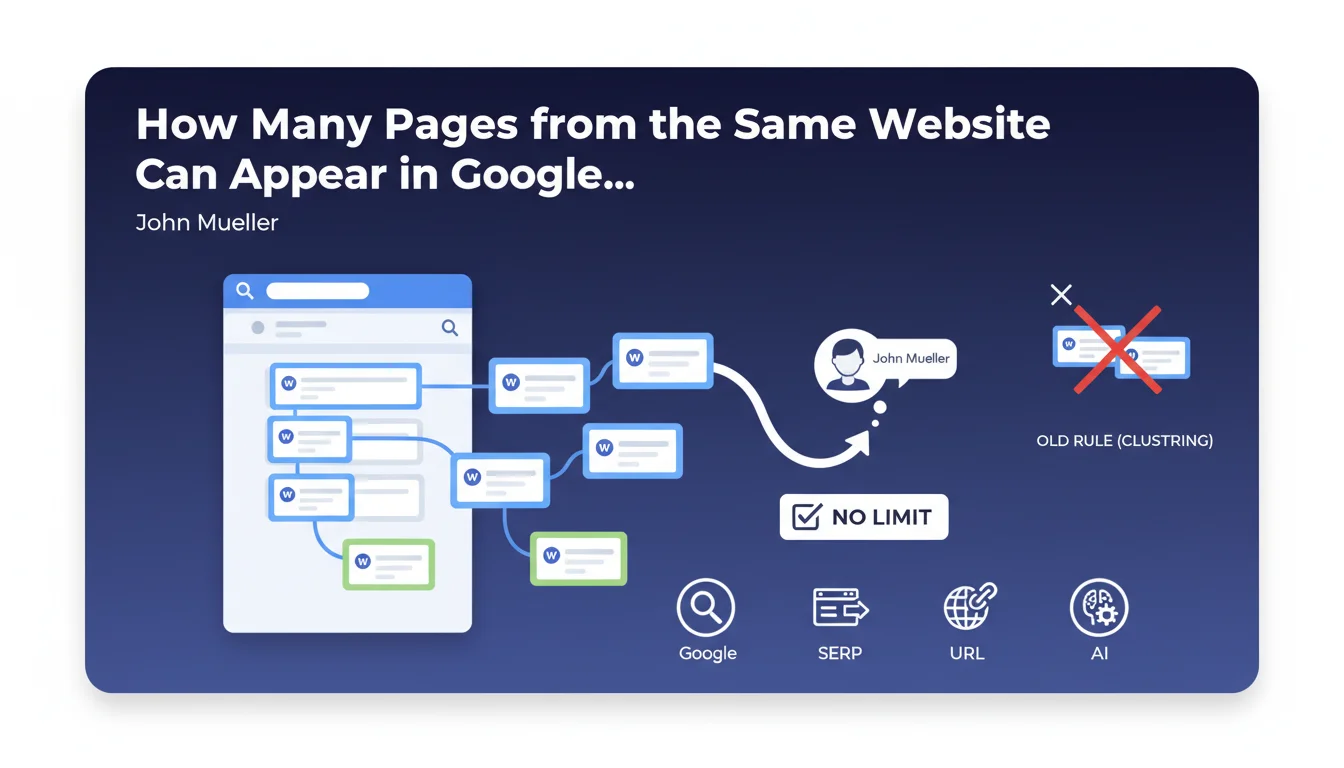
Clustering was a historical Google practice that limited to two URLs maximum for the same domain name on a results page. This restriction aimed to diversify the information sources presented to users.
For several years now, Google has gradually abandoned this limitation. Today, the same site can appear multiple times in a SERP with different pages, without any fixed numerical restriction. This evolution reflects Google's desire to prioritize relevance over artificial diversity.
Why did Google remove this limitation?
The main objective is to provide the most relevant answers possible for each query. If a site has multiple high-quality, specific pages for a given query, it would be counterproductive to exclude them artificially.
This approach favors sites with a solid semantic architecture and in-depth content covering different aspects of a topic. Google thus rewards expertise and depth of coverage.
What are the concrete implications for SEO?
- A site with topical authority can monopolize multiple positions in a SERP
- Cannibalization between internal pages becomes less problematic if each page targets a distinct intent
- Architecture in topical silos becomes even more important for organizing content
- Expert niche sites can dominate their target queries
- Diversity of formats (articles, guides, FAQs, videos) on the same topic becomes an asset
SEO Expert opinion
Is this statement consistent with field observations?
Absolutely. SEO practitioners have been observing for several years SERPs dominated by one or two major players. Sites like Amazon, Wikipedia, or specialized media regularly occupy 3 to 5 positions on certain queries.
This trend is particularly accentuated on complex informational queries where an expert site can legitimately offer multiple angles of response (beginner's guide, FAQ, comparison, in-depth analysis). Google's algorithms detect these multiple intents and respond with multiple pages from the same domain.
What nuances should be brought to this statement?
Although the technical limitation has been lifted, Google still applies a form of intelligent diversification. It is rare to see 10 URLs from the same site occupying an entire first page, except on brand queries or ultra-specific ones.
Google uses diversity signals to balance results: multiple sources, varied formats, different perspectives. A site can only monopolize a SERP if it demonstrates clear qualitative superiority over its competitors.
In which contexts is this multi-presence most frequent?
Brand queries are the most obvious cases: searching for "Nike" will naturally display multiple pages from the official site. But this also works on generic queries for sites with strong topical authority.
Ultra-specialized niche sites particularly benefit from this evolution. An expert photography site can occupy multiple positions on "how to photograph the milky way" with its guide, FAQ, video tutorials, and forum. Depth of coverage becomes a major competitive advantage.
Practical impact and recommendations
What should you do concretely to take advantage of this opportunity?
Develop a multi-format content strategy around your strategic queries. For each important topic, create multiple complementary contents: in-depth article, practical guide, FAQ, case study, explanatory video.
Work on your semantic silo architecture to strengthen topical coherence. Organize your content in clusters where a pillar page is supported by satellite pages covering specific aspects. Internal linking between these pages must be particularly well-crafted.
Optimize each page for a distinct search intent. Even if two pages deal with the same overall topic, one can target informational intent ("what is"), another transactional intent ("buy"), and a third comparative intent ("best").
What mistakes should you avoid in this approach?
- Do not create duplicate content or near-identical content hoping to multiply your positions
- Avoid over-optimization with pages too similar that would cannibalize each other
- Don't forget the user experience: each page must have real added value, not just an SEO objective
- Do not neglect quality in favor of quantity: 3 excellent pages are better than 10 mediocre ones
- Beware of zombie pages without traffic that dilute your site's authority
How can you measure and optimize your multi-page presence in SERPs?
Use Search Console to identify your queries where multiple of your pages already appear. Analyze positions, CTR, and impressions to understand how Google perceives the complementarity of your content.
Monitor your positions by page and by query with a rank tracking tool. Identify opportunities where you are present only once but could legitimately occupy 2-3 positions with complementary content.
Regularly perform cannibalization audits to detect pages that are negatively competing with each other. Consolidate or differentiate this content as appropriate. Test different approaches and measure the impact on your overall positions.
💬 Comments (0)
Be the first to comment.