
Official statement
What you need to understand
What is the alleged Google Sandbox?
The Sandbox refers to a persistent SEO theory according to which Google would deliberately place new websites in temporary quarantine. During this period, the site would not achieve the positions it deserves on competitive queries, even with quality content and proper technical optimization.
This notion emerged in the early 2000s and has fueled numerous debates in the SEO community. Many SEO professionals have observed ranking delays on new domains and theorized the existence of a punitive filter applied to recent sites.
What does Google actually say about this phenomenon?
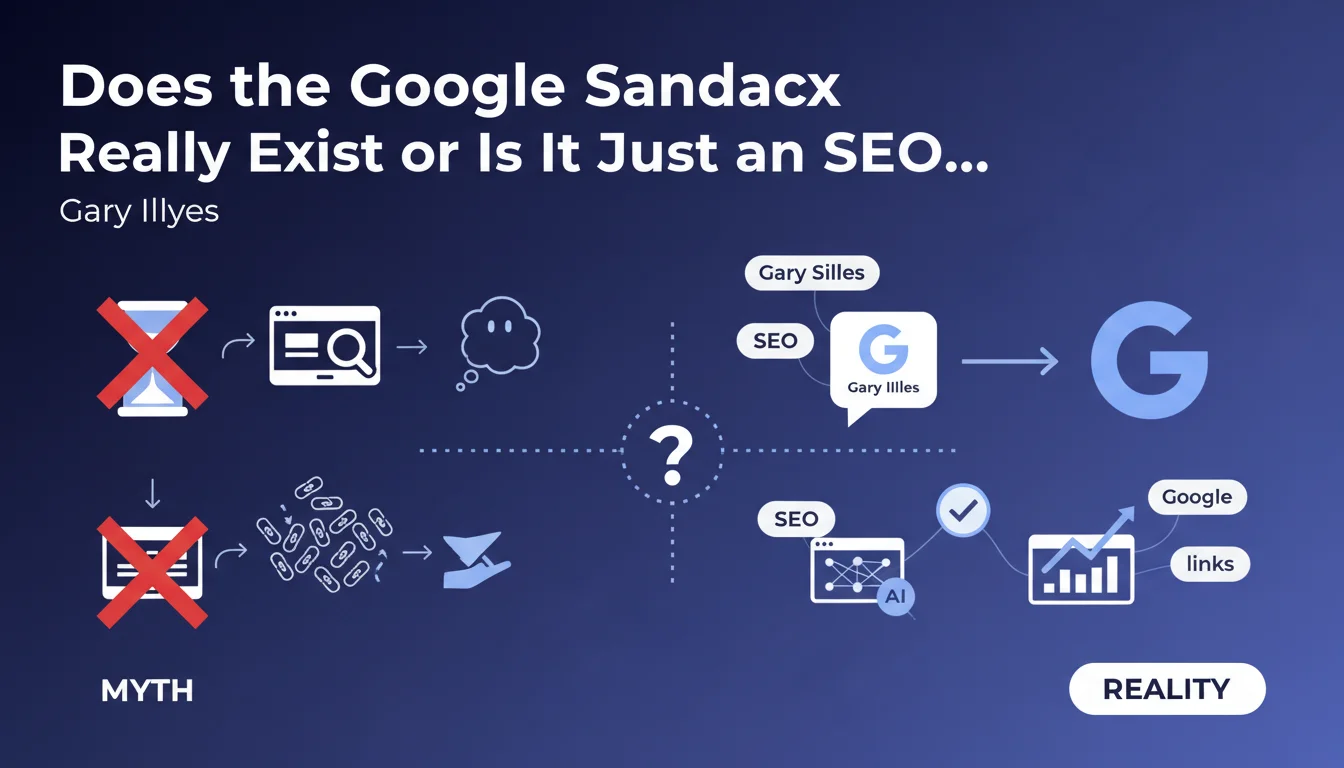
John Mueller clearly stated on Twitter that the Sandbox does not exist as a deliberate system. There is no mechanism at Google designed to voluntarily penalize new sites or artificially keep them out of search results.
This statement puts an end to years of speculation. Google does not intentionally throttle new domains. The ranking difficulties observed have other perfectly logical technical and algorithmic explanations.
Why do new sites take time to rank?
If the punitive Sandbox does not exist, ranking delays are very real. Several factors explain this phenomenon: the time needed for complete site indexing, progressive processing by Google's algorithms, and especially the initial lack of trust signals.
A new site starts with few or no backlinks, no traffic history, and no established authority. Google must collect data about the site, analyze user behavior, and evaluate content quality over time before granting high positions.
- No punitive system: no voluntary quarantine is applied to new sites
- Natural delays: indexing, algorithmic analysis, and signal collection take time
- Lack of initial signals: absence of backlinks, history, and authority at launch
- Progressive construction: Google evaluates the site's quality and relevance over time
SEO Expert opinion
Is this statement consistent with field observations?
After 15 years of experience, I confirm that John Mueller's analysis corresponds to empirical observations. The new sites I support do not experience artificial blocking, but undergo a progressive ramp-up. Domains that quickly obtain quality backlinks and produce relevant content rank faster.
What was interpreted as a Sandbox is actually the result of the normal functioning of the algorithms. Google cannot instantly trust a new site. It observes engagement signals, the quality of incoming links, and user satisfaction before granting high positions on competitive queries.
What nuances should be added to this official position?
Although the punitive Sandbox does not exist, Google does indeed apply differentiated quality filters according to domain age. A 10-year-old site with a clean history naturally benefits from algorithmic trust that a new site must build. This is not a penalty, it is an initial neutrality that requires proof of value.
In certain particularly sensitive sectors (health, finance, YMYL), trust requirements are higher. A new site in these niches will take significantly longer to rank, even with excellent content. Google applies the principle of enhanced E-E-A-T here.
In what cases do we observe prolonged ranking delays?
Certain situations create exceptionally long ranking delays. A domain previously penalized and then abandoned will carry this negative history. A site with deficient technical architecture will slow down indexing. A poorly targeted content strategy will prevent the accumulation of positive signals.
Sites in ultra-competitive niches (insurance, credit, casino) face a particularly high signal requirement. Without high-authority backlinks and without clear demonstration of expertise, these sites will remain invisible for months. This is not a Sandbox, it is the reality of algorithmic competition.
Practical impact and recommendations
How can you accelerate the ranking of a new website?
Since the punitive Sandbox does not exist, you can significantly accelerate the ranking of a new domain by working on the right levers. The absolute priority is to quickly obtain quality backlinks to send trust signals to Google from the first weeks.
At the same time, immediately produce high-value content that precisely answers search intents. Do not scatter your efforts: target 10-20 strategic keywords with in-depth content rather than 100 superficial articles. Google must quickly identify your thematic expertise.
Fast indexing is crucial. Submit your sitemap via Search Console, ensure your technical architecture is flawless, and optimize loading speed. The more efficiently Google can crawl and analyze your site, the faster you will accumulate the signals necessary for ranking.
What mistakes should you avoid when launching a new site?
The worst mistake is to launch an incomplete or low-quality site thinking you will improve it gradually. Google forms its first impression quickly, and a mediocre site at launch will take even longer to rank. Launch only with polished content and optimal user experience.
Do not expect immediate results on ultra-competitive queries. A new site must first rank on less competitive long-tail keywords, accumulate traffic and positive signals, then progress towards more generic queries. Directly targeting the top 3 on major queries is unrealistic.
Avoid aggressive link building practices early in life. A new site that obtains 50 backlinks in one week raises suspicions. Favor natural and progressive growth of your link profile, even if it requires more patience.
How can you measure and track your site's ramp-up?
Define realistic progression indicators according to your domain's age. During the first 3 months, primarily track indexing metrics, first long-tail rankings, and acquisition of your first backlinks. Do not focus yet on overall organic traffic.
Between 3 and 6 months, observe progression on medium-difficulty queries. Your site should start appearing on pages 2-3 for your main target keywords. This is a sign that Google has collected enough signals to position you in the competition.
- Obtain 10-15 quality backlinks in the first 3 months
- Publish at least 20-30 in-depth pieces of content (1500+ words) at launch
- Optimize technical architecture for fast crawling and indexing
- Initially target less competitive long-tail keywords
- Monitor position evolution weekly without expecting immediate results
- Build a coherent content strategy demonstrating thematic expertise
- Submit the sitemap and monitor index coverage in Search Console
- Analyze user behavior to optimize experience from the first visitors
💬 Comments (0)
Be the first to comment.