
Official statement
What you need to understand
Why is Google weighing in on multilingual links?
Many SEO practitioners mistakenly believe that receiving backlinks in a different language from their site constitutes a spam signal. This belief has led some SEOs to systematically disavow these links, fearing a penalty.
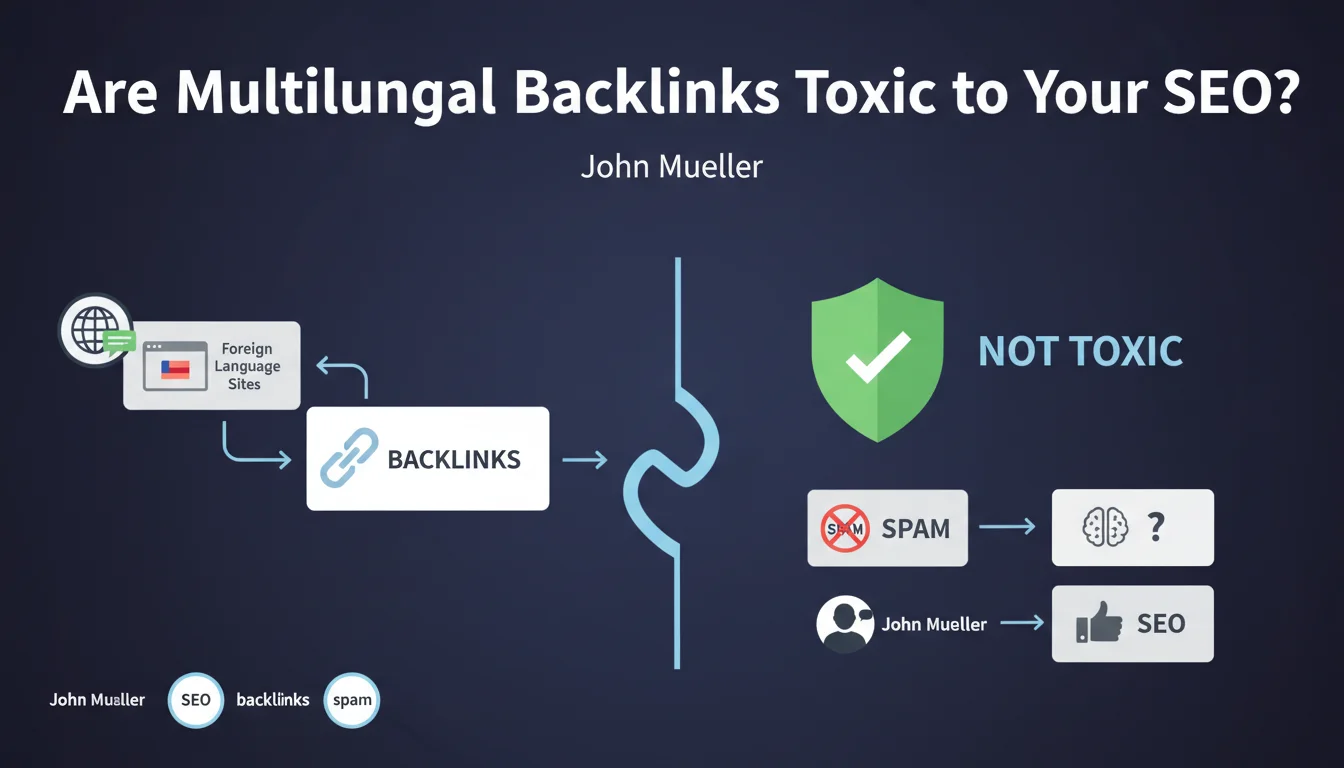
Google is clarifying its position: a link from a quality site in another language is absolutely not toxic. The search engine primarily evaluates the relevance and authority of the source, regardless of its language.
What is Google's official stance on this matter?
Google confirms that there is no automatic penalty related to backlinks from sites in other languages. The algorithm is sophisticated enough to understand multilingual and international contexts.
The only condition remains the intrinsic quality of the link: does it come from a trusted site, in a natural editorial context, with coherent thematic relevance? If yes, the language barrier is not an obstacle.
What elements does Google actually evaluate?
- The quality and authority of the source site, regardless of its language
- The thematic relevance between the source content and the target page
- The editorial context in which the link appears
- The naturalness of the overall link profile of the site
- The absence of obvious manipulative patterns
SEO Expert opinion
Does this statement align with real-world observations?
In my practice across hundreds of sites, I indeed observe that sites receiving quality international links do not suffer any penalties. On the contrary, these links often positively diversify the backlink profile.
Authority sites in their field naturally receive links from different geographical and linguistic zones. A French site expert in technology will logically be cited by English, German, or Spanish media.
What important nuances should be added to this statement?
While multilingual links are not inherently toxic, an unbalanced profile can raise questions. A 100% French site receiving only links from Russian or Asian sites without obvious thematic connection will arouse suspicion.
The semantic consistency of link anchors also remains important. An anchor text in Chinese pointing to a French page creates a dissonance that Google can hardly interpret positively.
In what contexts are multilingual links particularly beneficial?
For international brands, e-commerce sites exporting their products, or players in technical niches, receiving links from different languages is a signal of international recognition.
Media, scientific, or technology sites particularly benefit from this linguistic diversity, which reinforces their global authority in their field of expertise.
Practical impact and recommendations
How should you concretely manage multilingual backlinks in your strategy?
Stop immediately disavowing links from sites in other languages systematically. Evaluate each link based on its intrinsic quality, not its language.
Focus on analyzing the thematic relevance and authority of the referring domain. A link from a reputable German media outlet in your sector is worth much more than a French-language link from a low-quality directory.
What criteria should you use to evaluate a multilingual backlink?
- Check the domain authority of the source with reliable metrics (DR, DA, Trust Flow)
- Analyze the thematic coherence between the source site and your content
- Examine the editorial context: does the link appear in a quality article?
- Check the naturalness: does the link seem placed organically or artificially?
- Evaluate the proportion: what share do multilingual links represent in your overall profile?
- Monitor anchor texts: are they consistent despite the language difference?
What acquisition strategy should you adopt for a balanced profile?
Aim for a majority of backlinks in your main language to maintain semantic consistency, while naturally accepting quality international links that come your way.
Never force the acquisition of multilingual links artificially. They should come from natural mentions: international media coverage, academic citations, references in your industry.
💬 Comments (0)
Be the first to comment.