
Official statement
What you need to understand
What does Google's Topic Authority system actually mean?
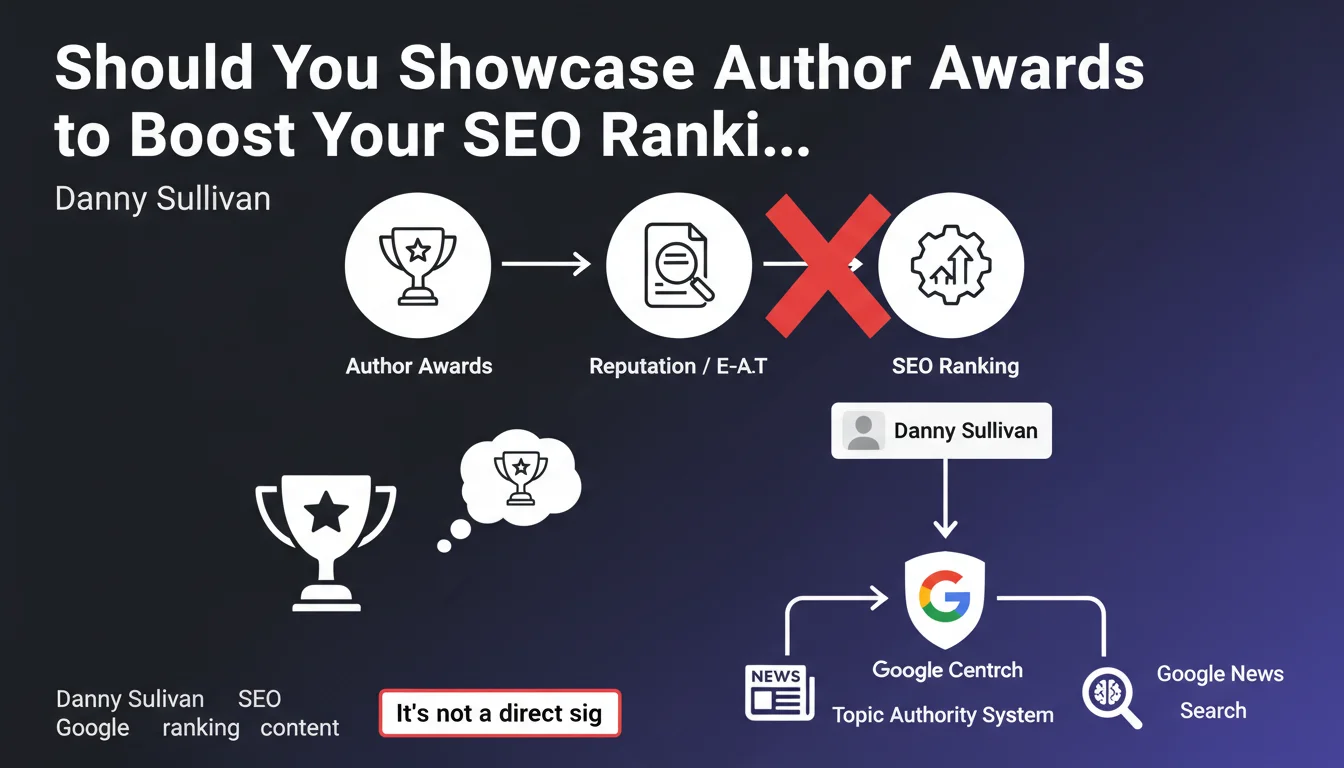
Google introduced the concept of Topic Authority to identify and promote expert content in Google News and standard search results. This system aims to reward sources that demonstrate recognized expertise in their field.
Contrary to what some might think, this system does not rely on direct and simplistic signals. Rather, it's a complex set of indicators that Google uses to assess the overall reputation of a source.
Are awards a direct ranking factor?
Danny Sullivan clarified this point explicitly: an author's distinctions and awards do not constitute a direct ranking signal. Rather, they serve as an indicator allowing Google to assess whether a source has acquired a good reputation in its field.
These awards can align with other reputation signals that Google uses, but they are not directly measured or integrated as a ranking factor. They are one contextual element among others.
What are the key takeaways from this statement?
- Professional awards are not a direct ranking signal in Google's algorithm
- They serve as a reputation indicator during manual or algorithmic assessment of credibility
- Google uses distinct signals to understand and measure a source's reputation
- Topic Authority relies on a complex set of criteria, not on a single element
- Displaying or not displaying distinctions on a site will not have a measurable direct SEO impact
SEO Expert opinion
Is this statement consistent with practices observed in the field?
This clarification from Google fits perfectly within the E-E-A-T logic (Experience, Expertise, Authoritativeness, Trustworthiness). Awards are indeed a credibility indicator, but never an isolated factor that would tip the ranking scales.
In practice, the best-performing sites demonstrate their expertise through multiple convergent signals: press mentions, citations by other experts, quality backlinks, publication history, audience engagement. Awards fit into this global ecosystem of reputation.
What important nuances should be added to this analysis?
There is a crucial distinction between direct signals and indirect signals. A direct signal would be, for example, the number of awards in structured data. An indirect signal is how these awards contribute to building perceived authority.
Awards can influence SEO indirectly: they reinforce credibility with users, can generate media mentions (thus backlinks), and improve click-through rates if they appear in meta descriptions. These effects are real but difficult to quantify.
In which contexts do awards matter most?
Awards take on a particular dimension in YMYL (Your Money Your Life) sectors: health, finance, legal. In these areas, demonstrating professional credentials becomes crucial to reassure both Google and users.
For news sites and journalistic publications, distinctions like Pulitzer Prizes or equivalents can indeed contribute to the assessment of Topic Authority. But even there, the determining factor remains consistent editorial quality and thematic coherence.
Practical impact and recommendations
What should you actually do with author awards?
Display your authors' relevant awards in their biography, but with moderation. The goal is to establish credibility for human visitors rather than for algorithms. Place this information in strategic locations: author page, end of article, "About" section.
Use appropriate schema.org markup (Person, Award) to structure this information, not to directly influence ranking, but to improve presentation in rich results. This approach remains aligned with structured data best practices.
Focus your efforts on signals that have a demonstrated impact: regular production of expert content, obtaining natural editorial backlinks, building an engaged community, and tangible demonstration of expertise through depth and originality of content.
What critical mistakes should you absolutely avoid?
Don't create artificial pages solely to list awards hoping to manipulate the algorithm. Google easily identifies these attempts and it could harm your overall credibility. Authenticity remains paramount.
Avoid overinvesting in displaying minor or irrelevant distinctions that could dilute your message. Prioritize quality over quantity: one prestigious and relevant award is worth more than ten obscure honorable mentions.
Don't neglect the other pillars of E-E-A-T in favor of awards. Demonstrated practical experience, publication regularity, factual rigor, and transparency remain far more determining factors for your visibility.
How do you build an effective and sustainable authority strategy?
- Create detailed author pages presenting expertise, experience, and relevant awards
- Implement schema.org markup (Person, Author, Award) consistently across the entire site
- Encourage your experts to regularly publish original content demonstrating their practical expertise
- Develop a press relations strategy to obtain mentions in reference media
- Participate in professional events and conferences to strengthen your experts' visibility
- Seek guest contributions on authority sites in your sector
- Create content that naturally generates citations and backlinks (studies, original data, in-depth analyses)
- Regularly measure your online reputation: brand mentions, sentiment, expert citations
- Document expertise through case studies, portfolios, and concrete demonstrations of results
Author awards do not constitute a direct SEO lever, but fit into a global reputation strategy. The essential thing is to demonstrate authentic expertise through multiple convergent signals: content quality, regularity, editorial backlinks, and audience engagement.
Building true topical authority requires a holistic approach combining technical optimization, expert content creation, and visibility development. This complex process involves coordinating numerous SEO levers simultaneously.
Faced with the increasing sophistication of algorithms and the need to demonstrate tangible expertise, support from a specialized SEO agency can prove valuable. An expert external perspective helps identify specific opportunities for your sector and orchestrate a coherent authority strategy, adapted to your resources and objectives.
💬 Comments (0)
Be the first to comment.