
Official statement
Other statements from this video 4 ▾
- □ How can you leverage search trends to anticipate demand and maximize your SEO traffic?
- □ Why Should You Use Topics Instead of Exact Search Terms in Google Trends?
- □ Can Google Trends really replace your dedicated SEO keyword research tools?
- □ Should you really be monitoring emerging topics in Google Trends to stay ahead of SEO opportunities?
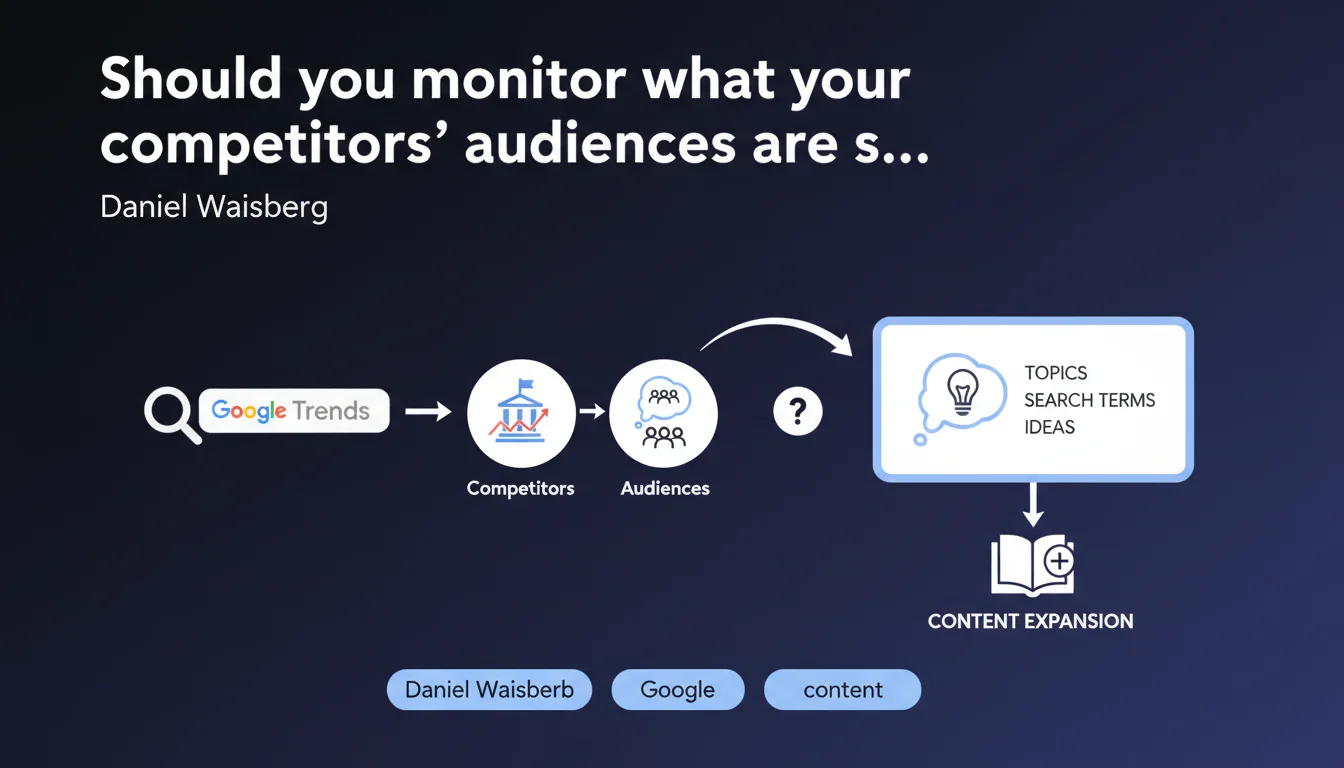
Google officially recommends using Google Trends to analyze search terms related to your competitors and identify content opportunities. An explicit validation of competitive analysis as a thematic expansion lever, complete with a free Google tool.
What you need to understand
Google validates here a practice that many of us already apply: observing what users search for around our competitors to detect blind spots in our editorial strategy. Daniel Waisberg isn't talking about copying, but expanding — a crucial distinction.
The statement positions Google Trends as a legitimate competitive intelligence tool. No paid APIs, no rogue scraping: just an official, free tool that exposes aggregated search data.
Is Google Trends really sufficient for serious competitive analysis?
Trends provides relative search volume trends, not absolute numbers. You see if "competitor X + term Y" is rising or falling, but not exactly how many monthly searches it represents. For precise keyword research, you'll need to cross-reference with other sources.
The tool shines especially for detecting seasonal spikes, emerging questions, or unexpected term associations. For example: a competitor in the travel space sees "cancellation insurance" spike in summer? That's a signal to exploit if you don't have content on it.
Which types of competitors should you analyze?
The statement mentions "competitors" without specifying: direct business competitors, or SEO competitors (sites competing with you for the same SERPs)? This distinction matters. A business competitor may attract queries you've never considered because your positioning differs slightly.
Conversely, a pure SEO competitor — a content aggregator, a media outlet — can reveal high-performing editorial angles that your business model hadn't envisioned. Both approaches are complementary.
- Google Trends is validated by Google as a competitive analysis tool to identify content opportunities
- The tool shows relative trends, not absolute volumes — cross-reference with other data sources
- Analyzing both business competitors and SEO competitors offers different perspectives
- The goal is to expand your thematic reach, not to clone what already exists
SEO Expert opinion
Is this recommendation new or just a formalization?
Let's be honest: no one waited for this statement to look at what competitors were doing. What's interesting is that Google is saying it publicly and even providing the tool. It legitimizes the approach with clients who are sometimes hesitant ("we don't want to copy").
From a practitioner's perspective, we were already using Ahrefs, SEMrush, or Sistrix for this work — with far more granularity. Trends remains a macro complement, not a replacement for professional tools. But it's free, and it's enough to break ground.
What limitations aren't mentioned in this statement?
Waisberg doesn't discuss the Trends biases. The tool aggregates anonymized data, but certain ultra-specialized niches are under-represented. If your market is niche B2B with 200 searches/month, Trends won't tell you anything.
Another blind spot: intent. Trends tells you that "competitor X + term Y" is being searched, but not whether it's informational, transactional, or just negative brand sentiment ("competitor X scam"). You need to cross-reference with manual SERP analysis. [To verify] case by case before producing content blindly.
In what cases could this method backfire?
If you blindly follow trends tied to competitors, you risk diluting your positioning. A competitor may rank on off-topic terms simply because they have high authority — that's not a reason for you to jump in too.
And there's the trap of me-too content: landing sixth on a topic already saturated by five well-established competitors is rarely a winning strategy. Sometimes it's better to identify angles that nobody's covering yet.
Practical impact and recommendations
How do you concretely use Google Trends for this analysis?
Start by listing 3-5 direct competitors, then enter their brand names in Trends. Scroll down to the "Related queries" and "Related topics" sections. You'll see what people are searching for in parallel.
Export these lists, cross-reference them with your existing editorial corpus to spot gaps. A term shows up for three competitors but not for you? That's a strong signal. Then verify the SERP to confirm the opportunity before producing.
What mistakes should you avoid in this approach?
Don't just look at rising volumes. A term may be declining but still highly voluminous — and if your competitors are abandoning it, that's a window of opportunity. Trends shows the dynamic, not the absolute value.
Another classic mistake: analyzing only competitors your size. The big players reveal macro trends you may not have the resources to attack head-on, but that you can niche down. Small competitors show hyper-specialized tactical angles.
How do you verify your strategy is working?
Track impressions and rankings for new terms identified via Search Console, segment by segment. If you're expanding your thematic spectrum, you should see an increase in long-tail queries driving qualified traffic.
Also measure bounce rate and time on page for these new entry points. If engagement metrics are low, the topic is misaligned with your audience — even if the query exists.
- Identify 3-5 business competitors and 3-5 pure SEO competitors
- Analyze "Related queries" and "Related topics" in Google Trends for each competitor
- Cross-reference this data with your existing content to spot thematic gaps
- Manually verify SERPs before validating a content opportunity
- Prioritize terms where multiple competitors are present but you're absent
- Track impressions and rankings in Search Console, segmented by new thematic cluster
- Measure engagement (time on page, bounce rate) to validate audience alignment
Competitive analysis via Google Trends is an effective starting point for expanding your editorial spectrum, especially when you're short on inspiration or want to validate a hunch. But it doesn't replace either deep user research or advanced keyword research tools.
For sites with complex content strategies, orchestrating this analysis, cross-referencing it with proprietary data, and driving the editorial production that follows requires methodical coordination. If your team lacks the time or expertise to fully exploit these opportunities, working with a specialized SEO agency can accelerate implementation and maximize ROI from this approach.
❓ Frequently Asked Questions
Google Trends remplace-t-il un outil de keyword research payant ?
Faut-il analyser les concurrents directs ou les concurrents SEO ?
Comment éviter de produire du contenu "me-too" en suivant cette méthode ?
Quelle fréquence d'analyse recommander pour suivre les concurrents ?
Google Trends fonctionne-t-il pour des marchés B2B de niche ?
🎥 From the same video 4
Other SEO insights extracted from this same Google Search Central video · published on 10/10/2024
🎥 Watch the full video on YouTube →
💬 Comments (0)
Be the first to comment.