
Official statement
What you need to understand
What is Google's official position on AI content?
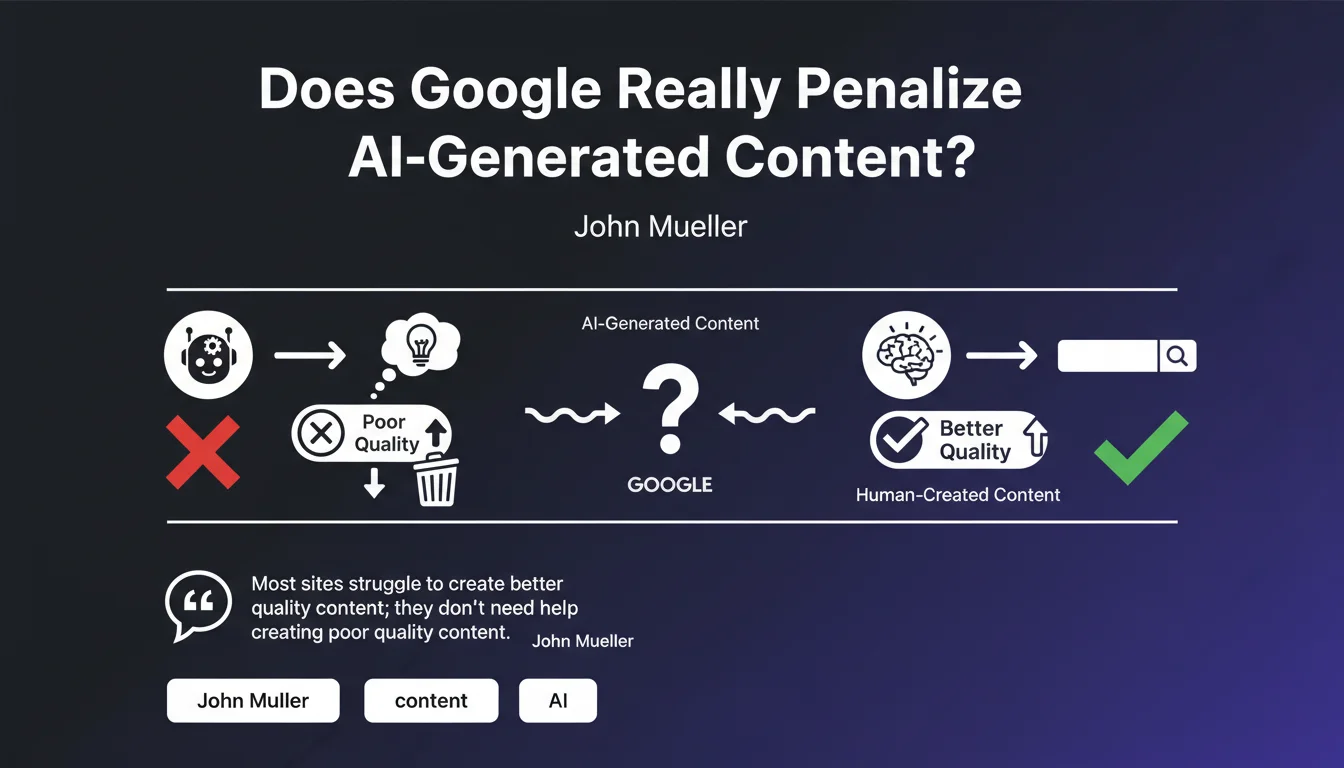
John Mueller has drawn a clear parallel between AI-generated content and older automated generation techniques like content spinning. His statement reveals that Google considers this content in the same category: low-quality content.
This position fits within a historical consistency. Google has been fighting since its inception against automated techniques aimed at producing mass content without real added value. AI is no exception to this rule.
Why does Google specifically criticize the quality of AI content?
Mueller points to a fundamental problem: most sites already struggle to create quality content. Adding AI tools to automate production therefore amounts to multiplying mediocre content rather than improving quality.
This statement comes in a context where Google's algorithms favor expertise, authority, and trustworthiness (E-E-A-T). Automated content generally struggles to demonstrate these essential qualities.
What are the concrete risks for sites using AI content?
Google has algorithms capable of detecting automated content patterns. Sites abusing these techniques expose themselves to algorithmic or manual penalties.
- Pure AI content is treated as automated spam by Google's guidelines
- Algorithms detect the lack of depth and genuine expertise
- Semantic duplication between AI contents can trigger filters
- The absence of unique added value penalizes ranking
- Algorithm updates specifically target low-quality content
SEO Expert opinion
Is Google's position consistent with practices observed in the field?
As an SEO expert, I do observe that sites massively using raw AI content experience disappointing performance. However, the reality is more nuanced than the official discourse.
Google's algorithms don't always detect the origin of content, but rather its quality signals. Well-edited, enriched, and verified AI content can perform perfectly well. The problem isn't the tool, but the use made of it.
What essential nuances should be added to this statement?
Mueller's position dates from a period when generative AI was less advanced. Today, tools like GPT-4 produce content whose baseline quality can exceed that of many poorly qualified human writers.
The fundamental distinction lies in the intention and process. Using AI as an assistant in a supervised editorial process is completely different from automated mass generation without supervision.
In what contexts does AI use remain problematic?
Certain AI uses remain clearly at risk. Automated generation without human intervention, mass production without differentiation, and absence of fact-checking expose to sanctions.
YMYL (Your Money Your Life) sectors such as health, finance, or legal are particularly sensitive. AI content often lacks the verifiable expertise that Google requires.
Practical impact and recommendations
How can you use AI without risking a Google penalty?
The key lies in the hybrid approach. AI should serve as an assistant to human expertise, not replace it. Each generated content must be reviewed, enriched, and personalized by a domain expert.
Focus on adding unique value: proprietary data, case studies, original perspectives, concrete examples. These elements cannot be produced by AI alone and constitute strong quality signals.
- Never publish AI content without thorough editorial review
- Systematically enrich with data, examples, and unique insights
- Verify all factual information and cite reliable sources
- Add an expert perspective and nuanced opinions
- Structure content for optimal user experience
- Integrate original multimedia elements (images, videos, infographics)
What critical mistakes must absolutely be avoided?
Mass generation without differentiation is the most common mistake. Publishing dozens of similar AI articles creates a detectable fingerprint and dilutes your site's perceived quality.
Also avoid AI content on topics requiring verifiable expertise. Algorithms look for authority signals that AI alone cannot provide: author history, external citations, industry recognition.
How do you audit and secure your existing content?
If you've already published AI content, conduct a thorough quality audit. Identify underperforming pages and enrich them with human expertise, recent data, and unique perspectives.
Monitor your performance metrics: reading time, bounce rate, engagement. Insufficient quality AI content generates negative usage signals that Google detects and penalizes.
- Analyze Core Web Vitals and engagement signals of your AI content
- Identify pages with low reading time or high bounce rate
- Prioritize enriching content on your strategic keywords
- Add expert author signatures with credible biographies
- Update regularly to demonstrate freshness and maintenance
- Obtain external links and mentions validating content quality
Using AI in SEO requires a sophisticated strategic approach combining technology and human expertise. The line between effective optimization and penalty risk is subtle.
These optimizations demand in-depth expertise in Google's algorithms, constant monitoring of developments, and the ability to finely audit quality signals. Faced with this growing complexity, support from a specialized SEO agency can prove valuable for implementing a balanced content strategy, intelligently leveraging AI tools while preserving the quality standards required by Google.
💬 Comments (0)
Be the first to comment.