
Official statement
Other statements from this video 1 ▾
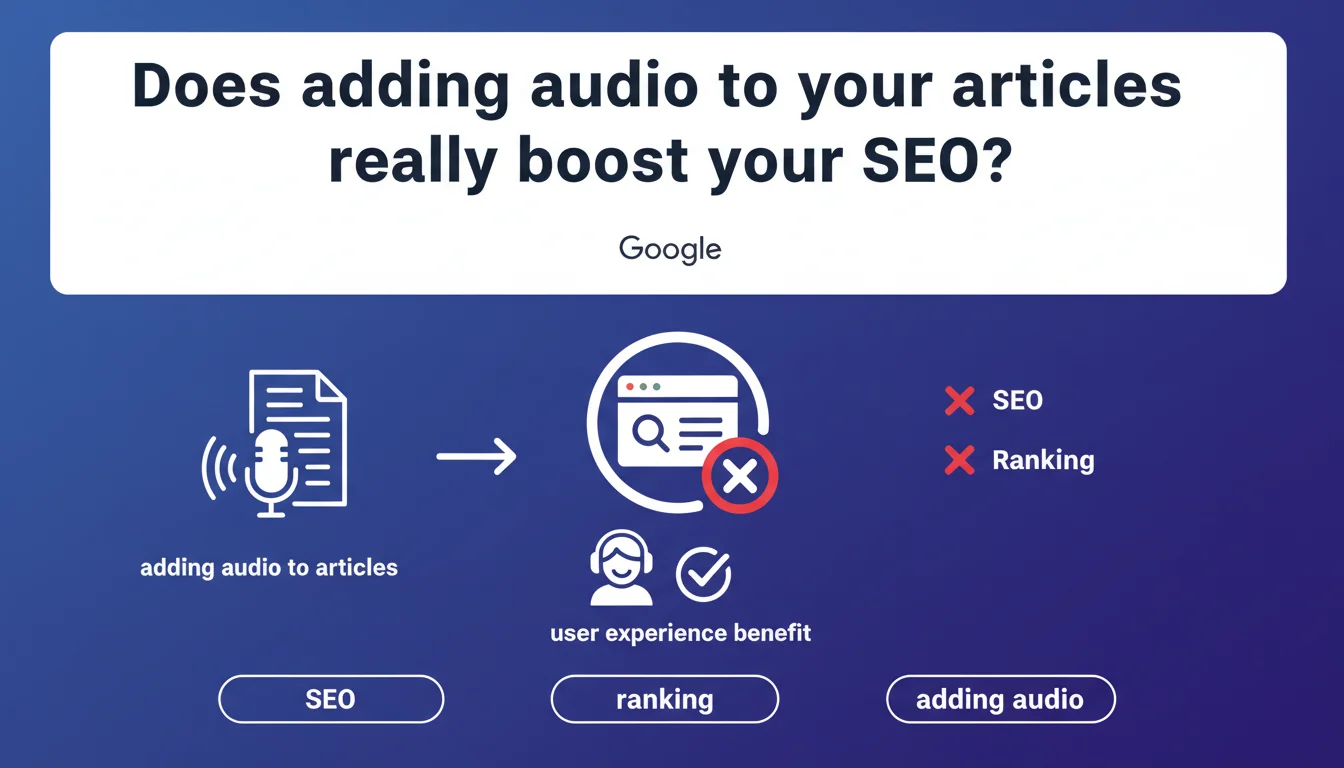
Google makes it crystal clear that adding an audio version to an article does not directly influence ranking in search results. It's a user experience element, not a ranking signal. If you were hoping for a direct SEO boost, this isn't it.
What you need to understand
Google is unequivocal: audio is not a ranking factor. This statement clarifies a question that has come up regularly since the explosion of audio content and podcasts integrated into articles.
The nuance matters. It's not that Google ignores audio — it can index it, transcribe it via algorithms. But its presence or absence does not change the relevance score of a page in the ranking algorithm.
Why does Google draw this distinction between UX and SEO?
Because the search engine seeks to evaluate informational relevance, not consumption comfort. Audio improves accessibility, enables mobile consumption, potentially reduces bounce rate for certain segments — all of that counts for engagement.
But engagement and ranking are two separate circuits. Google has never confirmed that direct behavioral signals (time spent, scrolling, etc.) serve as primary ranking factors. Audio falls into the same category: useful, but not decisive for climbing the SERP.
Does this statement contradict the importance of multimedia content?
Not really. Google values rich content — images, structured videos with schema.org, infographics. But audio embedded in an article has never had the same status as video, which generates rich snippets, carousels, optimized snippets.
Audio remains a secondary format in the Google ecosystem, unlike YouTube or podcasts indexed via Google Podcasts. On a standard web page, it doesn't provide measurable SEO leverage.
- Audio is not a ranking signal — Google explicitly confirms this
- It improves user experience for certain segments (accessibility, mobility)
- Multimedia content (video, images) retains superior SEO value through rich snippets
- User behaviors influenced by audio (time spent, engagement) do not directly translate to ranking boosts
SEO Expert opinion
Is this position consistent with what we observe in practice?
Absolutely. No serious study has ever shown a correlation between audio presence and better ranking. Sites that tested systematic audio integration on their articles saw no significant movement in organic positions.
On the other hand, some report indirect gains: lower bounce rate on mobile, increased average time per session, better retention on longer articles. But these metrics — if they actually influence SEO, which remains [to be verified] — are not enough to create a measurable effect at ranking level.
What nuances should be added to this statement?
The statement targets audio embedded in a standard web page. It does not concern podcasts indexed via Google Podcasts, or audio content hosted on third-party platforms that generate referral traffic.
Another point: if audio allows you to keep a visitor longer and they then consult other pages, you may be improving engagement signals. But this hypothetical path remains fragile — Google has never confirmed that these behaviors directly weigh on ranking.
In what cases could audio still have an indirect role?
If you add a complete, optimized text transcript under your audio player, you enrich crawlable content. Then, it's no longer the audio that matters — it's the generated text. Google crawls and analyzes this text like any other content.
Another case: audio improves conversion rate or trust (ex: founder's voice, customer testimonials). These elements can influence the business, and therefore indirectly the ability to invest in content or link building — but then we're outside strict SEO scope.
Practical impact and recommendations
Should you abandon audio on your articles?
No. Audio remains relevant for non-SEO objectives: accessibility (blind people, people on the move), editorial differentiation, audience retention for those who prefer listening to reading. If these KPIs matter to you, continue.
But if you were hoping for a direct SEO boost, reprioritize your efforts. Audio will never compensate for mediocre content, failing internal linking, or catastrophic loading speed.
What should you focus on instead?
Invest in proven SEO levers: semantic optimization, coherent heading structure, relevant schema.org, strategic internal links, videos with rich snippets, images optimized with contextual alt attributes.
If you have budget to allocate to enriched content, prioritize structured video (VideoObject schema) that generates rich snippets in the SERP, or crawlable infographics that create link-building opportunities.
How to integrate audio without harming SEO performance?
Prevent the audio player from slowing page loading. Systematic lazy loading, external hosting (Soundcloud, Spotify), optimized file size. A poorly integrated player can degrade your Core Web Vitals — and there you lose ground.
If you generate a transcript, structure it properly: spaced paragraphs, heading hierarchy, keywords naturally integrated. The transcript should enrich the content, not mindlessly duplicate it.
- Don't count on audio to improve your ranking — it's not a direct factor
- Continue integrating audio if your UX, accessibility, or business objectives justify it
- Prioritize structured video (VideoObject schema) for measurable SEO gains
- Systematically lazy load your audio players to preserve Core Web Vitals
- Add an optimized transcript if you want to enrich crawlable content
- Never let audio degrade loading speed or mobile experience
Audio is an engagement tool, not an SEO lever. Keep it if your editorial strategy or accessibility obligations justify it, but don't count on it to climb search results. Instead, invest in technical, semantic, and structural optimizations that have proven themselves.
These decisions between enriched content, technical performance, and editorial strategy often require pointed expertise. If you lack internal resources or strategic perspective, support from a specialized SEO agency can help you prioritize high-impact initiatives and avoid false good ideas.
❓ Frequently Asked Questions
L'ajout d'une transcription textuelle sous mon audio améliore-t-il mon SEO ?
Un player audio peut-il nuire à mes Core Web Vitals ?
Google indexe-t-il le contenu des fichiers audio sur mes pages ?
L'audio améliore-t-il le temps passé sur la page, et cela booste-t-il le SEO ?
Vaut-il mieux investir dans l'audio ou dans la vidéo pour le SEO ?
🎥 From the same video 1
Other SEO insights extracted from this same Google Search Central video · published on 19/02/2025
🎥 Watch the full video on YouTube →
💬 Comments (0)
Be the first to comment.