
Official statement
Other statements from this video 1 ▾
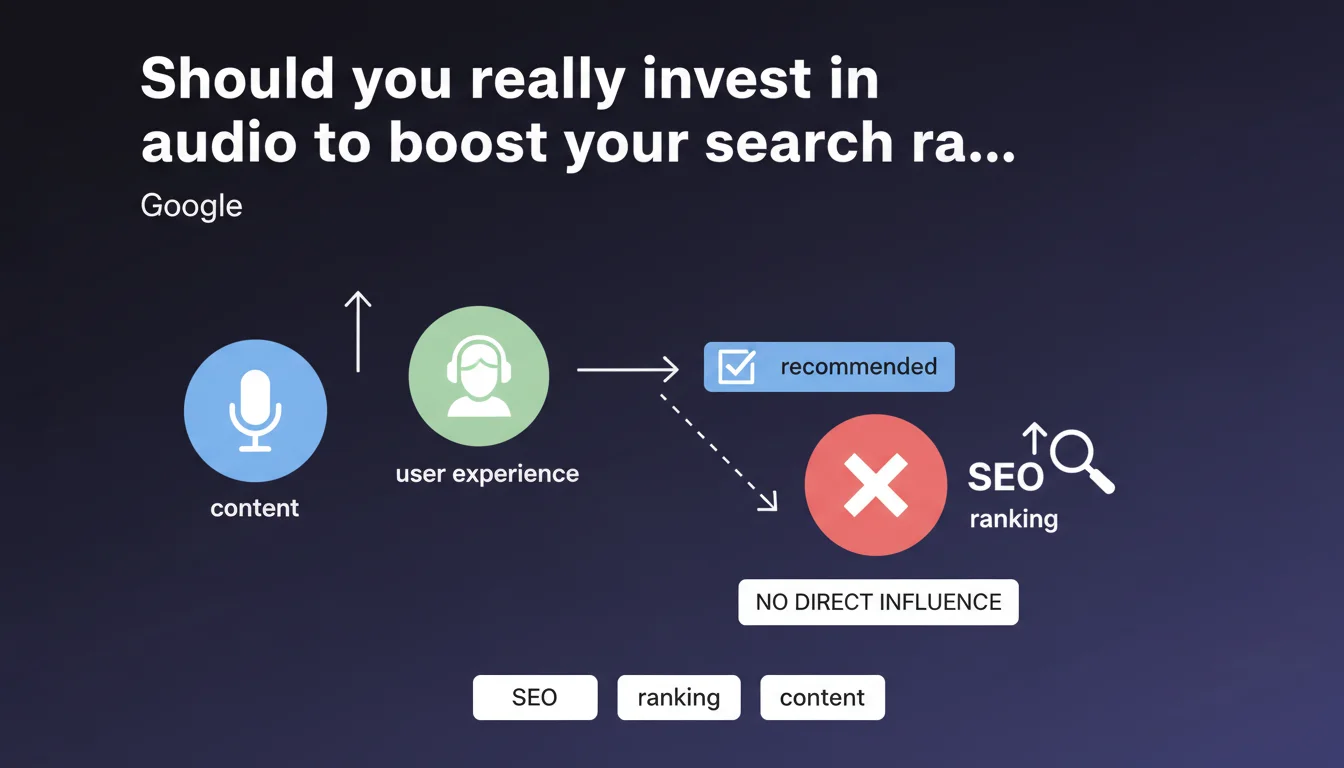
Google states that providing an audio version of content enhances user experience but has no direct impact on search rankings. Audio is a plus for accessibility and engagement, not a true SEO lever. If your goal is climbing the SERPs, invest your budget elsewhere.
What you need to understand
What exactly does Google say about audio and SEO?
Google draws a clear line: audio improves UX, but it is not a direct ranking signal. In other words, adding an audio player to read your articles sends no additional positive signals to the algorithm.
This position aligns with Google's historical philosophy: direct ranking signals remain textual, structural, and behavioral (content, backlinks, Core Web Vitals, measured engagement). Audio does not fall into this category.
Why does Google distinguish between UX and SEO here?
Because improved user experience does not always mechanically translate into better rankings. Better UX can reduce bounce rate, extend session duration, and encourage sharing—but Google does not directly measure these metrics as ranking signals.
Audio offers an alternative consumption method for users in a hurry, driving, or with visual impairments. It broadens your audience, but it does not change the textual relevance of your content in the crawler's eyes.
Does audio have an indirect impact on SEO?
Potentially yes, but Google does not confirm this. If audio improves real engagement (longer time spent, lower bounce rate), it could influence behavioral signals Google observes. However, no official confirmation exists on this point.
Furthermore, offering a podcast or indexable audio content (via transcript) opens doors to other search surfaces—Google Podcasts, voice search, featured snippets. But again, it is the transcribed text that does the SEO work, not the audio itself.
- Audio is not a direct ranking signal recognized by Google
- It improves UX, which may indirectly influence engagement
- A text transcript remains essential to index audio content
- Google values established textual, structural, and behavioral signals
SEO Expert opinion
Is this statement consistent with real-world observations?
Yes, generally speaking. No direct correlation has ever been observed between the presence of an audio player and improved rankings. Sites that climb the SERPs after adding audio often do so because they also optimized the transcript, enriched the textual content, or improved user engagement.
However, some publishers report gains in session duration and user retention after integrating audio. If these signals matter to Google—which remains unclear—then an indirect impact exists, but it is impossible to isolate. [To be verified]
What nuances does Google not mention here?
Google says nothing about the importance of accessible transcription. If you offer audio without text, you lose any chance of indexing the spoken content. The crawler does not read audio; it reads HTML.
Moreover, Google does not clarify whether enriched and structured audio content (with chapters, clickable timestamps, Schema.org tags like Clip or AudioObject) could ever become a signal. Voice search and voice assistants might change things, but for now, nothing concrete exists.
In what cases can audio still play an SEO role?
If you operate in a niche where engagement and audience retention are critical (media, education, coaching), audio can differentiate you and build loyalty. This generates recurring traffic, brand signals, and potentially natural backlinks.
Additionally, a well-structured podcast with complete transcript can multiply SEO entry points: one episode = one article + one podcast page + extracted featured snippets. But once again, the text does the work, not the audio.
Practical impact and recommendations
What should you do concretely if you want to add audio?
Do not do it for SEO; do it for your audience. If your users request audio, or if you target intensive mobile usage (commutes, exercise), then yes, invest. But do not expect your rankings to climb mechanically.
If you add audio, ensure you have a complete and indexable transcript on the same page. It will carry the SEO work. Structure the text with subheadings, semantic markup, and clickable anchors synchronized with the audio.
What mistakes should you absolutely avoid?
Never replace textual content with audio alone. Google cannot index an MP3 file or a player embed without accompanying text. You would lose all organic visibility for that content.
Do not overload your pages with heavy players that degrade Core Web Vitals. A poorly optimized audio player can tank your LCP and CLS, which would have a real negative SEO impact—ironically, the opposite of what you intended.
- Provide a complete and well-structured transcript for each audio piece of content
- Use a lightweight, performant audio player (no impact on Core Web Vitals)
- Add Schema.org tags of type AudioObject to enrich metadata
- Segment audio with chapters and clickable timestamps synchronized to the text
- Never sacrifice technical or editorial SEO budget for audio
- Measure real engagement (session duration, bounce rate) to assess indirect impact
How can you verify your audio strategy is aligned with SEO?
Audit your pages with audio: is the text indexable? Are Schema tags present? Do Core Web Vitals remain green? If audio degrades your technical performance, you have a problem.
Compare performance of pages with and without audio on similar queries. If no ranking difference appears but engagement increases, you have confirmation that audio affects UX, not rankings.
❓ Frequently Asked Questions
Est-ce que l'audio peut indirectement améliorer mon SEO via l'engagement utilisateur ?
Faut-il absolument transcrire mes contenus audio pour qu'ils soient indexés ?
Un lecteur audio lourd peut-il nuire à mon SEO ?
Google Podcasts ou la recherche vocale changent-ils la donne pour l'audio ?
Dois-je investir dans l'audio si mon objectif principal est le SEO ?
🎥 From the same video 1
Other SEO insights extracted from this same Google Search Central video · published on 19/02/2025
🎥 Watch the full video on YouTube →
💬 Comments (0)
Be the first to comment.