
Official statement
What you need to understand
Does Google Really Penalize Grammar and Typing Errors?
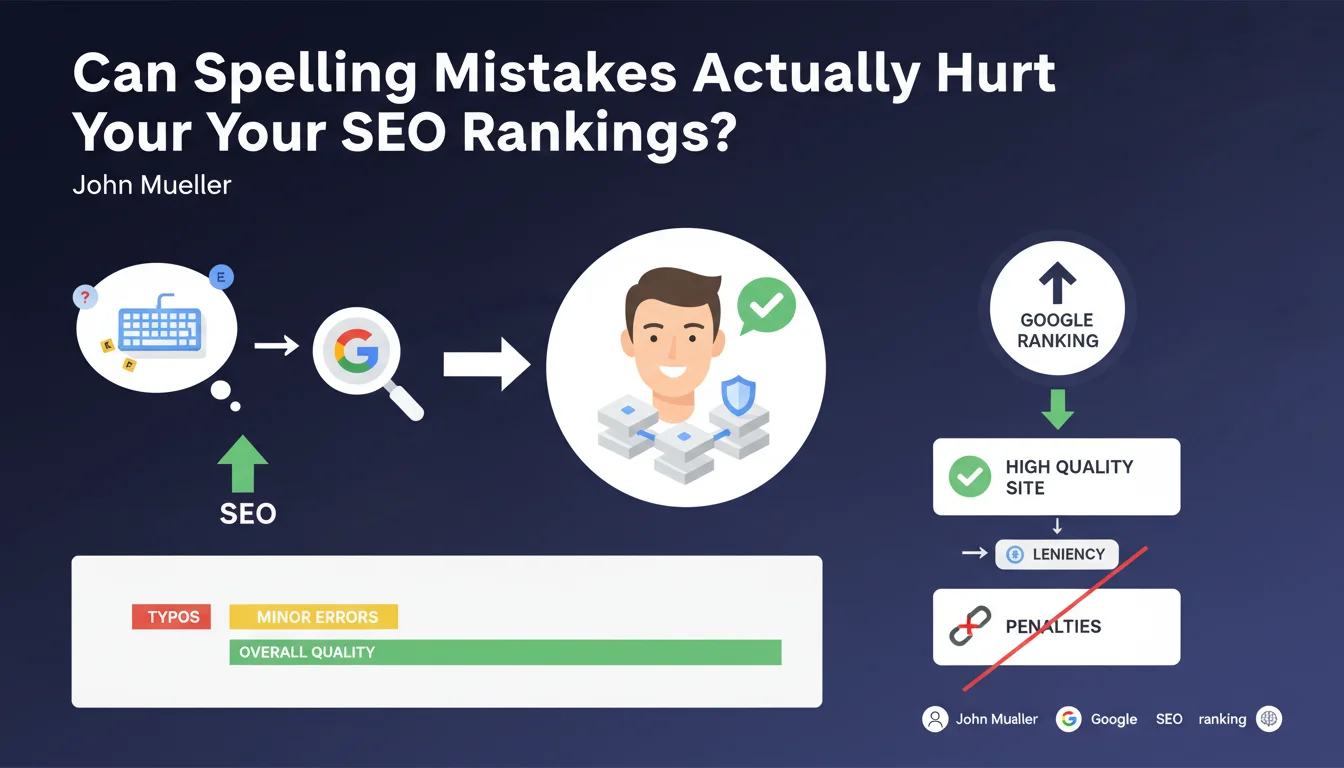
John Mueller's official answer is unequivocal: Google does not directly penalize typos or spelling mistakes. The algorithms do not have a specific mechanism to sanction these linguistic imperfections.
This position fits into a broader logic where Google favors overall quality assessment rather than a punitive approach on isolated criteria. The algorithm primarily seeks to understand the content and its relevance to the user.
How Does Google Actually Evaluate Content Quality?
Google adopts a comparative and contextual approach. Your content is constantly evaluated against other available results for the same query. This is the principle of relative competition rather than an absolute standard.
Overall quality encompasses multiple dimensions: informational relevance, demonstrated expertise, content structure, user experience and satisfaction of search intent. Errors represent just one factor among many others.
What Really Determines Your Rankings?
Ranking depends primarily on your ability to meet user needs better than your competitors. If your content provides superior informational value, a few mistakes won't hinder your visibility.
- No algorithmic penalty is triggered by spelling or grammar mistakes
- Evaluation is based on overall quality and not on isolated linguistic criteria
- Positioning is relative to competitors present on the same query
- Informational relevance takes priority over formal perfection
- Google's systems are not designed to detect and penalize linguistic imperfections
SEO Expert opinion
Is This Statement Consistent With What We Observe in the Field?
My 15 years of experience largely confirms this position. I have observed numerous sites with minor linguistic imperfections maintain excellent rankings, particularly in technical niches where expertise takes priority over style.
However, there is an important nuance to integrate. While Google doesn't actively penalize, errors can indirectly affect your performance through behavioral signals: bounce rate, time on page, and especially the perception of credibility by the user.
In Which Contexts Do Linguistic Errors Become Problematic?
Google's tolerance applies mainly to occasional and minor mistakes. On the other hand, content riddled with errors to the point of hindering comprehension can be perceived as low overall quality.
Some sectors are more sensitive than others. In YMYL (Your Money Your Life) domains such as health, finance or legal, poorly written text can undermine trust and perceived authority, essential criteria for ranking in these verticals.
What's the Real Algorithmic Logic Behind This Tolerance?
Google needs to index and rank content in hundreds of languages and dialects, including content created by non-native speakers. A strictly linguistic approach would unfairly penalize millions of sites.
The algorithm therefore favors more objective signals: query satisfaction, informational depth, freshness, topical authority and engagement signals. These metrics are more reliable for assessing the real usefulness of content for the end user.
Practical impact and recommendations
Should You Nevertheless Neglect the Writing Quality of Your Content?
Absolutely not. While you don't risk a direct algorithmic penalty, linguistic quality remains a strategic investment. Well-written text improves credibility, reduces cognitive friction and optimizes behavioral signals.
The goal is to find the right balance: don't block publication for a misplaced comma, but maintain a sufficient standard to inspire trust and encourage engagement.
How Should You Prioritize Your Content Optimization Efforts?
Focus first on the fundamentals that actually impact SEO: semantic structure, HTML markup, internal linking, depth of topic coverage, and satisfaction of search intent.
Linguistic revision then comes as an optimization factor rather than a prerequisite. For strategic pages (landing pages, content pillars), invest in professional proofreading. For secondary content, correct quality is sufficient.
- Prioritize relevance and informational depth before formal perfection
- Invest in professional proofreading for your strategic pages and conversion pages
- Use automatic correction tools (Grammarly, LanguageTool) as your first line of defense
- Monitor your engagement metrics: an abnormally high bounce rate may signal a readability problem
- In YMYL sectors, maintain a high writing standard to preserve your credibility
- Don't block publication of quality informative content for occasional minor mistakes
- Train your writers in the basics of web writing: short sentences, airy paragraphs, accessible vocabulary
- Establish a proofreading process adapted to the volume and stakes of each type of content
What Strategy Should You Adopt to Maximize Your Visibility While Optimizing Your Resources?
The trade-off between linguistic quality and production volume is complex. A balanced strategy consists of segmenting your content: writing excellence for high-stakes pages, correct standard for the rest.
For multilingual sites or those created by non-native speakers, favor local writers at least for final revision. The investment is largely offset by improved conversion rates and brand perception.
💬 Comments (0)
Be the first to comment.