
Official statement
What you need to understand
Does Google Apply the Same Rules to All Sites Regardless of Their Language?
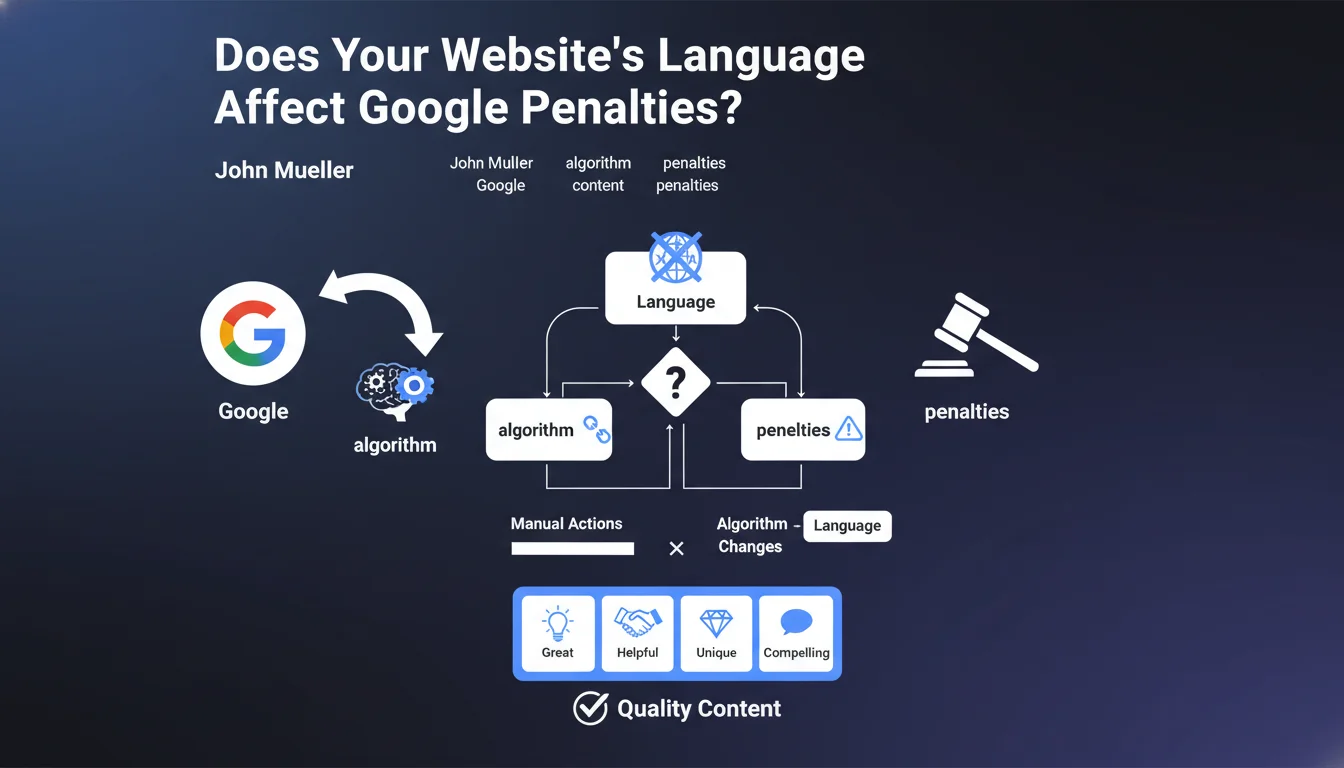
John Mueller clearly confirmed that Google's manual actions and algorithmic adjustments are completely independent of the language used on a site. This means that a site in French, English, Chinese, or Arabic is subject to the same evaluation criteria.
This statement puts an end to certain misconceptions that Google would be more lenient or stricter depending on the language. The reality is that quality standards are universal in Google's algorithm.
Why Is This Clarification Important for SEO Professionals?
Some SEO practitioners believed that sites in certain less common languages could more easily escape algorithmic penalties or manual actions. This idea is completely false.
Google has multilingual quality raters and automated systems capable of evaluating quality in virtually all languages. No language offers particular protection or disadvantage.
What Really Defines Quality Content According to Google?
Mueller specifies that great, helpful, unique, and compelling content can be created by people from all backgrounds. Quality does not depend on the author's native language or the language of the content.
The criteria that truly matter are: relevance to the user, demonstrated expertise, content originality, and its ability to answer search intents.
- Equal treatment: all sites are evaluated according to the same criteria, regardless of their language
- Universal standards: content quality is not tied to a specific language
- No linguistic advantage: impossible to escape penalties by using a less common language
- Focus on usefulness: what matters is the value provided to the user, not the language used
SEO Expert opinion
Is This Statement Consistent with What We Observe in Practice?
Absolutely. In my practice, I have seen sites in very diverse languages be penalized for the same reasons: duplicate content, link spam, cloaking, or thin content. No language is spared.
I have also observed that Google invests heavily in its multilingual capabilities, particularly with models like MUM and BERT that understand semantic context in over 100 languages. The idea that a language could escape surveillance is obsolete.
What Nuances Should Be Added to This Statement?
While the rules are universal, their application can vary depending on market maturity. In some less competitive countries or languages, we sometimes observe lower quality search results, not due to Google's leniency, but due to a lack of quality alternatives.
Furthermore, certain cultural and linguistic specificities influence what is considered relevant. Quality content in Japanese does not follow exactly the same conventions as in German, but the fundamental principles remain identical.
Does This Universal Rule Have Any Exceptions?
There are not really exceptions, but differences in priority. For example, Google may roll out certain algorithm updates gradually, first affecting English-language markets before being generalized. This doesn't change the principles, just the timing.
Some automatic detection tools may also be slightly less effective in rare or complex languages, but manual actions largely compensate for this gap. Ultimately, no site can rely on its language to escape Google's guidelines.
Practical impact and recommendations
What Should You Change in Your Multilingual SEO Strategy?
If you manage sites in multiple languages, apply exactly the same quality standards everywhere. Never lower your guard on a foreign language site thinking it will fly under the radar.
Invest in qualified native writers for each language rather than relying on automatic translation. Google can detect mechanically translated content that adds no value.
Monitor your quality metrics (bounce rate, time on page, engagement) across all your linguistic sites. Poor performance in a language likely signals a relevance or quality problem.
What Mistakes Should You Absolutely Avoid with Your Multilingual Sites?
Never use a linguistic version as a testing ground for risky tactics. Some SEOs test borderline techniques on sites in less monitored languages, thinking they're limiting risks. This is a monumental mistake.
Avoid automatically translated content without human review. Google is increasingly detecting these practices, and the penalty will be the same as in English or French.
- Audit all your multilingual sites with the same rigorous quality criteria
- Verify that each linguistic version brings real value to local users
- Avoid unsupervised automatic translations, considered thin content
- Properly implement hreflang tags to avoid duplicate content issues
- Monitor Search Console for each linguistic version separately
- Ensure your backlinks are natural and relevant for each linguistic market
- Adapt content to cultural specificities without compromising quality
How Can You Verify That Your Multilingual Site Meets Google's Standards?
Perform a complete SEO audit for each linguistic version, as if they were separate sites. Check content quality, technical structure, link profile, and user experience.
Use analysis tools in each target language and work with native experts who understand local nuances. Test your pages with real users from the concerned market.
💬 Comments (0)
Be the first to comment.