
Official statement
Other statements from this video 4 ▾
- □ Why does user and competitive analysis really make or break your SEO strategy?
- □ Should you really adapt your content to match the exact vocabulary of your target audience?
- □ Does Google really understand what your site is about if you don't tell it clearly?
- □ Does Google really require you to remove 'fluffy content' from your pages to rank higher?
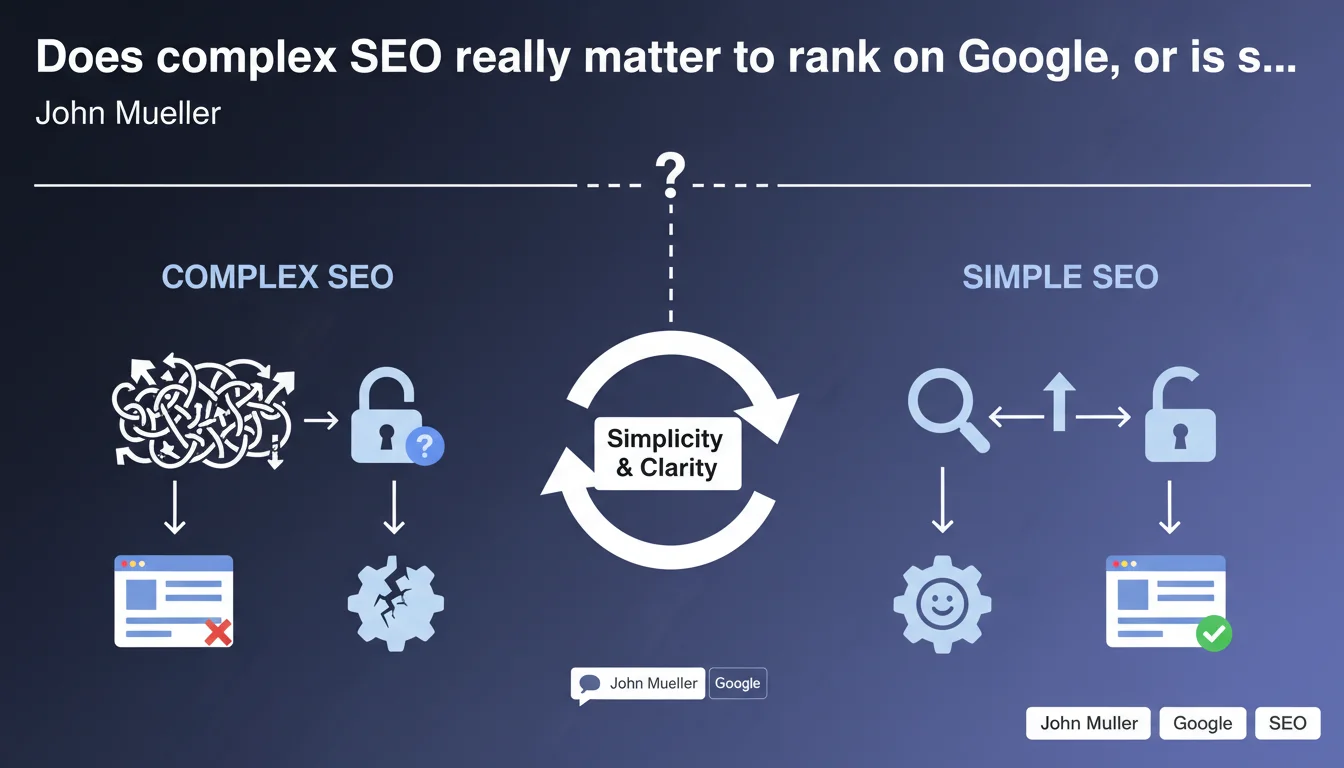
Google claims that sophistication and complexity aren't prerequisites for effective SEO. Simplicity and clarity are sufficient to achieve results, but this vague statement deserves to be tested against real-world conditions where certain niches demand advanced technical expertise.
What you need to understand
What exactly does Google mean by "simplicity"?
Mueller doesn't precisely define what he means by SEO simplicity. Does it mean sticking to the fundamentals — relevant content, clean structure, correct HTML markup — or abandoning any advanced technical optimization?
The wording deliberately remains vague. Google has an incentive to discourage over-optimization and borderline practices, but the line between "simple" and "insufficient" is never clearly drawn.
Does this recommendation apply to all websites?
A personal blog and an e-commerce site with 50,000 SKUs don't face the same technical constraints. For the former, a standard WordPress setup with quality content is more than enough. For the latter, crawl budget management, silo architecture, strategic internal linking, and structured data become essential.
Mueller's statement probably addresses small sites and content creators who get lost in superfluous technical optimizations before even publishing quality content.
What are the fundamentals Google is talking about?
- Original and useful content that matches search intent
- Clear semantic HTML structure (headings, paragraphs, lists)
- Proper user experience (acceptable speed, mobile-friendly)
- Coherent internal linking enabling page discovery
- Indexability without major technical obstacles
SEO Expert opinion
Is this statement consistent with observed practices?
Partially. On low-competition queries, a simple, well-designed site can indeed rank without technical tricks. Fundamentals executed well often beat a sophisticated strategy poorly implemented.
But once you tackle competitive sectors — finance, health, mainstream e-commerce — reality is quite different. Competitors dominating SERPs deploy advanced technical strategies: fine-tuned crawl budget management, server-side JavaScript optimization, semantic cocoon architecture, advanced structured data exploitation. [To verify]: Mueller suggests these optimizations are unnecessary, but correlation studies and A/B tests show they influence rankings.
What nuances need to be added?
Google deliberately conflates unnecessary complexity with mastered technical expertise. Stacking SEO plugins without strategy falls into the first category. Strategically structuring your internal link architecture with a data-driven approach falls into the second.
The simplicity Mueller discusses probably concerns the overall approach: prioritize users, avoid robot-focused optimizations that degrade experience, don't try to algorithmically manipulate rankings. But this doesn't invalidate the need for solid technical mastery for ambitious projects.
In which cases does this rule not apply?
High-volume sites (tens of thousands of pages), complex architectures (marketplaces, directories), ultra-competitive sectors where every detail matters. In these contexts, technical sophistication becomes a competitive advantage.
A news site publishing 200 articles daily can't afford to "keep it simple." It must manage canonical URLs, prioritize crawl of new pages, optimize rendering time, structure information with Schema.org NewsArticle. Ignoring these aspects under the guise of simplicity means leaving ranking positions on the table.
Practical impact and recommendations
What should you do concretely?
Start by auditing your site to identify major technical friction points: non-indexable pages, catastrophic speed, incomprehensible architecture. Fix these problems before launching into advanced optimizations.
Then focus on producing quality content that matches your audience's search intent. A well-researched article with clear structure and explicit subheadings beats mediocre text stuffed with keywords.
For advanced technical optimizations, ask yourself: does this change genuinely improve user experience or only attempt to manipulate the algorithm? If it's the latter, skip it.
What mistakes should you avoid?
Don't fall into the opposite trap: completely neglecting technical aspects under the pretext that "Google says it doesn't matter." Mueller speaks of unnecessary sophistication, not technical incompetence.
Also avoid over-optimizing marginal elements at the expense of structural problems. Fine-tuning meta descriptions for hours while 40% of your site isn't indexed means missing what actually matters.
How do you verify your approach is balanced?
- Your site loads in under 3 seconds on mobile with standard connection
- Main pages are indexed and accessible within 3 clicks from homepage
- Content clearly answers the search intent visible in SERPs
- HTML structure is semantically correct (logical heading hierarchy, clear navigation)
- You can explain the added value of each technical optimization deployed
- Search Console data shows stable indexation coverage without critical errors
❓ Frequently Asked Questions
Dois-je arrêter toutes mes optimisations techniques avancées ?
Cette déclaration signifie-t-elle que les données structurées sont superflues ?
Comment savoir si mon approche SEO est trop complexe ?
Un site simple peut-il vraiment concurrencer des acteurs établis ?
🎥 From the same video 4
Other SEO insights extracted from this same Google Search Central video · published on 17/08/2023
🎥 Watch the full video on YouTube →
💬 Comments (0)
Be the first to comment.