
Official statement
What you need to understand
What exactly is a YMYL site and why does Google place such particular importance on it?
YMYL (Your Money, Your Life) sites deal with topics that can directly impact users' health, financial security, or well-being. Google applies much stricter evaluation criteria for this content, because inaccurate information could have serious consequences.
These sites are subject to thorough analysis according to E-E-A-T criteria (Experience, Expertise, Authoritativeness, Trustworthiness). Google's core updates particularly target these sites to ensure that only reliable sources appear on the first page.
Why can mixing YMYL and non-YMYL content on the same site create problems?
When a site covers both sensitive topics (finance, health) and lighter content (lifestyle, entertainment), Google may have difficulty assessing the overall level of expertise of the domain.
This algorithmic confusion can lead to a dilution of the trust granted to the site. YMYL content risks being ranked lower, while general content may be penalized by association with stricter evaluation standards.
What does Google specifically recommend regarding content separation?
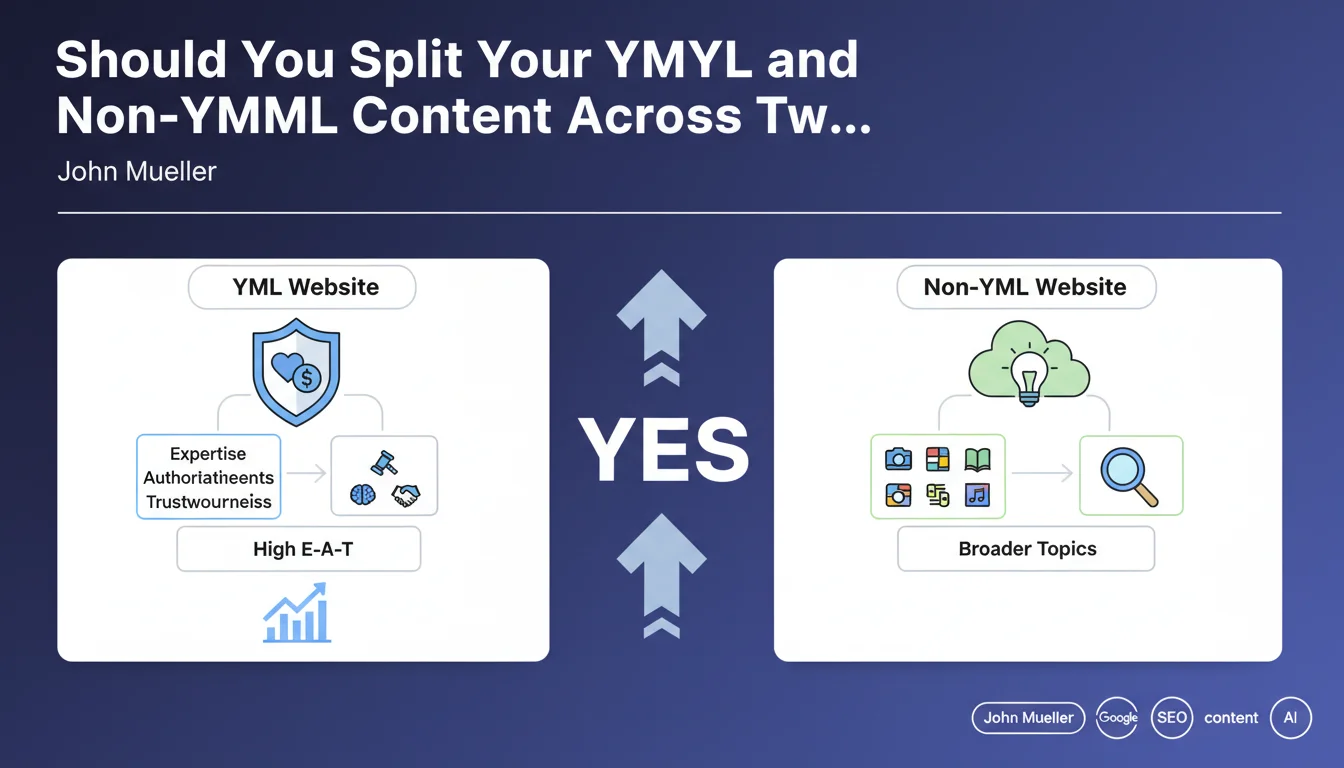
The official recommendation suggests creating two distinct sites: one dedicated to YMYL content with all necessary expertise guarantees, and another for less sensitive topics. This separation allows Google to better categorize each site.
This approach facilitates the application of the right evaluation criteria to each property. The YMYL site will be judged on high standards of expertise, while the other site will benefit from a more flexible evaluation adapted to its content.
- YMYL sites concern health, finance, legal matters, safety, and important life decisions
- Google applies stricter filters during core updates for these content categories
- Mixing YMYL and non-YMYL creates algorithmic confusion about the required level of expertise
- Separation into two distinct sites enables clearer categorization by algorithms
- This recommendation should be evaluated from the conception of your content strategy
SEO Expert opinion
Is this separation recommendation always relevant in every case?
This directive must be nuanced according to your actual situation. For an established general media outlet with strong domain authority, separating content could be counterproductive and sacrifice years of SEO work.
On the other hand, for a new project or startup, this separation makes perfect sense. Launching two sites from the start with clear positioning avoids future problems and allows for an E-E-A-T strategy adapted to each context.
What are the practical limitations of this separation approach?
Managing two distinct properties involves significant costs: two hosting plans, two content strategies, two link-building campaigns, potentially two editorial teams. These resources aren't always available.
Moreover, you're dividing your domain authority and link equity. A single well-established domain possesses cumulative strength that two separate sites will take years to rebuild individually.
How can you identify if your site genuinely suffers from this mixing problem?
Analyze your performance after each core update. If your YMYL content regularly loses positions while your other content remains stable, that's a strong signal of a categorization problem.
Also examine your backlink profile and authority signals. If you primarily receive lifestyle links but attempt to rank for medical queries, Google will perceive an inconsistency between your perceived authority and your positioning ambitions.
Practical impact and recommendations
What criteria should you use to decide whether or not to separate your content?
First evaluate the YMYL/non-YMYL ratio of your site. If less than 20% of your content is YMYL, separation may be excessive. However, with a 50/50 ratio, the question deserves thorough analysis.
Then consider your development stage. An established site with strong authority has more to lose than gain. A new project will largely benefit from separation from the start.
Check whether you're experiencing persistent ranking problems on your YMYL content despite its quality. This is often a sign that Google doesn't recognize your expertise in that specific domain.
How do you concretely implement this separation if you decide to adopt it?
For an existing site, plan a multi-phase migration. First identify all YMYL content, then create the new domain with a solid architecture before proceeding with progressive 301 redirects.
For a new project, clearly define your editorial line from the start. If you plan to cover both YMYL and lifestyle topics, launch two distinct sites with different domain names, editorial guidelines, and teams.
Strengthen specific E-E-A-T signals on each property. The YMYL site requires identified expert authors, citations from recognized medical/financial sources, and detailed legal notices. The lifestyle site can adopt a freer tone.
What mistakes should you avoid when implementing this strategy?
Don't create duplicate content between the two sites, even partially. Google could penalize both properties. Clearly differentiate the editorial angles and content covered on each domain.
Avoid excessive cross-linking between the two sites. A few natural mentions are acceptable, but artificial interlinking could signal to Google that this is a workaround of its recommendations.
Don't neglect the user experience in this transition. If your visitors must juggle between two sites to find information, you'll lose engagement and conversions, which will negatively impact your SEO.
- Audit your current content and calculate the YMYL/non-YMYL ratio
- Analyze your performance during recent core updates by content category
- Evaluate your current domain authority and the cost of separation
- If launching a new mixed project, plan two sites from the start
- Identify and document expert authors for YMYL content
- Create detailed author pages with verifiable credentials
- Implement a strict editorial charter for each property
- Develop a link-building strategy adapted to each context
- Monitor performance metrics separately for each site
- Test user perception before any definitive migration
💬 Comments (0)
Be the first to comment.