
Official statement
What you need to understand
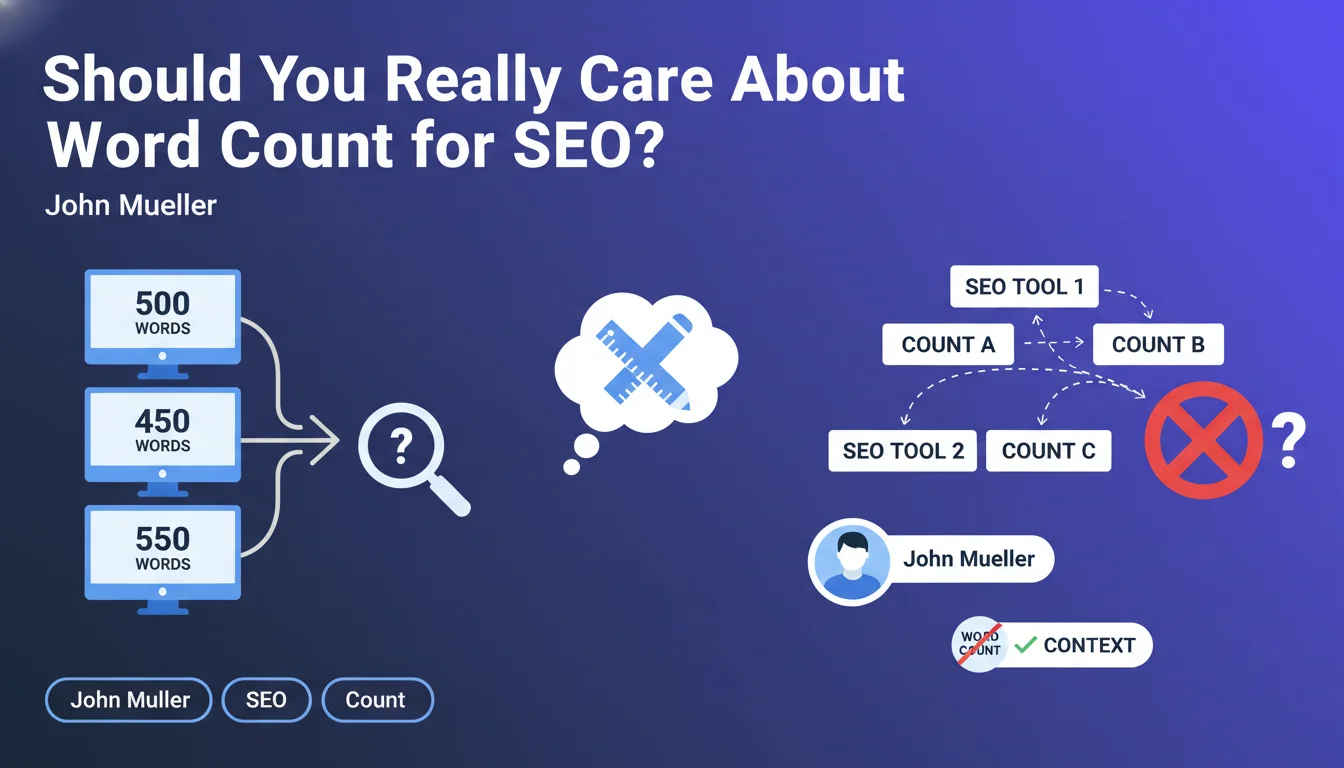
Google has clearly stated that word count is not a relevant ranking factor. This statement follows the observation that different SEO tools display different word counts for the same page, revealing the absence of a standardized methodology.
The fundamental problem is that counting words doesn't reflect content quality. Does a word count if it's in the navigation menu? In a quote? In a comment? Each tool calculates differently, making this metric unreliable.
This position from Google emphasizes a broader principle: quality trumps quantity. The search engine seeks to evaluate whether content satisfactorily answers the user's search intent, not simply whether it reaches an arbitrary word quota.
- Word count is not a direct ranking factor
- SEO tools count words differently according to their algorithms
- Google prioritizes content relevance and completeness
- Short but precise content can outperform long but diluted text
- Search intent should guide content length
SEO Expert opinion
This statement is perfectly consistent with what we observe in the SERPs. Many short, precise pages rank ahead of exhaustive but verbose content. The optimal length entirely depends on the topic and targeted query.
However, an important nuance is necessary: length remains statistically correlated with good rankings, not through direct causation, but because complex topics naturally require more development. A comprehensive guide on real estate taxation logically requires more words than a technical term definition.
There are specific cases where length indirectly matters: for complex informational queries, Google favors content that covers the topic in depth. But be careful, it's not the word count that matters, it's the complete semantic coverage of the topic.
Practical impact and recommendations
- Stop using word count as a primary KPI in your content briefs
- Instead, analyze semantic coverage: what concepts, entities, and questions are addressed by competing pages?
- Adapt length to search intent: transactional (short), informational (variable), navigational (very short)
- Prioritize more relevant metrics: reading time, scroll depth, engagement rate
- Use semantic analysis tools rather than simple word counters
- Compare your content to the top 10 in the SERP to identify missing elements, not just length
- Train your writers to write to answer intent, not to reach a word quota
- Avoid artificial padding: each paragraph must provide informational value
- Test different lengths for your content and measure actual ranking performance
In summary: word count is a misleading metric that should be abandoned as a direct SEO objective. Focus on relevance, semantic completeness, and answering search intent.
Implementing a quality and intent-oriented content strategy requires in-depth SERP analysis, a fine understanding of semantic algorithms, and a potential overhaul of your editorial processes. Since these transformations are technical and strategic in nature, working with a specialized SEO agency can prove beneficial to receive personalized support and a proven methodology tailored to your industry.
💬 Comments (0)
Be the first to comment.