
Official statement
What you need to understand
Google is warning about an emerging phenomenon: the explosion of AI-powered bot traffic. These automated agents no longer just crawl occasionally; they massively explore the web to feed artificial intelligence models.
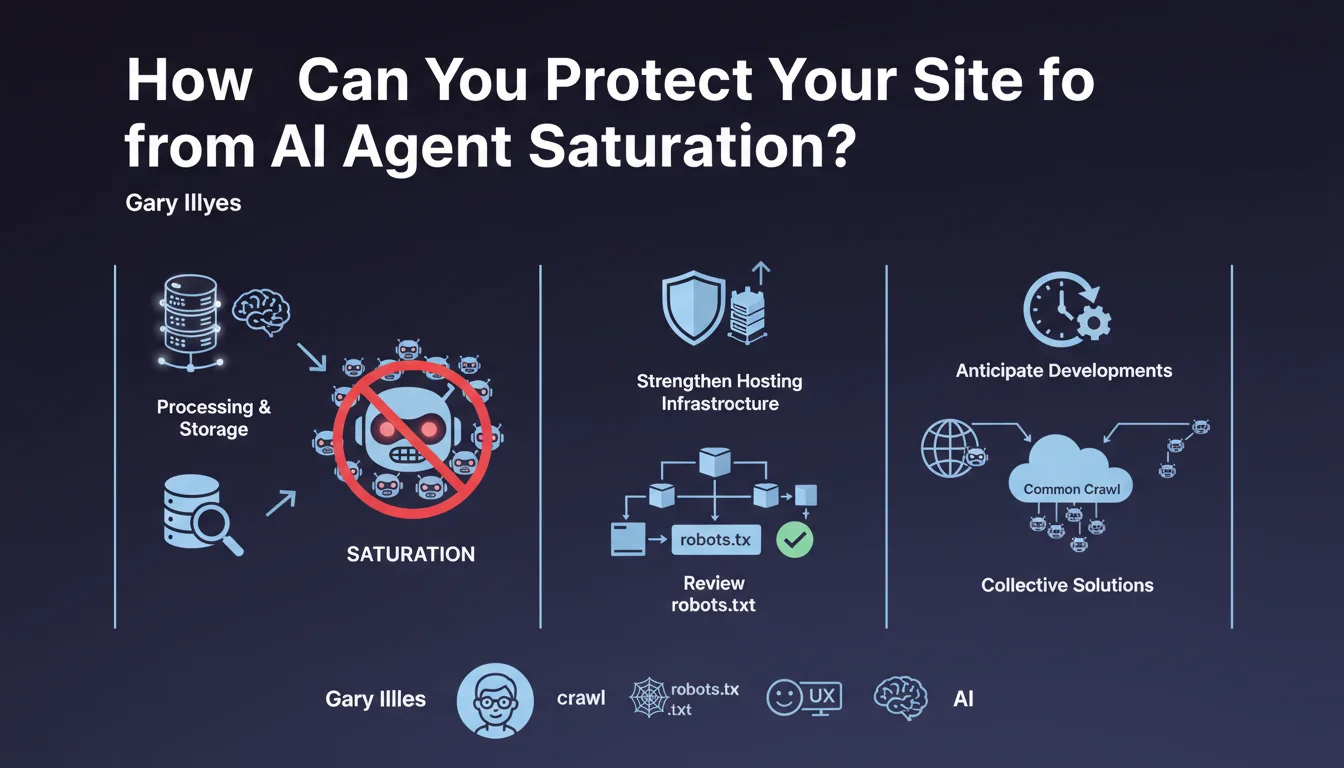
Contrary to common belief, it's not so much the crawling itself that's problematic, but the processing and storage of data it generates. These operations intensively strain server resources and can quickly overwhelm unprepared infrastructures.
This wave of automated traffic requires technical anticipation from site owners. Without adaptation, sites risk slowdowns, degraded response times, or even service interruptions.
- AI crawling differs from traditional crawling in its intensity and frequency
- Critical resources are processing and storage, not bandwidth
- The robots.txt file becomes a strategic regulation tool
- Hosting infrastructure must be re-evaluated upward
- Collective solutions like Common Crawl can distribute the load
SEO Expert opinion
This warning is perfectly consistent with field observations. Since 2023, server logs show a 5 to 10-fold increase in traffic from AI agents (GPTBot, Claude-Bot, Perplexity, etc.). Sites with poorly optimized databases are already experiencing performance degradation.
An important nuance: not all sites face equal risk. Sites rich in textual content (blogs, media, documentation) are particularly targeted. Conversely, application sites or e-commerce platforms with little exploitable content are less exposed.
The recommendation on Common Crawl is particularly relevant: allowing a shared crawl rather than enduring dozens of independent bots mechanically reduces the load. It's a win-win approach that remains underutilized.
Practical impact and recommendations
- Audit your server logs to identify the actual volume of AI bot traffic currently received
- Assess your hosting infrastructure: CPU, RAM, and especially your database processing capacity
- Optimize your SQL queries and properly index your tables to reduce processing times
- Implement a robust caching system (Varnish, Redis) to limit direct database access
- Review your robots.txt file: define specific rules for each AI bot (crawl-delay, forbidden sections)
- Monitor Core Web Vitals metrics which may degrade under automated traffic pressure
- Consider a CDN with DDoS protection to absorb bot traffic spikes
- Document your crawling policy and communicate it clearly (dedicated page /ai-crawling-policy)
- Regularly test server load by simulating request spikes
- Evaluate the opportunity to contribute to or use Common Crawl to share the effort
💬 Comments (0)
Be the first to comment.