
Official statement
What you need to understand
Why Does Google Recommend a Gradual Page Launch?
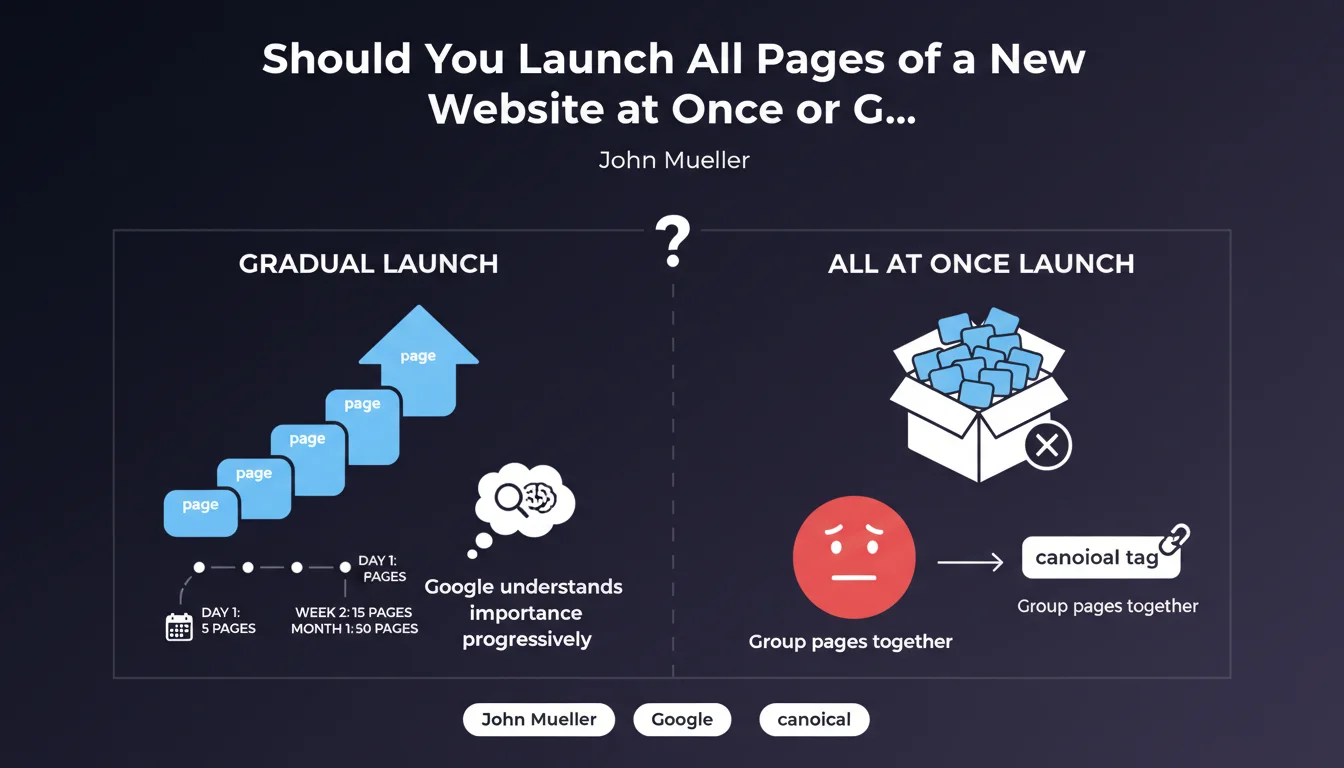
When a website is launched with thousands of pages simultaneously, Google may struggle to determine the hierarchy and relative importance of each piece of content. The search engine must analyze the structure, internal links, and content quality to understand which pages deserve to be highlighted.
A gradual rollout allows Googlebot to evaluate each wave of content and understand the site's editorial logic. This approach facilitates crawl budget allocation and improves the distribution of internal PageRank between pages.
What's the Alternative Proposed with the Canonical Tag?
Google also suggests using the canonical tag to group similar content. This approach is particularly relevant for e-commerce sites or platforms with page variations.
The canonical tag tells Google which version of a page should be considered the primary reference, thus avoiding the dilution of relevance signals across near-identical content.
What Are the Concrete Benefits of Progressive Growth?
- Improved crawl frequency: regular content addition encourages Googlebot to return more often
- Better crawl budget distribution: Google focuses on fewer pages at a time
- Progressive understanding of the topic: the engine better identifies the site's expertise
- Freshness signal: a site that evolves regularly is perceived as active and maintained
- Time to adapt strategy: ability to analyze performance and adjust content
SEO Expert opinion
Does This Recommendation Apply to All Types of Sites?
This Google directive is particularly relevant for new sites without history or authority. For an established site launching a new section or redesigning its structure, the impact is less critical because the domain already benefits from acquired trust.
Be careful, however: highly specialized niche sites with few pages (20-50 pages maximum) can be launched all at once without problem. The recommendation mainly targets sites with hundreds or thousands of pages from the start.
What Nuances Do We Observe in Real Practice?
Field experience shows that this progressive approach does indeed work, but the deployment speed can be faster than you might think. Adding 50-100 pages per week for a medium-sized site is generally well tolerated.
The key lies in the thematic consistency of each content wave. It's better to first publish all pages of a main category before opening a new section, rather than scattering the content.
Is the Advice on Canonicals Still Relevant?
Using canonicals to "group" pages at launch is a workaround solution, not an ideal strategy. If you need to hide pages with canonicals, it's often a sign that these pages shouldn't exist or should be merged.
Canonicals are valuable for managing inevitable technical duplications (URL parameters, separate mobile versions, etc.), but not as a launch strategy. It's better to plan a gradual rollout than to publish everything and canonicalize massively.
Practical impact and recommendations
How Do You Concretely Plan the Gradual Launch of a New Site?
For a content or e-commerce site, start by publishing your basic architecture with main pages: homepage, main category pages, legal pages, and a few flagship content pieces (10-20 pages maximum).
Then, add content in coherent thematic waves: one complete category at a time, with 20-50 pages every 1-2 weeks. This approach allows Google to progressively understand your semantic structure.
Use Google Search Console to monitor the evolution of crawling and indexing. If you notice that Google indexes quickly and returns often, you can accelerate the publication pace.
What Mistakes Should You Absolutely Avoid?
Never publish thousands of auto-generated or low-quality pages at once, even progressively. Google might classify your entire site as spam or thin content.
Also avoid creating a URL structure that changes between phases. Plan your final architecture from the beginning, even if all sections aren't yet populated with content.
Don't use canonicals as an easy solution to put everything online quickly. This approach can create semantic inconsistencies and complicate your structure long-term.
How Can You Verify That the Strategy Is Working Correctly?
- Monitor the indexing rate in Search Console: it should follow your publication pace
- Check the crawl frequency: it should gradually increase with content addition
- Analyze discovered pages vs indexed pages: a significant gap may signal quality issues
- Control average positions: they should improve over time, not deteriorate
- Evaluate the indexing time: it should decrease as Google understands your site
- Measure the evolution of organic traffic: it should grow proportionally to published content
- Use index coverage reports to quickly identify errors or exclusions
In summary: the gradual launch of a new site isn't just a theoretical recommendation, it's a proven strategy that facilitates Google's work and improves your chances of success. Plan coherent publication waves, monitor indexing metrics, and adjust the pace based on Search Console feedback.
Implementing such a strategy requires rigorous editorial planning, constant technical monitoring, and an ability to interpret Google's signals. For large-scale projects or sites with significant business stakes, support from a specialized SEO agency can prove valuable in orchestrating this progressive deployment, avoiding costly mistakes, and maximizing the chances of optimal ranking from the very first weeks.
💬 Comments (0)
Be the first to comment.