
Official statement
What you need to understand
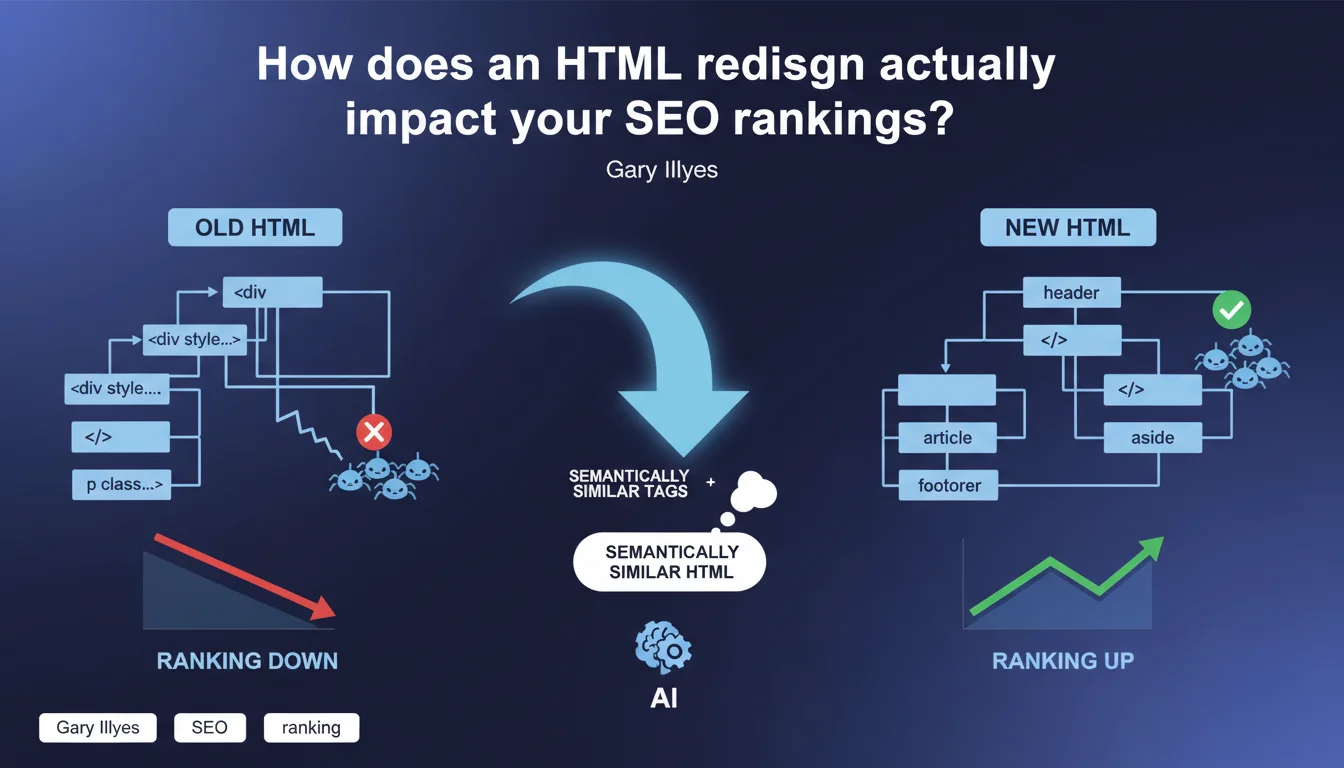
When redesigning a website, any modification to the HTML code of pages can influence rankings in search results. This statement confirms what many SEO practitioners have observed: Google analyzes HTML structure to understand content and its hierarchy, and any change in this structure can lead to a repositioning reassessment.
The concept of "semantically similar HTML code" is essential here. It's not about keeping exactly the same code, but maintaining the same semantic meaning: if a title was an H1, it must remain an H1; if a section was marked as important, it must remain so after the redesign. The logical structure of content must be preserved so that search engines continue to interpret pages in the same way.
The warning against adding unnecessary tags is also revealing. Each additional HTML element can dilute the semantic relevance of the page and complicate its analysis by Google's algorithms.
- Any HTML change can affect ranking, positively or negatively
- The semantic similarity of code must be maintained during redesigns
- Avoid over-tagging: each tag must have a clear function
- The impact is not systematically negative if the redesign improves the structure
- Search engines reevaluate pages after structural changes
SEO Expert opinion
This statement is perfectly consistent with field observations during site migrations. I have observed on numerous occasions that well-executed redesigns, with particular attention paid to HTML semantics, maintain or even improve positions, while neglected redesigns lead to significant visibility losses. The key point lies in understanding that Google doesn't read your site like a human: it relies heavily on HTML signals to understand the structure and hierarchy of information.
However, nuance is needed: HTML is just one factor among others. A redesign that improves user experience, loading speed, or site architecture can compensate for minor HTML changes. Conversely, maintaining exactly the same HTML but deteriorating other technical aspects can also harm SEO. The recommendation to maintain a similar semantic structure must be accompanied by an overall improvement in technical quality.
Practical impact and recommendations
- Before the redesign: Document the current HTML structure of your strategic pages (heading hierarchy, semantic tags, content structure)
- Map correspondences: Create a mapping table between old and new markup for each page template
- Prioritize native semantic tags: Use <article>, <section>, <aside>, <nav> rather than generic <div> with CSS classes
- Maintain heading hierarchy: If your current H1 performs well, keep the same H1-H6 structure in the redesign
- Eliminate redundant markup: Remove nested <div> without semantic function, empty or purely decorative tags
- Test in staging environment: Validate new HTML with Google tools (Rich Results Test, Mobile-Friendly Test) before production deployment
- Deploy gradually if possible: Test first on less critical sections to observe impact before generalization
- Monitor Core Web Vitals: New HTML can affect performance, check CLS, LCP and INP
- Post-launch monitoring: Track positions, impressions and clicks daily for 4-6 weeks after the redesign
- Prepare a rollback: Keep the ability to revert to the old version if significant losses are observed
💬 Comments (0)
Be the first to comment.