
Official statement
What you need to understand
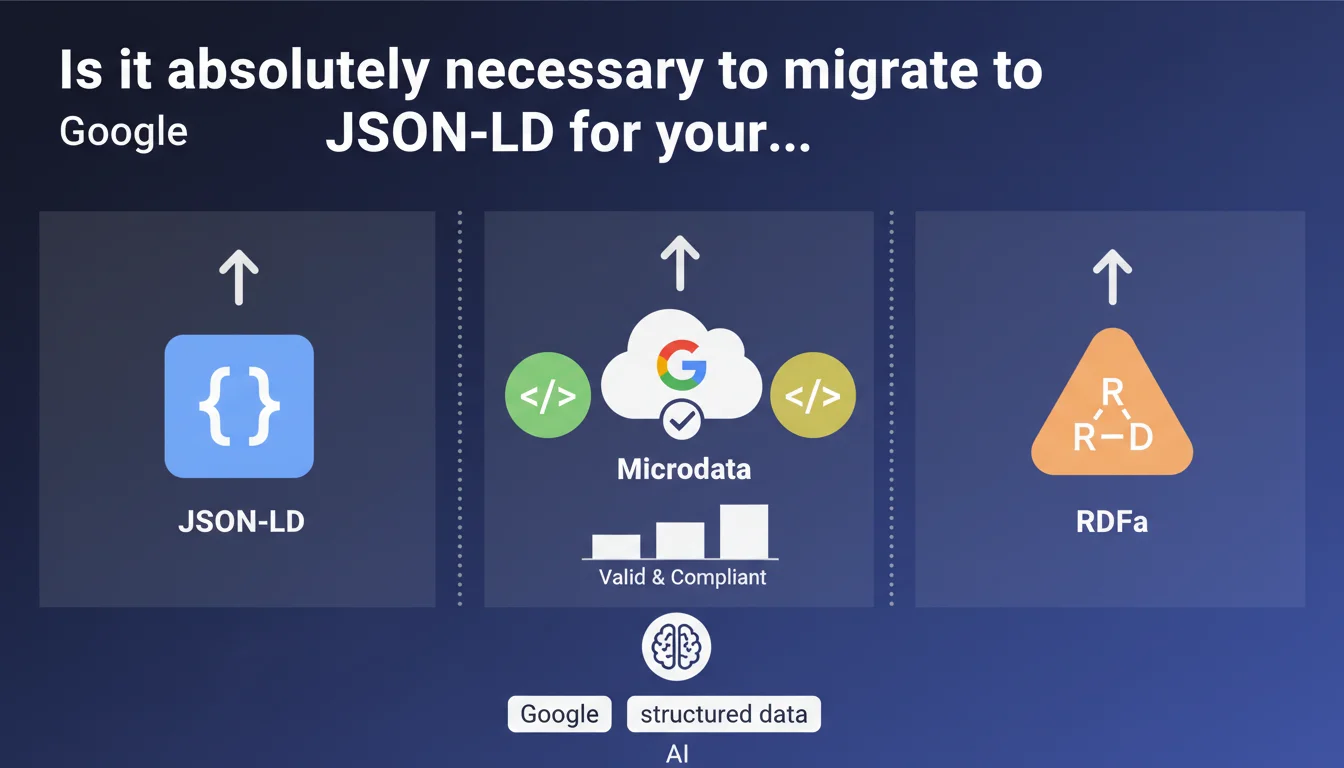
Google has just clarified its official position regarding the three structured data formats accepted by its search engine: JSON-LD, Microdata, and RDFa. This documentation update specifies that these formats are treated equivalently, with no particular privilege granted to one over another, provided they are valid and correctly implemented.
This statement puts an end to certain speculations that JSON-LD would benefit from preferential treatment in Google's algorithm. The reality is more nuanced: all formats are technically equivalent for crawling and indexing, but JSON-LD remains recommended for purely practical and operational reasons.
Concretely, this means that a site using Microdata or RDFa is not penalized and should not necessarily undertake an expensive migration solely for SEO reasons. The priority should be the validity and consistency of structured data, regardless of the chosen format.
- All three formats (JSON-LD, Microdata, RDFa) are treated identically by Google
- No direct SEO advantage is granted to any particular format
- Data validity and compliance are the priority criteria
- JSON-LD is recommended for its ease of implementation, not for an SEO gain
- Existing sites using Microdata or RDFa do not need to migrate urgently
SEO Expert opinion
This official position indeed corresponds to what I've been observing in the field for several years. Well-positioned sites use all three formats interchangeably, and I have never found any correlation between format choice and performance in rich snippets or rankings. What truly matters is the quality and completeness of structured data, not the technical container used.
However, my recommendation remains oriented toward JSON-LD for new projects, for pragmatic reasons: separation of semantic code and HTML, ease of maintenance by technical teams, possibility of dynamic injection via GTM, and above all reduced risk of errors during template updates. E-commerce sites with thousands of product pages particularly benefit from this centralized approach.
Practical impact and recommendations
- Do not undertake an urgent migration solely to switch to JSON-LD if your current implementation is working correctly
- Audit the validity of your existing structured data with Google's Rich Results Test and Schema.org Validator
- Prioritize fixing validation errors and enriching data before any format considerations
- Choose JSON-LD for new developments or complete site redesigns to facilitate future maintenance
- Absolutely avoid mixing multiple formats on the same page (risk of duplication and inconsistency)
- Check for conflicts between data automatically generated by your CMS and manually added data
- Document the chosen format in your technical style guide to maintain consistency
- Regularly test rich snippet display in Search Console to ensure Google correctly interprets your data
- Train your teams on the selected format to guarantee quality implementations during updates
💬 Comments (0)
Be the first to comment.