
Official statement
What you need to understand
What does overall site quality really mean to Google?
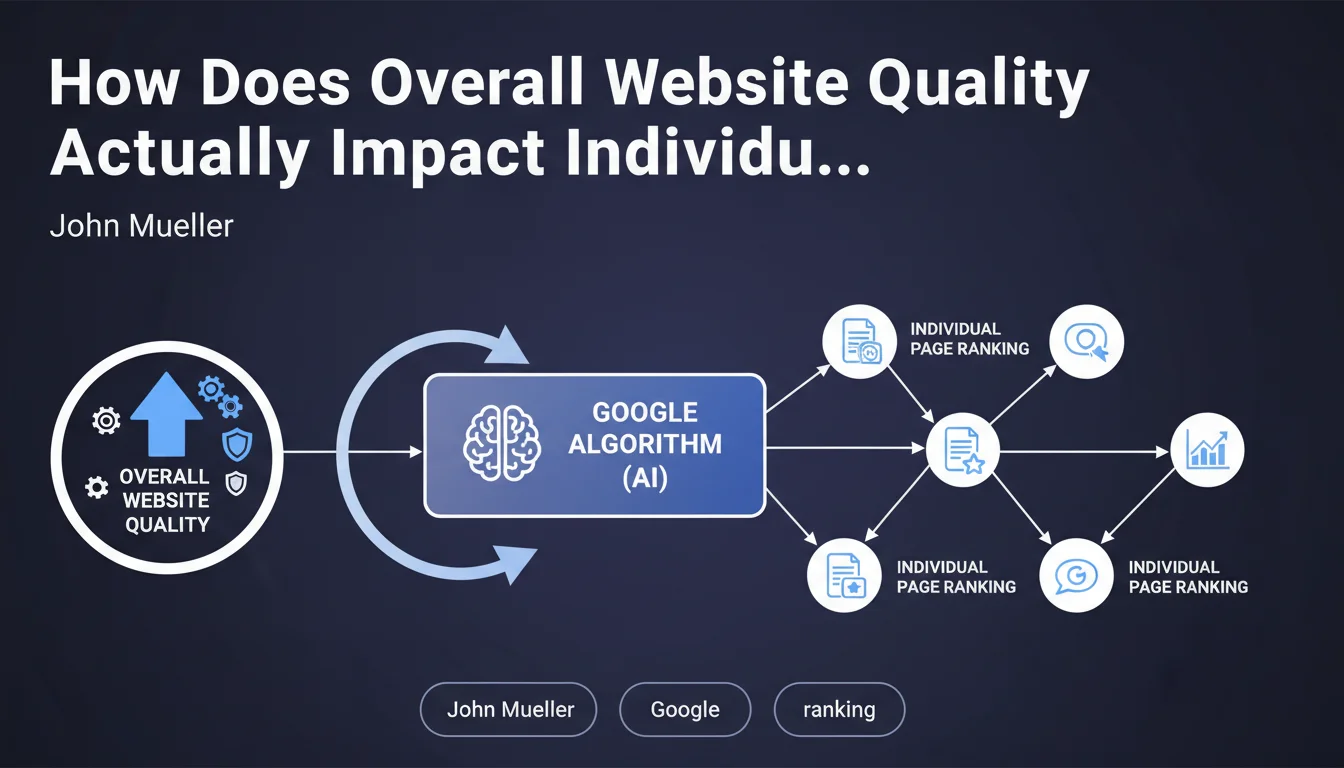
Google doesn't simply evaluate pages individually in isolation. The algorithm analyzes the entire website to determine its overall quality.
This holistic approach means that all indexed pages contribute to the general impression Google forms of your site. A low-quality page can degrade the perception of the entire domain.
Why aren't non-indexed pages the primary indicator?
Many SEOs focus on excluded pages in Search Console. This is a mistaken perspective according to this statement.
What really matters is the quality of actually indexed pages. These pages represent what Google considers worthy of presenting to users.
What's the difference between indexation and quality?
Indexation absolutely does not guarantee quality. A page can be indexed without being considered excellent by Google.
Conversely, certain pages may be excluded voluntarily (noindex) or for technical reasons, without negatively impacting the site's overall quality.
- Overall quality is evaluated across the entire site, not just excluded pages
- All indexed pages contribute to Google's quality perception
- Indexation is not synonymous with high-quality content
- You need to analyze the actual content of indexed pages, not just their indexation status
SEO Expert opinion
Is this statement consistent with practices observed in the field?
Absolutely. In my 15 years of experience, I've found that Google does indeed apply a quality rating at the domain level. This is sometimes called "domain authority" or "site quality score".
Sites with lots of indexed content but low overall quality tend to perform less well, even for their best pages. This is particularly visible during Core Updates.
What important nuances should be added to this statement?
The first nuance concerns evaluation scale. Google can assess quality at different levels: domain, subdomain, site section, or even content category.
The second nuance relates to the quality/quantity ratio. A large site with 10% mediocre content won't be impacted the same way as a small site where 50% of pages are low quality.
In what contexts does this rule apply differently?
For very large sites (e-commerce, media), Google seems to segment its evaluation by sections or categories. A low-quality blog section may have less impact on the rest of the site.
For niche sites or SMEs, the impact is more direct and immediate. Each page counts more in the overall evaluation because the total volume is limited.
Practical impact and recommendations
What should you do concretely to improve overall quality?
The first action is to audit all indexed pages, not just those generating traffic. Use Google Search Console to identify all your pages in the index.
For each indexed page, evaluate its real value to the user. Ask yourself: does this page deserve to be in Google's index? Does it provide unique and useful information?
Next, classify your pages into three categories: excellent quality, acceptable quality, insufficient quality. Focus your efforts on improving or removing low-quality pages.
What common mistakes should you absolutely avoid?
The classic mistake is focusing only on pages that generate traffic. Pages without traffic but indexed also contribute to the overall evaluation.
Another pitfall: keeping indexed pages by default with no added value. Tag pages, obsolete archives, or product filters can dilute perceived quality.
Finally, many think having more indexed pages is always better. This is false. Fewer pages of better quality often outperforms a large volume of average content.
How can you verify and maintain a high quality level?
Implement a regular evaluation process for your indexed pages. Quarterly, analyze a representative sample of your content.
Use tools like Screaming Frog combined with Search Console data to identify pages with low engagement (high bounce rate, low time on page, no conversions).
- Extract the complete list of indexed pages via Search Console
- Evaluate the content quality of each page (depth, uniqueness, usefulness)
- Identify low-quality pages and decide: improve, merge, or deindex
- Prioritize improving strategic pages before creating new content
- Implement a quality control process before publication
- Regularly audit indexed pages, not just high-traffic pages
- Monitor engagement metrics across the entire site
- Document quality standards to maintain consistency
💬 Comments (0)
Be the first to comment.