
Official statement
Other statements from this video 2 ▾
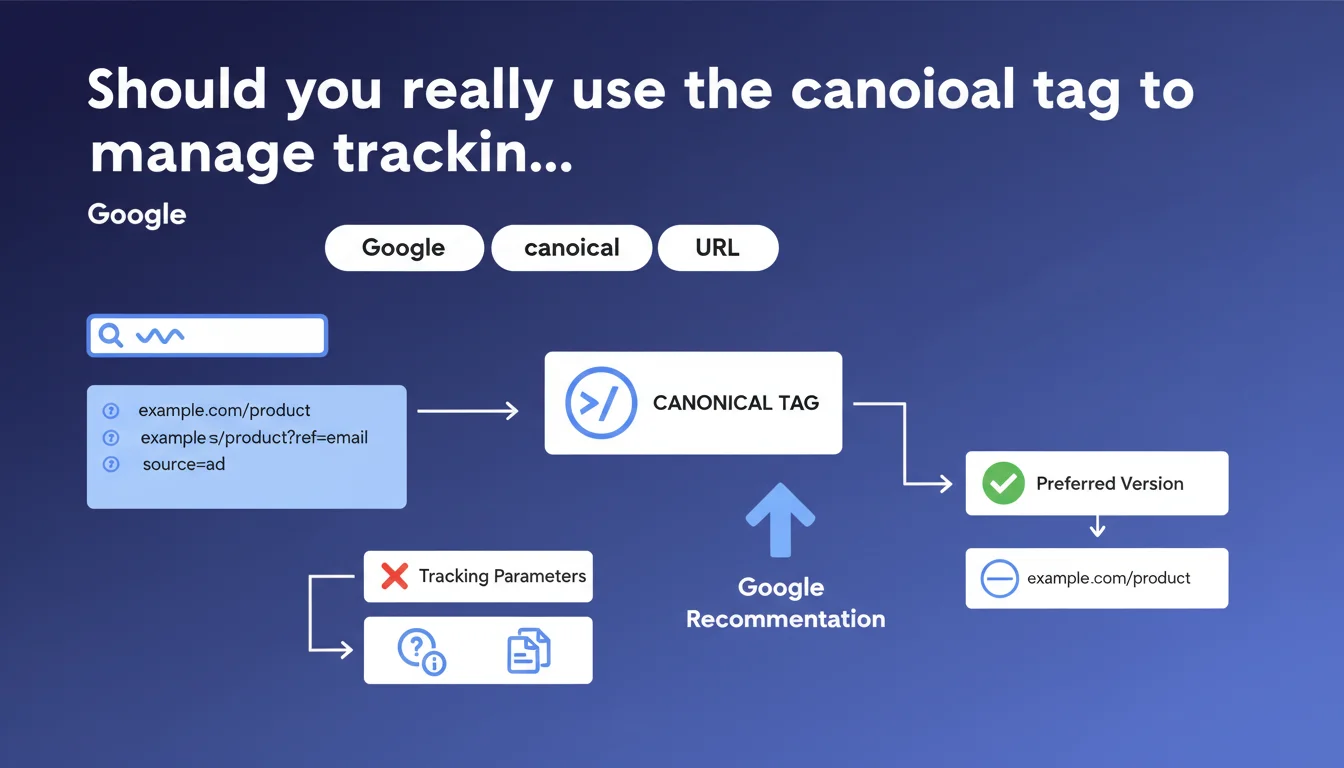
Google explicitly recommends using the canonical tag to prevent tracking parameters (UTM, session IDs, etc.) from appearing in search results. This approach makes it clear which version of a page should be indexed, without having to resort to robots.txt files or Search Console exclusions.
What you need to understand
Why does Google insist on canonical tags for parameters?
URL parameters (tracking, filters, sorting) create technical duplicates: the same content, different URLs. Google has to choose which version to index, and without clear direction, it can make the wrong choice.
The canonical tag solves this problem by explicitly pointing to the "clean" URL you want to appear in the SERPs. It's an HTML-side instruction, independent of server configuration.
What types of parameters are affected?
Mainly marketing tracking parameters (utm_source, utm_campaign), session identifiers (sessionid, PHPSESSID), and personalization parameters (ref, source). Anything that doesn't change the actual page content.
Google can theoretically handle this on its own — but in reality, it gets it wrong regularly. Hence this explicit recommendation.
Is it really more effective than other methods?
Google describes this approach as "practical and effective". In practice, it's less risky than robots.txt blocking (which prevents crawling AND signal consolidation) and more reliable than parameter management in Search Console (a deprecated interface, by the way).
The canonical allows Googlebot to crawl all variants while consolidating signals to a single canonical URL. It's clean, transparent, and works for all search engines that respect the standard.
- The canonical avoids duplicates in the index without blocking crawling
- It works for all search engines, not just Google
- It's an HTML-side directive, independent of server configuration
- Google can still choose a different URL if it believes the canonical is incorrect
SEO Expert opinion
Is this recommendation really being followed in the field?
Let's be honest: many sites don't implement it correctly. You still see e-commerce sites where each sorting variant generates a unique URL without a canonical, or news sites where UTM parameters create dozens of indexed versions of the same article.
The problem? Google doesn't directly penalize the absence of a canonical — it just tries to guess. And sometimes, it indexes the wrong version. Result: a URL loaded with parameters appears in the SERPs instead of the clean URL. It's ugly, dilutes PageRank, and disrupts analytics.
What nuances should be added to this directive?
Google says it's "practical and effective" — but it fails to mention that the canonical is a directive, not an instruction. In other words: Google can ignore it if it thinks you're wrong.
Classic example: you set a canonical to the desktop version on a mobile page, but Google indexes the mobile version anyway because it judges that's the relevant version for users. [To verify]: Google doesn't publish stats on canonical tag compliance rates, so we're flying blind.
In what cases does this rule not apply?
The canonical solves nothing if your parameters modify content in a meaningful way. A "lowest price first" filter? Canonical to the unsorted version. But a "red shoes" filter that changes displayed products? That's a distinct page.
Another edge case: multilingual or multi-currency sites. If you use parameters like ?lang=fr or ?currency=eur, the canonical should point to the version in that language/currency, not to a "default" version. And many get this wrong.
Practical impact and recommendations
What should you actually do on your site?
Start by auditing your indexed URLs. Run a site: search in Google or extract URLs from Search Console. Look for suspicious patterns: ?utm_, ?ref=, ?sessionid=, etc. If these URLs appear in the index, you have a problem.
Next, implement self-referential canonicals on all your important pages. Even without parameters, it's good practice that clarifies your intent. When a parameter appears, the canonical should point to the "clean" version of the URL.
How do you verify that implementation is correct?
Use the URL Inspection Tool in Search Console. Paste a URL with parameters, see which URL Google considers canonical. If it's not the one you declared, there's a conflict (contradictory canonical, redirect that overrides, etc.).
Also check your server logs: Is Googlebot massively crawling URLs with parameters? If so, that's crawl budget waste. The canonical doesn't block crawling, but it should reduce crawl frequency on variants.
What mistakes should you absolutely avoid?
Never put a canonical to a 404 page or redirected page. Google will ignore the directive and choose for itself. Don't create canonical chains (A canonical to B, B to C) — technically valid but it dilutes the signal.
Watch out for relative vs absolute canonicals. A poorly configured relative URL can point anywhere if your domain structure is complex (subdomains, mixed HTTPS/HTTP). Always use absolute URLs.
- Audit indexed URLs to spot variants with parameters
- Implement self-referential canonicals on all key pages
- Verify canonical consistency via the Search Console inspection tool
- Use absolute URLs in canonical tags (not relative ones)
- Never point a canonical to a page that redirects or returns an error
- Distinguish cosmetic parameters (tracking) from functional parameters (filters)
- Monitor logs to detect excessive crawling of parameterized variants
❓ Frequently Asked Questions
La balise canonical empêche-t-elle Googlebot de crawler les URLs avec paramètres ?
Peut-on utiliser une canonical cross-domain pour gérer les paramètres ?
Que se passe-t-il si Google ignore ma balise canonical ?
Faut-il aussi bloquer les paramètres dans le robots.txt en complément ?
Les autres moteurs de recherche respectent-ils la canonical comme Google ?
🎥 From the same video 2
Other SEO insights extracted from this same Google Search Central video · published on 25/07/2025
🎥 Watch the full video on YouTube →
💬 Comments (0)
Be the first to comment.