
Official statement
What you need to understand
Why Does This Confusion Between Google Analytics and SEO Persist?
Many web professionals mistakenly believe that Google uses Google Analytics data to determine site rankings. This belief stems from the fact that Google owns both the search engine and the Analytics tool.
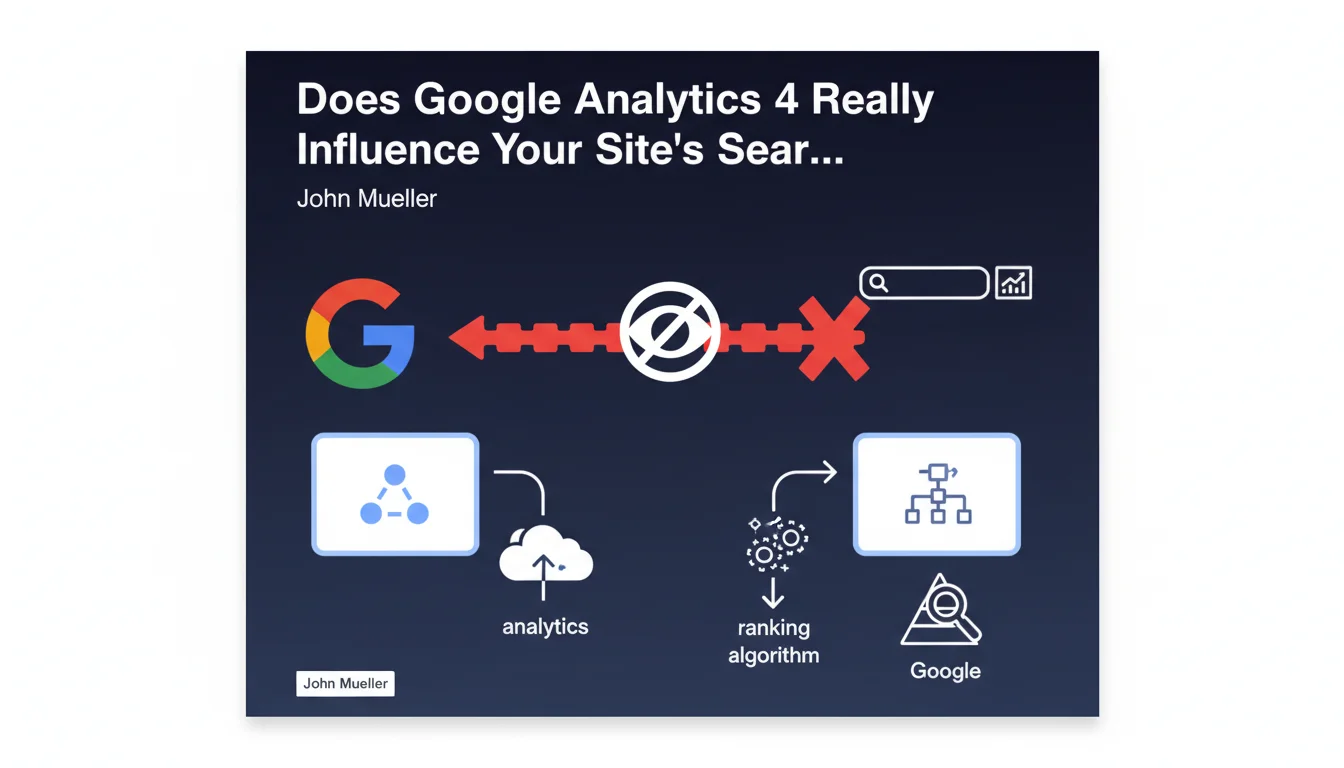
Yet John Mueller has clearly reaffirmed that GA4 is not a ranking factor. Metrics like bounce rate, time on site, or page views in Analytics are not transmitted to the search algorithm.
What's the Difference Between Signals Used by Google Search and GA4 Data?
Google Search uses its own data collection mechanisms to evaluate user experience. Chrome, Core Web Vitals, and engagement signals collected directly by the search engine are the real sources of information.
GA4, on the other hand, is a declarative and optional analytics tool. Users can block cookies, use ad blockers, or simply not be tracked. This data is therefore incomplete and not representative.
What Are the Key Takeaways from This Statement?
- Google Analytics 4 does not influence the positioning of your site in search results
- GA4 data and ranking signals come from completely different sources
- Not installing GA4 on your site will have no negative impact on your organic search rankings
- Core Web Vitals and other user experience signals are measured directly by Google via Chrome and other channels
- This separation ensures a certain neutrality of the algorithm regarding Google's proprietary tools
SEO Expert opinion
Is This Statement Consistent with Real-World SEO Observations?
Absolutely. Tests conducted by the SEO community confirm this assertion. Sites without Google Analytics installed rank perfectly well, while others with excellent GA4 metrics may have mediocre SEO performance.
The correlation sometimes observed between good GA4 metrics and good rankings is explained differently: a site that offers a good real user experience will naturally have good metrics in GA4 AND good behavioral signals that Google captures through its own means.
Why Does Google Maintain This Strict Separation Between Analytics and Search?
First and foremost, it's a matter of credibility and regulatory compliance. If Google used GA4 data for ranking, it would create an unfair competitive advantage and raise major antitrust issues.
Moreover, this separation ensures that the algorithm remains objective and based on universal signals. All sites, whether or not they use Google tools, are evaluated on the same criteria measured independently.
When Might This Rule Appear to Be Contradicted?
Some observe that sites with poor engagement metrics lose rankings. But it's not GA4 that Google reads: it's real user behaviors captured via Chrome, Android, or returns to search results.
There's also an indirect correlation: a site that works on its UX to improve its GA4 metrics will also improve the real signals that Google measures. The optimization is common, but the data sources remain distinct.
Practical impact and recommendations
What Should You Actually Do Following This Clarification?
Don't sacrifice your SEO budget to optimize only your GA4 metrics. Instead, focus on real user experience: loading speed, content quality, mobile usability.
Continue using GA4 as an analysis and steering tool for your digital strategy, but not as a direct indicator of SEO performance. GA4 metrics remain valuable for understanding your audience and optimizing your conversions.
What Mistakes Should You Avoid Given This Persistent Myth?
Don't trust agencies that promise to improve your SEO by optimizing your GA4 metrics. This is a fundamental misunderstanding of how Google works.
Also avoid panicking if your GA4 statistics show a high bounce rate or low session duration. These metrics can be skewed by ad blockers and don't necessarily reflect what Google measures.
How Can You Optimize the Real Behavioral Signals Google Actually Considers?
- Measure and optimize your Core Web Vitals via Google Search Console and PageSpeed Insights
- Improve the quality and relevance of your content to reduce the SERP return rate (pogo-sticking)
- Work on your site architecture to facilitate navigation and encourage multi-page visits
- Optimize your real loading speed across all devices, especially mobile
- Create engaging and comprehensive content that fully addresses search intent
- Monitor your metrics in Google Search Console (click-through rate, impressions, positions) which are more revealing
- Test user experience with real users, not only through analytics tools
💬 Comments (0)
Be the first to comment.