
Official statement
What you need to understand
How does Google detect the language of content?
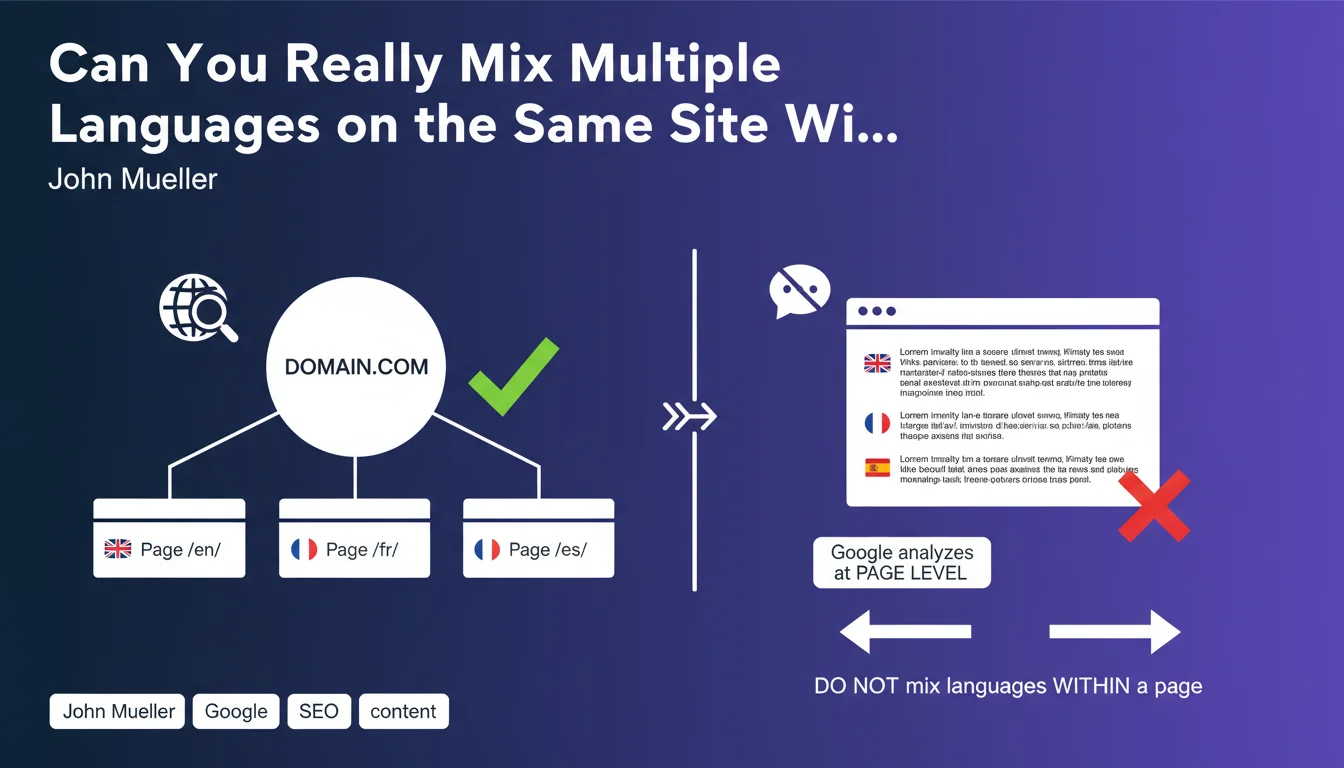
Google analyzes the language at the level of each individual page, not at the level of the site as a whole. This approach allows the search engine to correctly index pages in different languages hosted on the same domain.
This means that your site can perfectly well offer one page in French, another in English, and a third in Spanish, without creating any confusion for Google. Each page will be indexed and ranked according to its own detected language.
What is the major restriction to respect?
The golden rule formulated by John Mueller is simple: one page = one language. You should never mix multiple languages within the same page, as this would disrupt Google's linguistic analysis.
This constraint concerns the main content of the page. Minor elements such as short quotes in another language or international brand names generally do not pose a problem.
Which multilingual architectures are therefore compatible?
This statement validates two commonly used international architecture approaches: the use of language directories (example.com/fr/, example.com/en/) and the use of subdomains (fr.example.com, en.example.com).
- Google can handle multiple languages on the same domain without difficulty
- Language detection works page by page, not site by site
- Mixing languages within the same page should be avoided
- Strategies using directories or subdomains are fully compatible
SEO Expert opinion
Is this statement consistent with practices observed in the field?
Absolutely. In my practice, I have found that well-structured multilingual sites (with clear page-level separation) have never encountered indexing problems related to the multiplicity of languages. Google has been handling this situation for years.
The crucial element remains linguistic consistency at the level of each URL. Sites that respect this rule see their pages correctly assigned to the appropriate language versions of Google (google.fr, google.co.uk, etc.).
What nuances should be brought to this rule?
Although the "one page = one language" rule is fundamental, a few practical exceptions exist. Multilingual navigation menus, legal notices in multiple languages, or user comments in different languages generally do not disrupt detection.
Google focuses on the main content of the page (title tags, h1, text paragraphs) to determine the language. Minor peripheral elements in other languages are tolerated as long as they do not represent the majority of the content.
In which cases can this approach pose problems?
Difficulties appear mainly on international e-commerce sites where certain product descriptions remain in English even on localized versions. Google may then hesitate about the page's primary language.
Similarly, sites using automatically generated content or partial translations often create linguistically inconsistent pages that confuse language detection algorithms.
Practical impact and recommendations
What should you do concretely to optimize language detection?
First, make sure that each page contains at least 80-90% of content in a single language. This includes titles, descriptions, paragraphs, and image alt tags.
Systematically use the hreflang attribute to explicitly indicate to Google the relationships between your language versions. Although Google automatically detects the language, hreflang reinforces this detection and avoids confusion.
Also implement the lang attribute in your HTML tag (<html lang="en">) for each page. This technical indication helps Google confirm its automatic detection.
What mistakes should you absolutely avoid?
Never use duplicated content between languages on the same page. Some sites display the same text in multiple languages to "satisfy" different visitors, which is counterproductive.
Avoid partial automatic translations that leave blocks of text in the original language. If you cannot fully translate a page, it is better to keep it entirely in its source language.
- Verify that each page respects the "one page = one language" rule
- Implement hreflang tags between all language versions
- Add the lang attribute in the HTML tag of each page
- Check that the main content (title, h1, paragraphs) is linguistically homogeneous
- Eliminate blocks of text in foreign languages from the main body
- Test indexing by checking which version of Google (google.fr, google.com...) your pages appear in
How do you audit and correct existing language issues?
Perform a complete crawl of your site with tools like Screaming Frog by activating language detection. Identify pages where multiple languages coexist significantly.
Analyze your Search Console data by country to detect potential inconsistencies: French pages generating traffic from non-French-speaking countries may indicate a language detection problem.
💬 Comments (0)
Be the first to comment.