
Official statement
What you need to understand
Managing multiple versions of a site (API v1, v2, v3, annual documentation, successive editions) poses a major SEO challenge. Each version typically has its own URL, which dilutes visibility and complicates inbound link management.
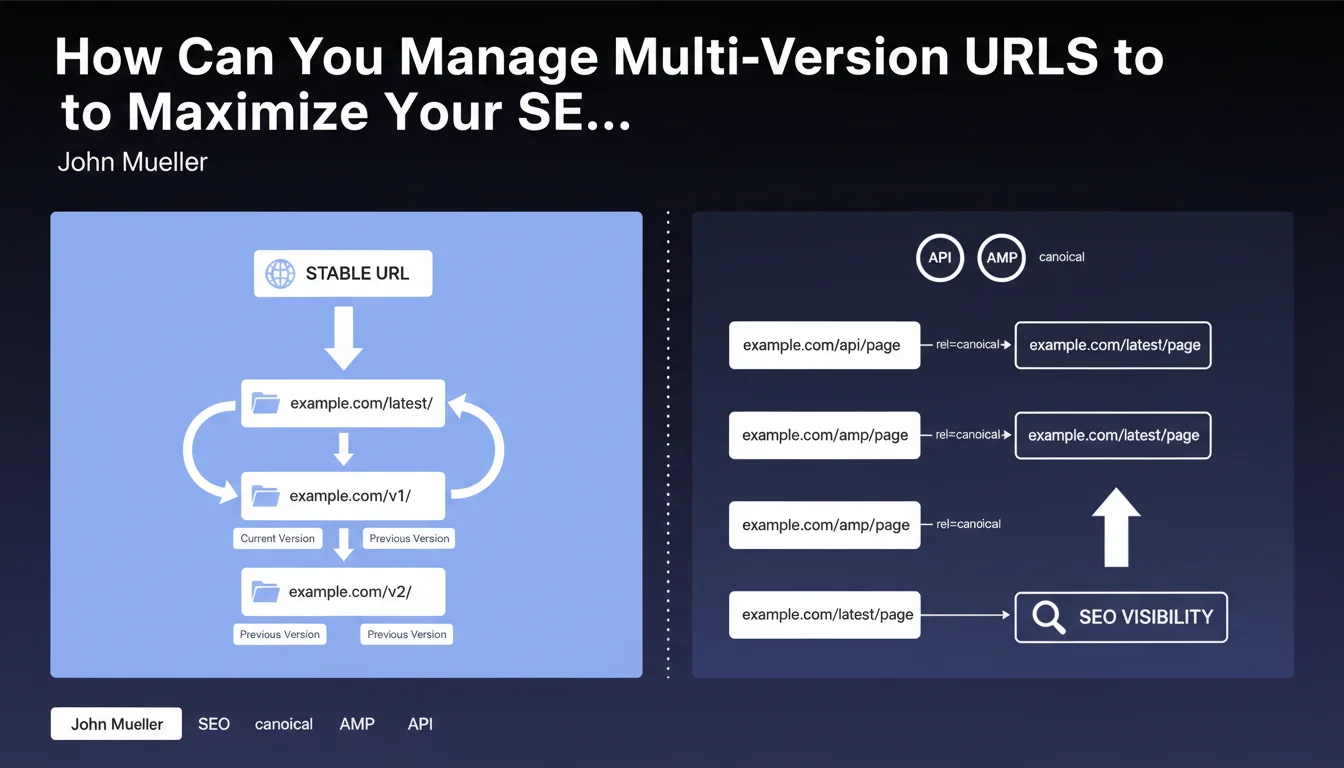
Google now recommends adopting a stable and permanent URL for the current version. Concretely, this involves creating a generic URL (such as /api/current/ or /docs/latest/) that always points to the latest available version.
This approach is accompanied by a versioned directory architecture: specific versions retain their own URLs (/api/v3/, /api/v2/...) but use a rel=canonical tag to the stable URL. This way, SEO signals concentrate on a single primary URL.
- Stable URL: creates a unique and permanent entry point for the current version
- Versioned URLs: maintained for direct access and history
- Canonical: redirects SEO power to the stable URL from each version
- Benefits: link consolidation, simplified navigation, better overall visibility
SEO Expert opinion
This recommendation is perfectly consistent with best practices observed on high-performing technical sites. It elegantly solves the authority dilution problem that affects sites with multiple versions.
However, be aware of the technical implications: the stable URL must be a real page (not just a 301 redirect), and its content must actually correspond to the current version. The canonical from specific versions to the stable URL is only relevant if the content is identical or very similar.
For sites with annual cycles (reports, studies), this approach is particularly beneficial: the URL /annual-report/ always points to the latest edition, maximizing natural inbound links, while /report-2024/, /report-2023/ remain accessible with canonical to the current version only for the current year.
Practical impact and recommendations
- Audit your current architecture: identify all versioned content (APIs, docs, annual products)
- Create stable URLs: define generic paths (/current/, /latest/, /latest-version/) for each type of versioned content
- Implement canonicals: add rel=canonical from the current version to the stable URL only
- Maintain versioned URLs: keep /v1/, /v2/, /2023/, /2024/ for direct access and history
- Configure future redirects: plan the update process when a new version becomes current
- Update your internal linking: prioritize links to the stable URL in your navigation and content
- Communicate to stakeholders: encourage the use of the stable URL for external links
- Monitor indexing: check in Search Console that Google properly respects your canonicals
In summary: adopting stable URLs for your versioned content centralizes your SEO authority, simplifies link management, and improves user experience. However, this architecture requires rigorous planning and precise technical implementation.
The complexity of this structural redesign should not be underestimated: it involves deep technical modifications, careful canonical management, and rigorous indexing monitoring. To ensure risk-free implementation and truly optimize your visibility, support from a specialized SEO agency can prove valuable, particularly for sites with complex architectures or high business stakes.
💬 Comments (0)
Be the first to comment.