
Official statement
What you need to understand
Why was the URL submission tool temporarily shut down?
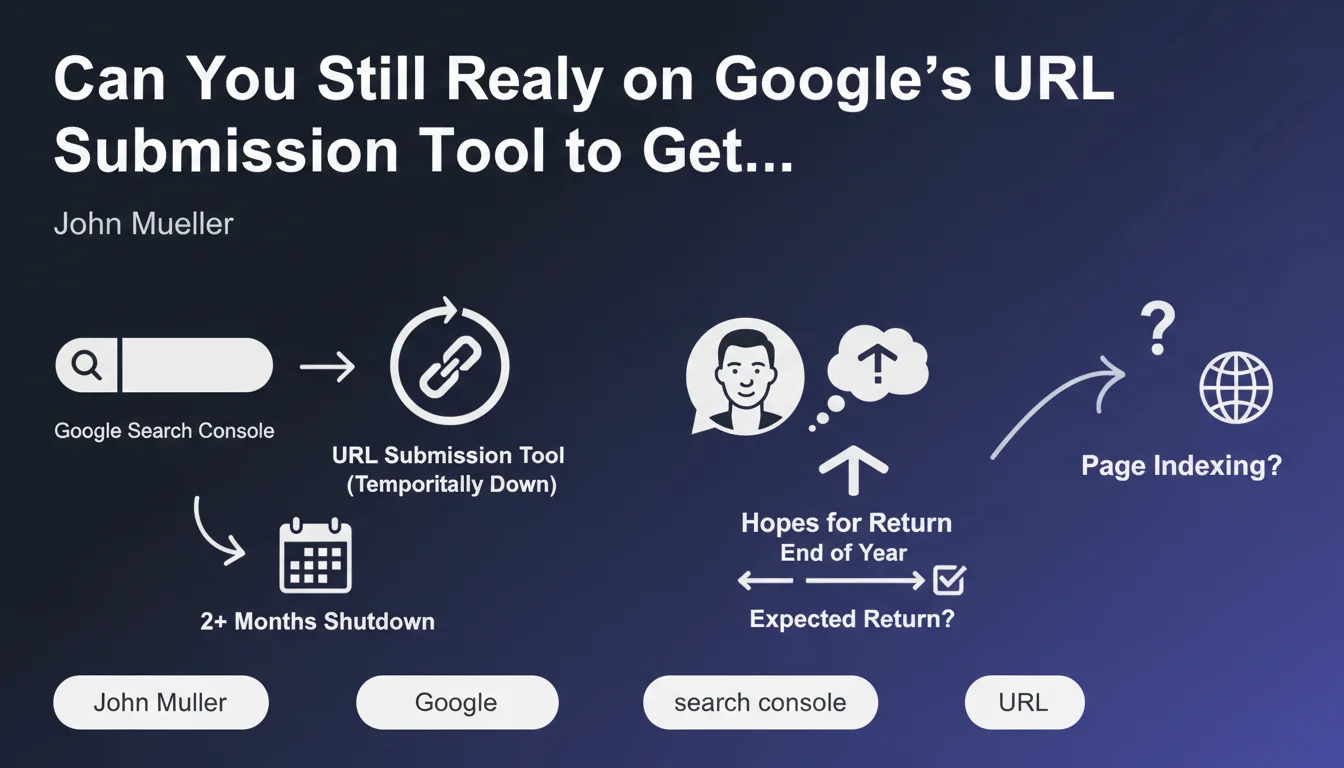
Google suspended access to the URL submission tool in Search Console more than 2 months before this statement. This interruption, described as "temporary," had no precise return date.
John Mueller mentioned at the SMX conference a potential return before the end of the year, without any firm guarantee. This uncertainty likely reflects technical issues or abuse of the tool by certain users.
What role did this tool play for SEO professionals?
The URL submission tool allowed site owners to request rapid indexing of specific pages. It was particularly useful for new content or urgent corrections.
Unlike Googlebot's natural crawl, this tool offered an accelerated solution for flagging priority URLs. Its absence forces SEO professionals to return to traditional indexing methods.
What are the implications of this prolonged suspension?
This extended pause reveals that Google can temporarily withdraw essential tools without guaranteed notice of restoration. The comment also mentions risks of future manipulations.
- The tool isn't essential to the search engine's operation
- Google favors its natural discovery process via crawl and sitemaps
- SEO professionals must maintain alternative indexing methods
- The tool's return could come with usage limitations or restrictions
SEO Expert opinion
Does this suspension reveal Google's intent to limit SEO control?
With 15 years of experience, I observe that Google is gradually tending to reduce direct action levers for SEO professionals. The prolonged suspension of this tool fits this trend.
The comment about "manipulations by ill-intentioned SEOs" is revealing. Google likely wants to limit abuse related to mass submissions or attempts to force indexing of low-quality content.
Can we really count on a return before the end of the year?
The expression "he hopes so at least" used by John Mueller is far from a firm commitment. This cautious wording suggests that even Google doesn't have a definitive timeline.
In my practice, I've found that deadlines announced by Google are often extended. It would be unwise to plan your SEO strategy counting on this tool's quick return.
Which alternatives have proven effective during this period?
During this interruption, my analyses show that sites with solid technical architecture and optimized XML sitemaps experienced no negative impact on their indexing.
Traditional methods remain the most reliable: optimized crawl budget, coherent internal linking, and sitemap submission. The URL submission tool was ultimately just a temporary accelerator, not a structural necessity.
Practical impact and recommendations
What should you implement immediately to avoid depending on this tool?
The absolute priority is to strengthen your natural indexing infrastructure. No longer count on manual submission tools as your primary solution.
Focus on optimizing your XML sitemap and ensure it's properly declared in Search Console. This is your main communication channel with Google.
- Verify that your XML sitemap is up to date and submitted in Search Console
- Optimize your crawl budget by eliminating unnecessary pages and redirect chains
- Strengthen your internal linking to facilitate discovery of new pages
- Use modification dates (lastmod) in your sitemap to signal updated content
- Monitor server logs to understand Googlebot's actual behavior
What mistakes should you avoid while waiting for the tool's potential return?
The main mistake would be to neglect your indexing strategy by betting on the tool's quick return. Maintain your current best practices.
Also avoid multiplying hasty workaround solutions like over-soliciting the Indexing API (reserved for specific content) or attempts to manipulate the crawl.
How can you adapt your long-term SEO strategy facing this uncertainty?
Adopt an approach where your site is naturally indexable without manual intervention. This is the only guarantee of sustainability against Google's tool changes.
Invest in robust technical architecture: optimized loading times, coherent silo structure, and automatic sitemap update system. These foundations will withstand all tool evolutions.
💬 Comments (0)
Be the first to comment.