
Official statement
What you need to understand
What does this statement about structured data really mean?
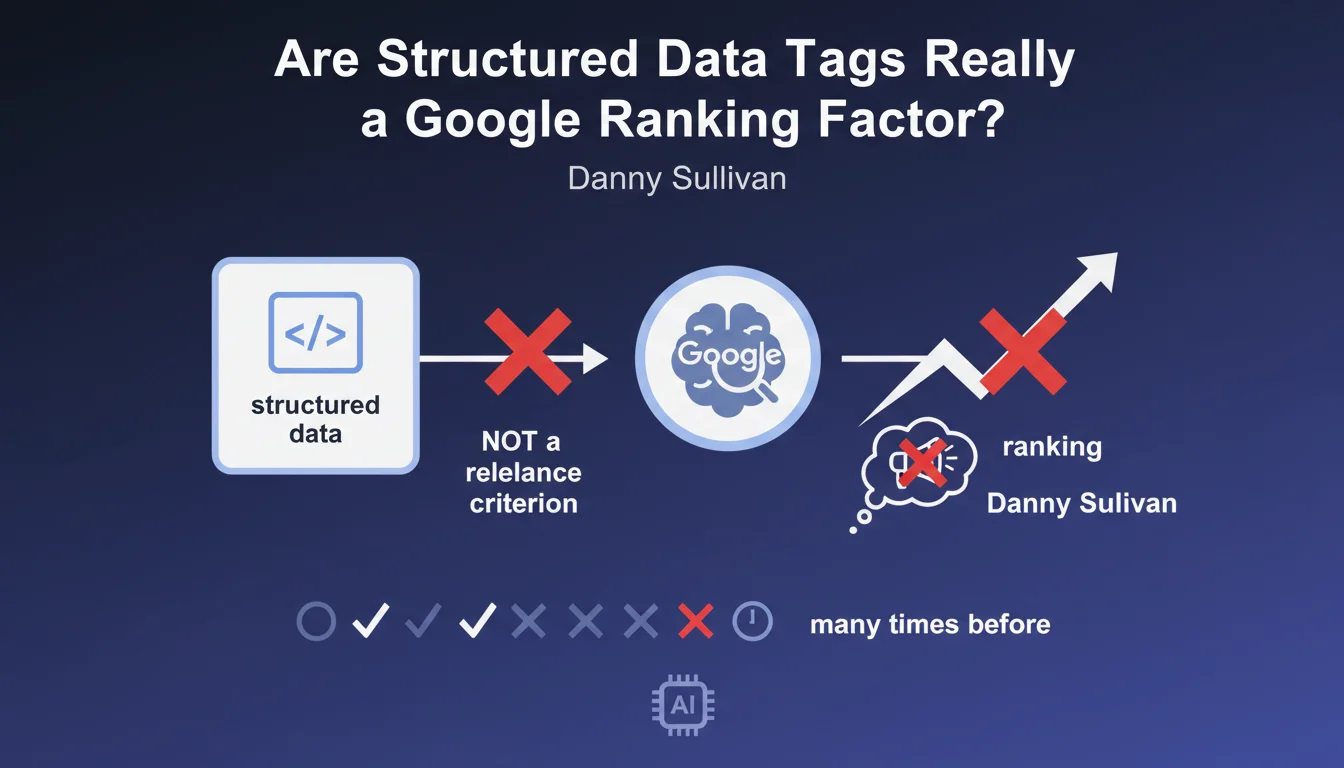
John Mueller reveals that the direct impact of structured data tags on search results ranking is "extremely weak." This statement may come as a surprise, as these tags are often presented as essential.
The reason is simple: Google already understands the content of your pages by analyzing the visible text. Structured data generally only confirms what the algorithm has already identified on its own.
Why does Google give so little weight to structured data in its algorithm?
Google's natural language processing algorithms are now sophisticated enough to automatically extract key information from a page. Entities, relationships, dates, prices... all of this is already understood without specific tags.
Structured data therefore serves more to confirm and formalize this information than to reveal it. They help Google have absolute certainty about certain information, but don't provide major revelations.
In what context was this statement made?
This clarification is part of an effort to demystify ranking factors. Too many sites invest heavily in structured data hoping for a major SEO gain, when the effort should first focus on content quality.
- Impact on ranking: extremely weak according to Google
- Main reason: Google already understands content through textual analysis
- Real function: confirmation and formalization of already-identified information
- SEO priority: quality content remains the determining element
- Added value: improvement of SERP display, not positioning
SEO Expert opinion
Is this statement consistent with what SEO experts observe in the field?
Yes, absolutely. For years, A/B tests on structured data have shown negligible impacts on rankings. The gains observed relate more to click-through rate thanks to rich snippets, not the ranking itself.
I've personally conducted dozens of audits where adding structured data led to no measurable ranking improvement. On the other hand, enriched display in SERPs has sometimes increased CTR by 15 to 30%.
What important nuances should be added to this statement?
First nuance: even if the impact on organic ranking is weak, the impact on total visibility can be significant. Rich snippets, carousels, knowledge panels... all of this requires structured data.
Second nuance: in certain very specific sectors (recipes, events, job listings, e-commerce products), structured data is virtually mandatory to appear in special SERP features. Without them, you're invisible in these formats.
Third nuance: for sites whose content is difficult to interpret (complex structures, dynamically generated content), structured data can provide valuable clarification to Google.
When does this rule not fully apply?
For highly structured content (events, products, recipes), structured data becomes a prerequisite for eligibility for special features. Their absence de facto excludes you from these visibility opportunities.
In sectors where competition is extreme, even an "extremely weak" impact can make the difference between position 3 and position 4. Every marginal advantage counts when other signals are equivalent.
Practical impact and recommendations
What should you actually do with structured data?
First priority: focus on your content quality. If your content is mediocre, structured data won't improve your ranking. That's the foundation.
Then, implement structured data relevant to your sector: Schema.org Organization, Article, Product, FAQ, Breadcrumb, etc. The goal is to be eligible for rich snippets and special features.
Aim for precision rather than exhaustiveness. A few well-implemented and maintained tags are better than complete but approximate or obsolete markup.
What mistakes should you absolutely avoid?
Don't fall into the trap of over-tagging. Some sites add dozens of types of structured data hoping for a miracle effect. It's useless and can even create confusion.
Avoid misleading structured data that doesn't match the visible content. Google can penalize you if your tags contain information different from what the user sees.
Don't neglect maintenance. Obsolete structured data (old event dates, outdated prices) is worse than no data at all. They generate errors in Search Console.
How should you prioritize your SEO efforts following this revelation?
Reallocate your time budget: 80% on quality content and user experience, 20% on technical aspects including structured data. This is the proportion that reflects their real impact.
For existing sites, do a prioritization audit: first check if your content meets search intents, then optimize the technical aspects. Structured data comes as a complement, not a priority.
- Audit the quality and relevance of your existing content
- Identify relevant structured data types for your sector
- Implement essential Schema.org tags (Organization, Article, Breadcrumb)
- Check for errors in Google Search Console
- Test display with Google's rich results testing tool
- Document your implementations to facilitate maintenance
- Monitor CTR evolution in SERPs, not just positions
- Regularly update dynamic structured data (prices, availability)
- Prioritize content and UX before any advanced technical optimization
💬 Comments (0)
Be the first to comment.