
Official statement
What you need to understand
In Which Specific Cases Does Google Use URL Structure?
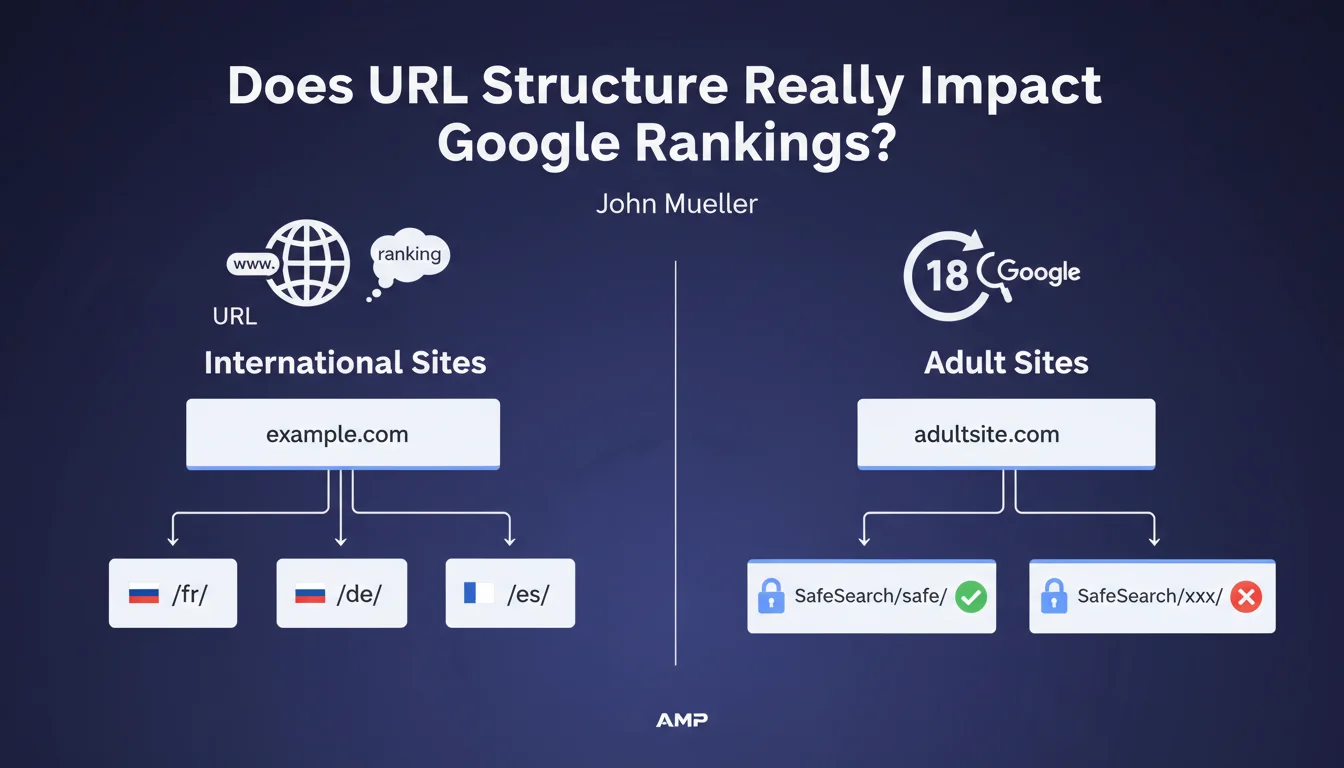
Google has confirmed that URL structure plays an active role in two specific contexts. For international sites, the use of language directories (/fr/, /de/, /en/) allows the search engine to understand the geographic and linguistic segmentation of content.
For adult sites, the structure enables Google to apply its SafeSearch filter in a granular way, identifying which sections should be filtered. This logic can extend to other categories of sensitive content.
Why Is Structural Clarity Important Beyond SEO?
A well-structured URL facilitates navigation for users who can instantly identify their position in the site hierarchy. This readability improves user experience and reduces bounce rate.
From a technical perspective, a consistent structure simplifies site management for teams, facilitates analytics tracking, and improves the understanding of performance reports.
What Are the Characteristics of an Optimal URL?
- Conciseness: avoid excessively long URLs that harm readability
- Clear hierarchy: reflect the logical site architecture
- Consistency: maintain a uniform structure across the entire domain
- Logical segmentation: use directories to organize content by topic, language, or region
- Absence of superfluous parameters: favor clean URLs over complex parameter strings
SEO Expert opinion
Is This Recommendation Consistent with Field Observations?
Absolutely. SEO audits consistently reveal that sites with coherent URL structure perform better in terms of crawling and indexation. Google robots follow a logical architecture more efficiently.
Multilingual sites using subdirectories (/fr/, /es/) generally achieve better results than those with parameters (?lang=fr), because Google can more easily assign geographic targeting and distribute PageRank in a structured manner.
What Nuances Should Be Applied to This Statement?
URL structure is not a direct ranking factor in most cases. Rather, it acts as a facilitator for other signals: crawling, indexation, international targeting, and content filters.
It's important to note that modifying the URL structure of an established site carries risks. 301 redirects must be perfectly planned to avoid loss of traffic and rankings.
In Which Cases Does This Rule Deserve an Exception?
For very small sites (fewer than 50 pages), the impact of URL structure is marginal. The restructuring effort doesn't always provide significant ROI.
Sites using specific technologies like Single Page Applications may have technical constraints making it difficult to implement a classic structure. In these cases, other optimizations must compensate.
Practical impact and recommendations
How Do I Audit and Optimize My Site's URL Structure?
Start with a complete crawl using tools like Screaming Frog or Botify to map all your URLs. Analyze crawl depth and identify structural inconsistencies.
Verify that your hierarchy reflects your strategy: important sections should be accessible within 2-3 clicks maximum from the root. Examine whether your URLs contain relevant keywords without being overloaded.
- Map all URLs and their current structure
- Identify sections with inconsistent or too-deep structures
- Define a standardized nomenclature for all page types
- For international sites, choose between subdomains, subdirectories, or ccTLDs
- Document URL conventions for future publications
What Mistakes Should I Avoid When Restructuring URLs?
The most common mistake is changing without redirects. Each changed URL must have its 301 redirect to the new version, without multiple redirect chains.
Also avoid overly complex structures with too many depth levels. A URL like /category/subcategory/sub-subcategory/product is counterproductive. Three levels maximum are generally sufficient.
What Should I Concretely Implement on My Site?
Establish a naming charter specifying how to build URLs for each content type. This documentation must be shared with all site contributors.
For an international site, favor the subdirectory structure (/fr/, /de/) on a main domain, which combines SEO advantages and management simplicity. Properly configure hreflang tags in consistency with this structure.
- Create a URL naming charter validated by SEO and technical teams
- Implement URL rewriting rules on the server side
- Set up an automatic generation system for compliant URLs
- Test the structure on a development environment before deployment
- Plan a progressive migration by sections if complete restructuring
💬 Comments (0)
Be the first to comment.