
Official statement
What you need to understand
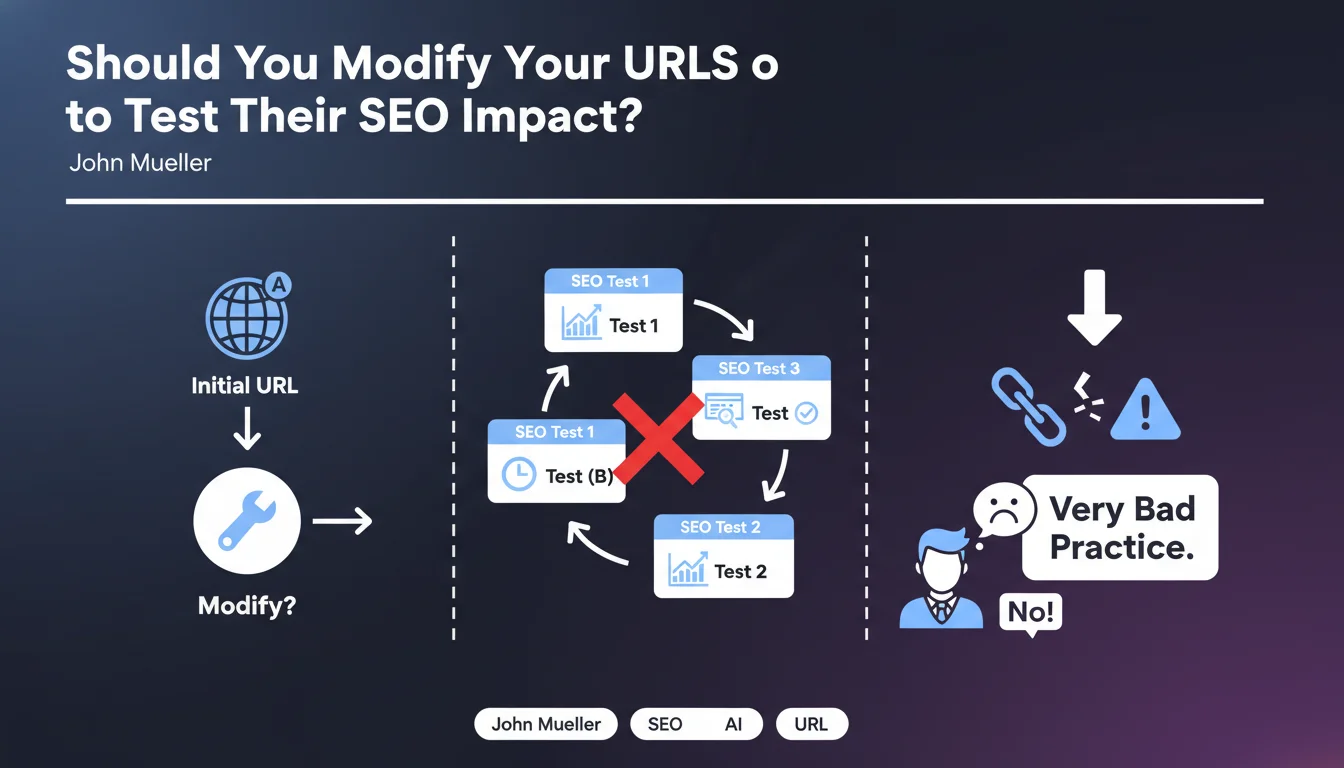
Google strongly advises against the practice of repeatedly modifying a site's URLs to perform SEO tests, then reverting to the initial structure. This warning is part of a logic of technical stability essential to search engine optimization.
When a URL changes, Google must reindex the new address and transfer the "SEO juice" from the old one to the new one. This process mobilizes crawl resources and takes time. Multiplying these changes creates instability that disrupts ranking algorithms.
The problem worsens when modifications are made back and forth: the old SEO signal is never completely recovered after several successive changes. We systematically observe a loss of positioning with each iteration.
- Keywords in URLs have negligible SEO weight according to Google
- Each URL change requires a stabilization period of several weeks
- 301 redirects do not transmit 100% of PageRank instantly
- A/B tests on URLs are particularly risky and rarely justified
- Consistency and stability of URLs are trust factors for Google
SEO Expert opinion
This position from Google is perfectly consistent with field observations from recent years. Sites that frequently modify their URL structure indeed experience organic traffic fluctuations, even with correctly implemented redirects.
However, there are a few legitimate cases where a URL overhaul is necessary: major technical migration, site structure change, internationalization, or correction of an initially problematic architecture. In these situations, the change must be unique, definitive, and carefully planned.
The comment about the low weight of keywords in URLs deserves nuance: while their direct impact on ranking is minimal, descriptive URLs improve click-through rate in SERPs and facilitate content understanding by users. A clear URL therefore remains an element of UX and trust, even if it no longer directly boosts ranking.
Practical impact and recommendations
- Never modify URLs solely to test the impact of keywords or syntactic variations
- Create a definitive URL structure from the design phase of the site or a new section
- Favor short, descriptive, and consistent URLs without seeking over-optimization
- If a URL overhaul is absolutely necessary, plan it only once with a comprehensive redirection plan
- Implement permanent 301 redirects (never temporary) and maintain them indefinitely
- Carefully monitor positions for 3 to 6 months after any URL change
- Submit the new XML sitemap and use the change of address tool in Search Console if applicable
- Invest the time saved from URL testing into content optimization, internal linking, and link acquisition
- Document the chosen URL structure in an editorial charter to ensure future consistency
Strategic management of URLs and redirects requires advanced technical expertise and a global vision of the site's architecture. The issues of crawl budget, popularity transfer, and timing are complex. For high-volume sites or during sensitive migrations, support from a specialized SEO agency helps secure these critical transitions and avoid lasting traffic losses that can cost far more than expert advice.
💬 Comments (0)
Be the first to comment.