
Official statement
What you need to understand
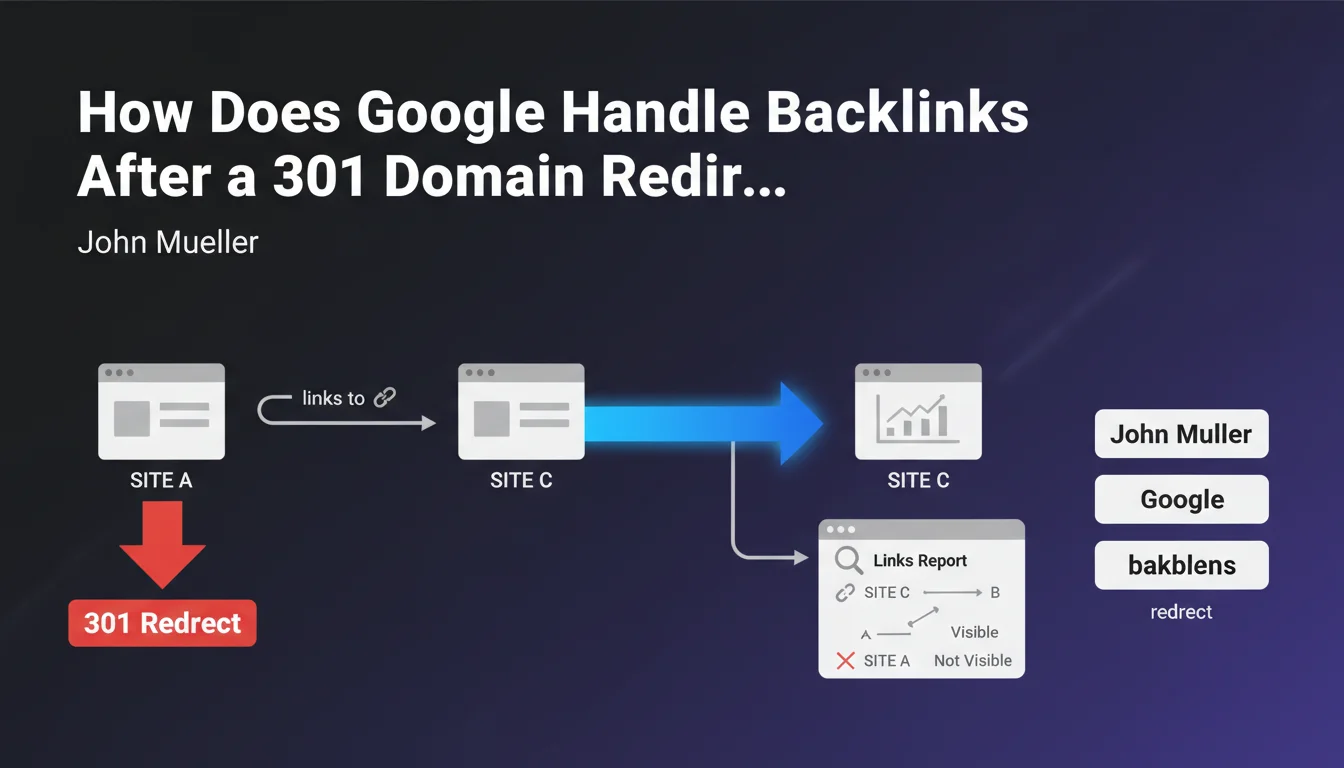
When site A redirects to domain C via a 301 redirect, backlinks pointing to A are theoretically transferred to C. Google has confirmed that in this scenario, if A links to B, it is indeed C that will appear as the link source in B's Search Console.
Concretely, this means that Google updates the origin of links in its systems to reflect the new structure. Site B will therefore see in its backlink profile that the link comes from C, and no longer from A.
However, this update process presents a significant time lag. Even when the redirection is correctly taken into account by Google, the data in Search Console may continue to display the old domain A for an extended period.
- 301 redirects transfer the attribution of outbound links to the new domain
- Search Console eventually reflects the new domain as the source of backlinks
- The update delay in tools can be very long (several months)
- This latency does not mean that the redirection is not being taken into account for SEO purposes
SEO Expert opinion
This statement indeed corresponds to what we observe in the field. The transfer of outbound link attribution is a logical consequence of how 301 redirects function, but is rarely documented this explicitly.
The important nuance lies in the data update delay. SEO practitioners regularly notice that Search Console displays historical data for 6 to 12 months after a migration. This lag creates confusion, as it doesn't necessarily reflect the actual state of indexing.
In cases of redirect chains (A→C→D), complexity increases and Google may have difficulty properly consolidating attribution. It is therefore crucial to prioritize direct redirections.
Practical impact and recommendations
- After a domain migration: Don't be alarmed if Search Console still displays the old domain for several months in backlink reports
- Monitor real indicators: Focus on organic traffic and rankings rather than domain display in reports
- Avoid redirect chains: Always redirect directly to the final destination, not through intermediate domains
- Keep redirects active: Maintain 301 redirects for at least 12 to 18 months to allow complete consolidation
- Document your migrations: Keep a record of redirection dates to contextualize Search Console data
- Verify technical implementation: Ensure that 301 redirects are properly configured at the server level (not in JavaScript)
- Monitor 404 errors: Some URLs may slip through the cracks during a complex migration
Domain migrations involve numerous technical aspects that can have a lasting impact on your visibility. Between managing redirections, interpreting analytical data, and optimizing authority transfer, these operations require specialized expertise to avoid traffic losses. A specialized SEO agency can guide you through this critical process by providing personalized monitoring and anticipating common pitfalls of complex migrations.
💬 Comments (0)
Be the first to comment.