
Official statement
What you need to understand
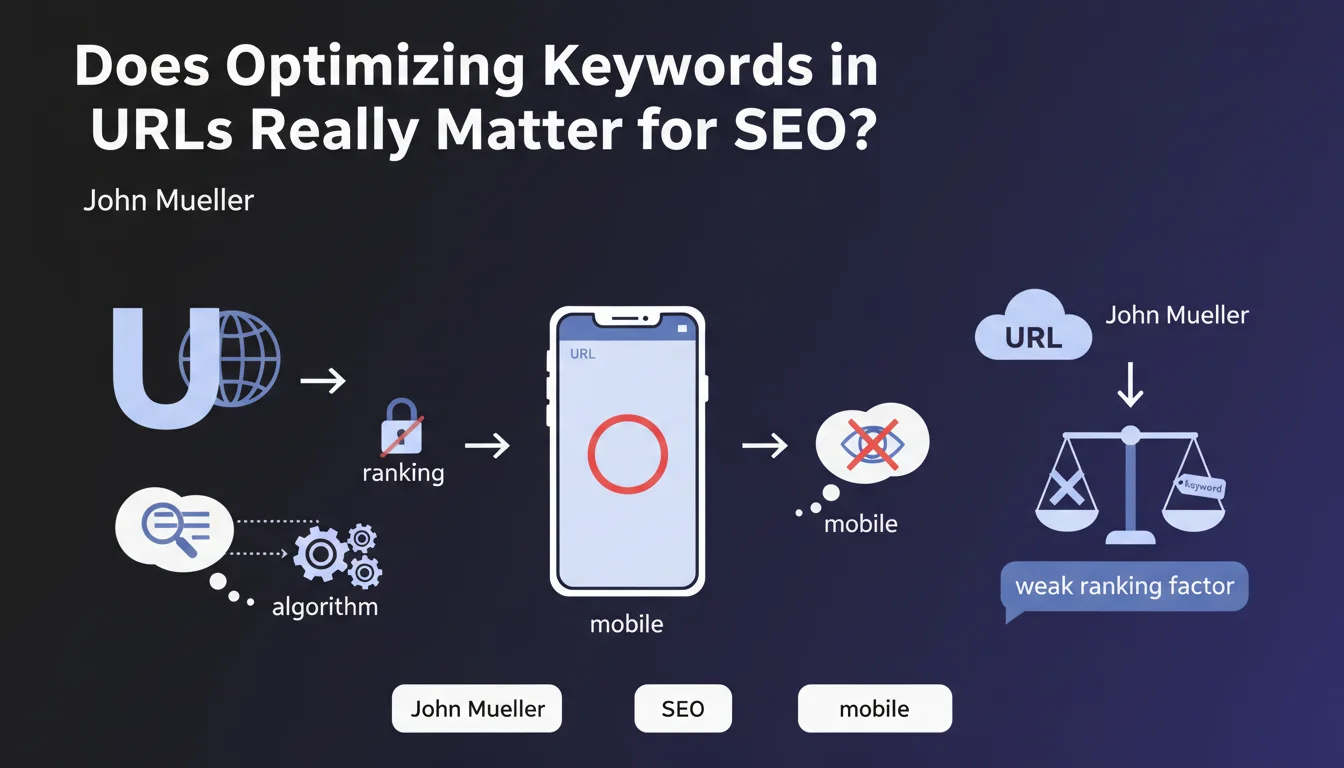
Google has officially confirmed that the presence of keywords in URLs has only a very weak impact on ranking in search results. This statement contradicts a belief still very widespread among SEO practitioners.
Contrary to what many think, stuffing a URL with keywords like /best-divorce-lawyer-paris-75-cheap.html will bring virtually no SEO benefit. Google's algorithms have evolved significantly and no longer rely on this low-quality signal.
This doesn't mean that URLs should be neglected. The essential criterion remains readability and immediate understanding of the page's content. A clear URL helps users and facilitates link sharing.
- Impact of keywords in the URL: very weak, even negligible
- Readability takes precedence over keyword density
- A descriptive URL helps user experience and crawling
- Avoid generic URLs like /page123 or /product?id=456
- Favor simplicity and clarity over excessive optimization
SEO Expert opinion
This statement is perfectly consistent with field observations over the past several years. Many sites ranked in first position have very simple URLs, sometimes even without any primary keyword, while competitors with "perfectly optimized" URLs struggle to rank.
The important nuance to bring concerns the content creation context. For a new site, starting with descriptive and clean URLs from the outset remains a good architectural practice. However, massively modifying existing URLs solely to add keywords is counterproductive: the risks of ranking loss related to redirections far exceed the hypothetical gains.
Practical impact and recommendations
In summary: Focus your SEO efforts on factors that truly matter (content, links, technical) rather than wasting time excessively optimizing your URLs. Simplicity and clarity are your best allies.
- For new content: Create simple, short, and descriptive URLs that clearly indicate the page's topic
- Absolutely avoid modifying existing URLs that work well just to add keywords
- Ban overloaded URLs like /keyword-1-keyword-2-keyword-3-city-region.html
- Favor logical structure: a clear hierarchy is more important than the presence of keywords
- Remove stop words (the, a, of, etc.) to shorten your URLs without losing clarity
- Test the simple rule: if someone can guess your page's content by reading only the URL, it's perfect
- Reallocate your time to real levers: content quality, technical optimization, link building strategy
- Audit your overall architecture rather than micro-optimizing each URL individually
Implementing a balanced SEO strategy requires knowing how to prioritize tasks according to their actual impact. Between technical architecture, content optimization, link strategy, and the hundreds of possible micro-optimizations, it can be difficult to identify where to invest your energy. Support from a specialized SEO agency allows you to benefit from expert insight to build a personalized roadmap, focused on high-ROI actions for your specific project.
💬 Comments (0)
Be the first to comment.