
Official statement
What you need to understand
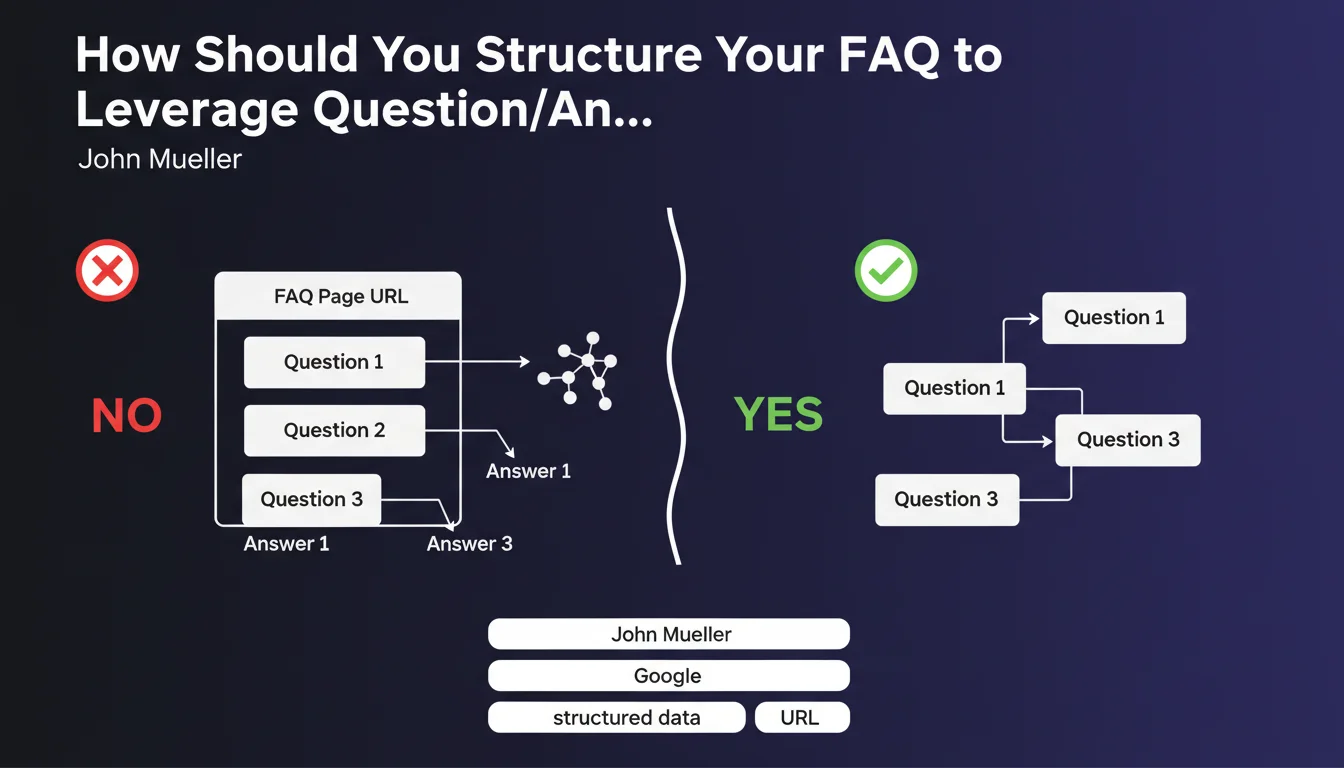
Google has introduced a type of structured data specific to Question/Answer pages, but with a major constraint that is often misunderstood. This markup can only be applied when a single question and its unique answer occupy a dedicated page.
Contrary to what many SEO professionals had anticipated, traditional FAQ pages with multiple question/answer pairs are not eligible for this structured markup. This clarification profoundly changes the way we need to think about support content architecture.
The essential points to remember regarding this limitation:
- One page = one question = one answer: this is the golden rule for using this markup
- Classic multi-question FAQs cannot use this structured data format
- An architectural redesign may be necessary to benefit from this rich display
- The potential impact on visibility justifies rethinking the structure of your Q&A content
This technical clarification therefore imposes a strategic choice between content consolidation and optimization for Rich Snippets. Each approach has advantages and disadvantages that should be evaluated according to your specific context.
SEO Expert opinion
This restriction from Google is consistent with their desire to guarantee the relevance of rich results. By limiting the markup to single-question pages, the search engine ensures that users land exactly on the answer they're looking for, without having to scan through a lengthy page.
However, this approach creates an architectural dilemma for websites. On one hand, multiplying pages potentially improves visibility in rich results and generates more entry points. On the other hand, it can dilute authority, complicate navigation, and create problems with overly thin content on certain pages.
In practice, we observe that Google does indeed favor single-topic pages in rich results. However, a well-structured consolidated FAQ can also perform through other signals (engagement, internal links, authority), even without a Rich Snippet.
Practical impact and recommendations
Given this technical clarification, here are the concrete actions to consider for optimizing your Question/Answer content strategy:
- Audit your existing FAQs: identify high-potential search questions that deserve a dedicated page
- Prioritize intelligently: don't systematically split all your FAQs, focus on queries with significant volume
- Create a hybrid architecture: maintain a general FAQ for user navigation, and detailed pages for strategic questions
- Enrich the content: if you create single-question pages, add context, examples, and complementary content to avoid overly thin pages
- Implement markup correctly: use QAPage structured data only on pages that respect the 1 question/1 answer format
- Monitor performance: measure the impact in terms of impressions, CTR, and conversions before deploying at scale
- Avoid cannibalization: ensure that your single-question pages don't compete with other more comprehensive content on the same topics
💬 Comments (0)
Be the first to comment.