
Official statement
What you need to understand
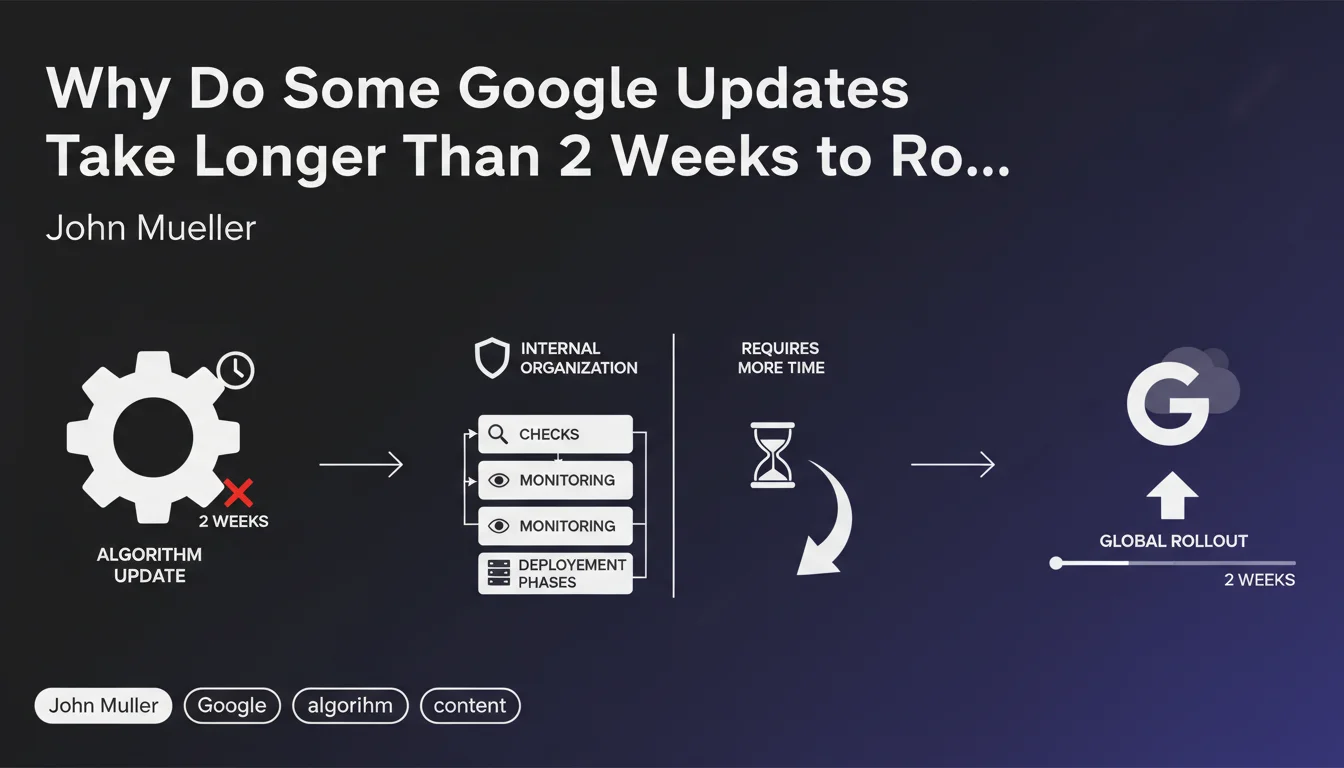
The variable duration of Google's algorithmic updates regularly raises questions in the SEO community. Traditionally, updates roll out over approximately 2 weeks, but some recent ones like the Link Spam Update or the Helpful Content Update have required more time.
According to Google's official spokespeople, an extended duration doesn't signify greater intensity of the algorithm. This clarification is important because many SEO professionals interpret a lengthy update as a signal of major changes ahead.
The reality is more mundane: it's mainly about internal organizational constraints at Google. Teams must conduct thorough verifications, ensure rigorous quality monitoring, and coordinate deployments across different teams and datacenters.
- Duration ≠ Impact: A longer update isn't necessarily more aggressive
- The delays reflect internal validation processes and quality control
- Deployment timing (such as before holidays) can artificially extend the observed duration
- Google teams prioritize caution and verification over speed
SEO Expert opinion
This clarification from Google is perfectly consistent with field observations. Indeed, some lengthy updates (3-4 weeks) haven't shown more brutal impacts than standard 14-day deployments. The perceived intensity depends more on the nature of the algorithm than on its rollout duration.
However, this official statement needs nuancing. An extended duration can indicate increased technical complexity, particularly when Google makes adjustments during deployment based on initial feedback. The simultaneous updates mentioned (Link Spam + Helpful Content) also illustrate a sometimes questionable deployment strategy that complicates analysis of respective impacts.
Practical impact and recommendations
- Don't hastily modify your site during a lengthy update - wait for the official end of deployment before analyzing the real impact
- Monitor your KPIs daily but only draw conclusions after complete stabilization (minimum 7 days post-update)
- Document fluctuations precisely with dates and metrics to facilitate retrospective analysis
- Distinguish multiple impacts: if several updates overlap, try to isolate the effects of each on different segments of your site
- Maintain your usual SEO roadmap: don't suspend planned optimizations just because an update is ongoing
- Avoid overreactions: variations of 5-10% during a deployment are often temporary and normalize afterward
- Prepare your post-update analyses: have Analytics segments ready to measure impact by content type or page categories
These periods of algorithmic uncertainty require expert and methodical analysis of often contradictory signals. Managing multiple simultaneous updates, coupled with your ongoing optimizations, can quickly become complex to orchestrate alone. Support from a specialized SEO agency provides an objective perspective, advanced monitoring tools, and proven expertise to navigate these algorithmic transition phases smoothly while maintaining a coherent strategy.
💬 Comments (0)
Be the first to comment.