
Official statement
What you need to understand
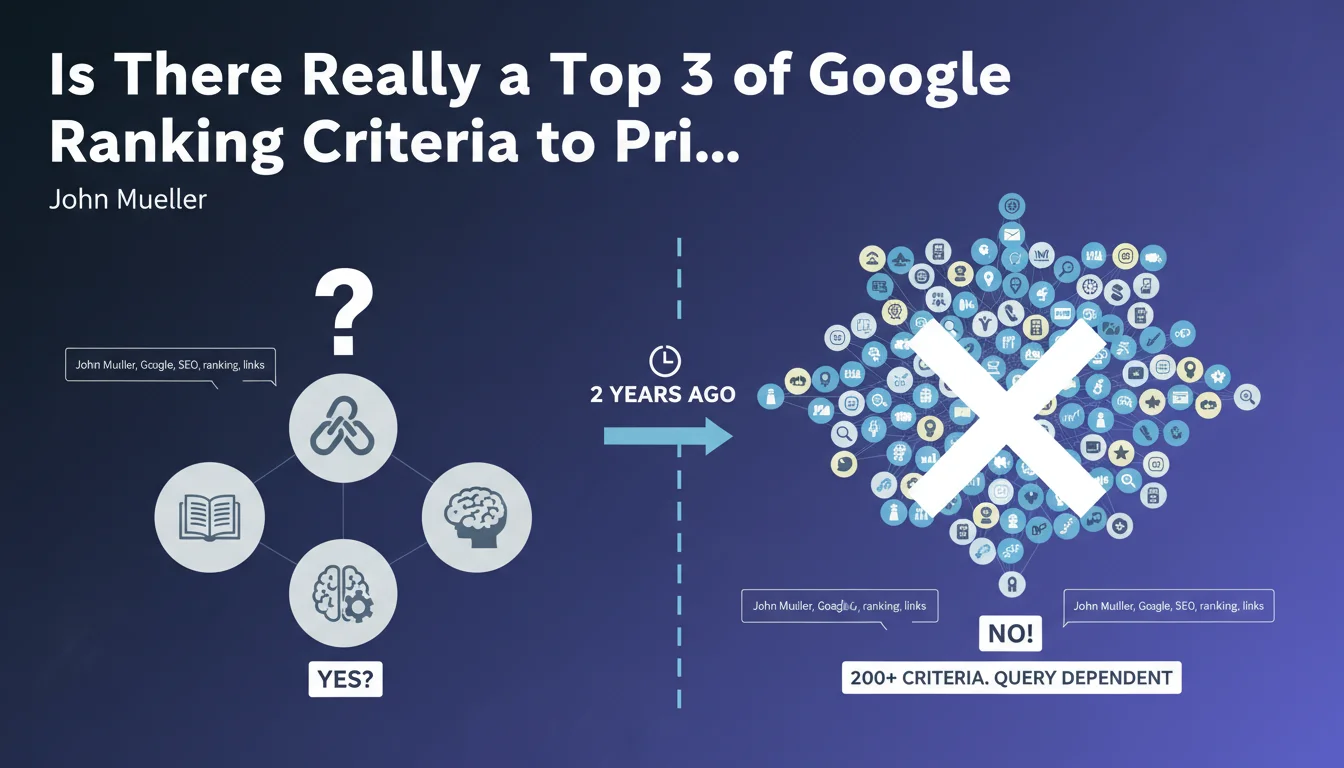
Many SEO professionals have long believed that there were three major criteria in Google's algorithm: content, inbound links, and RankBrain (Google's artificial intelligence). This simplified view suggested that by focusing on these three pillars, one could effectively optimize their search engine rankings.
However, John Mueller and Gary Illyes have clearly refuted this approach. They remind us that Google uses more than 200 ranking criteria, and that the importance of each varies considerably depending on the nature of the query performed.
This nuance is fundamental: there is no universal formula that would work for all searches. A local query will not be evaluated with the same priorities as an informational search or a transactional intent.
- Google's algorithm dynamically adapts to the type of query performed
- The 200+ ranking criteria have variable weighting depending on context
- Content, links, and RankBrain remain important but do not constitute an exclusive trio
- An effective SEO strategy must be holistic and contextual, not monolithic
SEO Expert opinion
This clarification from Google is perfectly consistent with field observations. SEO audits regularly reveal that sites with excellent backlinks can underperform if other signals are neglected, such as user experience, loading speed, or semantic relevance.
The important nuance concerns search intent. For a query like "restaurant near me," local signals (Google Business Profile, proximity, reviews) far outweigh backlinks. For a complex informational query, content depth and topical authority become predominant.
True SEO expertise consists precisely in identifying which criteria to prioritize for each type of page and search intent, rather than blindly applying a single recipe.
Practical impact and recommendations
- Abandon the "Top 3" approach and adopt a holistic vision of your SEO strategy
- Analyze your pages by intent typology (informational, navigational, transactional, local)
- For each type of content, identify the priority criteria observed in search results
- Diversify your optimizations: technical, content, authority, user experience, mobile, local
- Invest in Core Web Vitals and UX, not just backlinks
- Develop your topical authority with coherent internal linking and content clusters
- Optimize local signals (Google Business Profile, reviews, NAP) for geolocated queries
- Work on semantic relevance and in-depth topic coverage
- Track differentiated KPIs according to page typologies rather than a single metric
In summary: The era of a universal SEO recipe is over. Modern search engine optimization requires a strategic approach adapted to each context, taking into account the multiplicity of ranking signals.
This growing complexity of the SEO ecosystem demands sharp expertise and constant monitoring. Faced with these multidimensional challenges, many decision-makers choose to rely on an experienced SEO agency, capable of orchestrating these different components coherently and adapting the strategy to the specificities of each project, to maximize the effectiveness of investments.
💬 Comments (0)
Be the first to comment.