
Official statement
What you need to understand
What does Google's statement about ranking factors really mean?
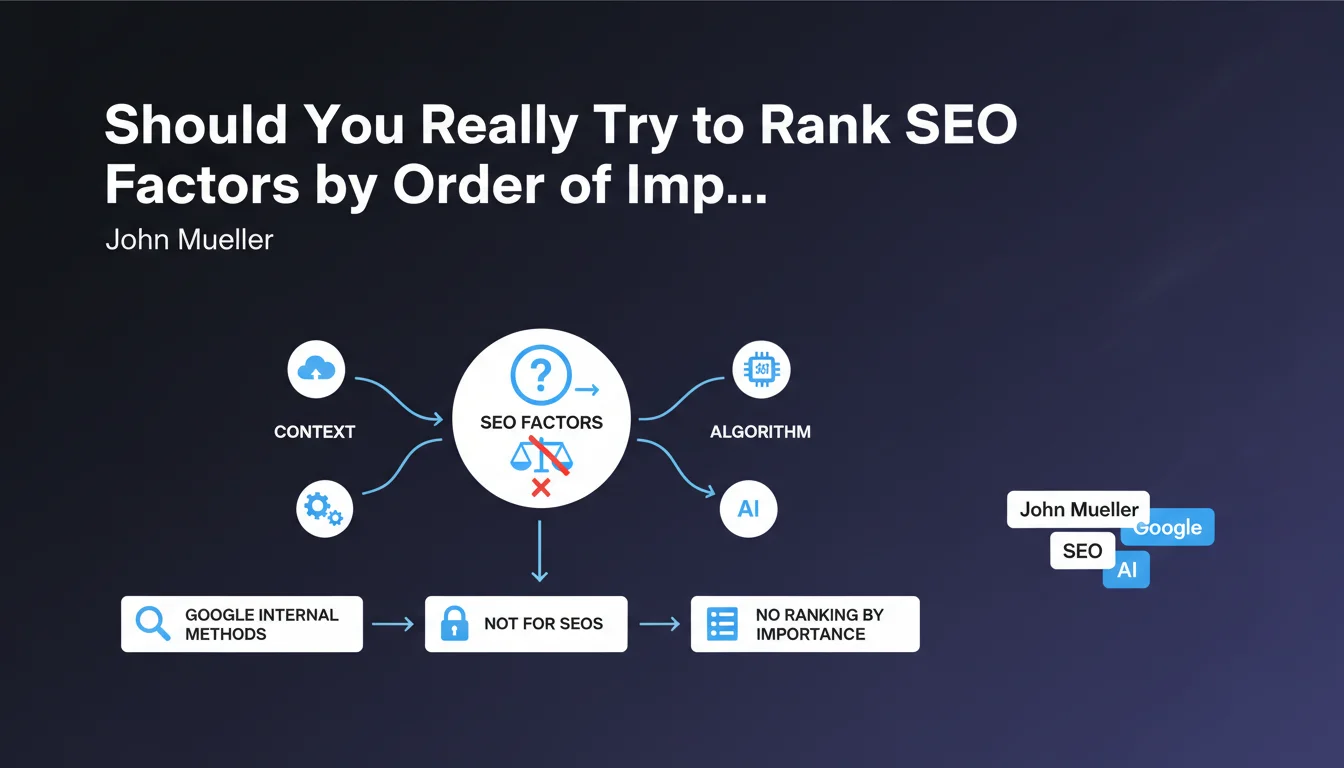
Google states that it is impossible to hierarchize the relevance criteria of its algorithm in a universal manner. Each query, each context, each situation involves different combinations of signals.
This official position challenges the traditional approach of many SEOs who attempt to establish weighted lists of ranking factors. Google does have internal classification systems, but their complexity makes them unsuitable for practical use by search engine optimization professionals.
Why does Google refuse to communicate about the weight of criteria?
The main reason is that the weight of criteria varies considerably depending on the context. An informational query will not mobilize the same signals as a transactional or local query.
Moreover, Google's algorithm uses machine learning systems that dynamically adjust the importance of criteria. What works for a query in a given sector can be totally different for another topic.
What are the essential points to remember from this official position?
- There is no universal list of ranking factors ranked by order of importance
- The context of the query determines which criteria will be predominant
- The three major categories (technical, content, links) all have their importance depending on the situations
- Google uses complex weighting methods that are not transferable to practical SEO
- The dogmatic approach of universal "golden rules" is counterproductive
SEO Expert opinion
Is this statement consistent with what SEOs observe in the field?
Absolutely. Any experienced practitioner notices that success factors vary across SERPs. A winning strategy in e-commerce can fail in information.
However, there are indeed observable general trends. Content quality, technical relevance, and authority remain constant pillars, even if their relative weight fluctuates. Experience shows that certain criteria statistically have more impact than others in similar contexts.
What important nuances should be added to this position?
Even if Google refuses strict hierarchization, this does not mean that all criteria are equal. Some factors like loading speed or links remain structural signals in the majority of cases.
The real subtlety lies in the combination of criteria rather than in their individual weight. A site can compensate for a weakness in one aspect with excellence in another, but this depends heavily on the sector and competition.
In which cases is this contextual rule particularly true?
Local queries perfectly illustrate this principle: geographic signals and customer reviews take on disproportionate importance compared to a classic informational query.
Similarly, for news queries, content freshness becomes a dominant criterion that even overrides the historical authority of the domain. YMYL (Your Money Your Life) queries activate much stricter expertise and reliability filters.
Practical impact and recommendations
What should you do concretely in the face of this algorithmic reality?
Adopt a contextual analysis approach rather than blindly following universal rules. Study the SERPs of your target queries to identify which criteria seem predominant.
Focus on multi-criteria excellence rather than excessive optimization of a single factor. A site well-balanced across all technical, editorial, and popularity aspects will be more resilient to algorithmic changes.
What critical mistakes should you absolutely avoid?
Don't fall into the trap of over-optimizing a single lever. Investing massively in links while neglecting content, or vice versa, creates imbalances detectable by Google.
Also avoid relying on generalist correlation studies that claim to rank factors. These analyses, even well-intentioned, reflect only an average that may not apply to your specific sector.
How can you adapt your SEO strategy to this contextual logic?
- Systematically analyze the pages currently ranking for your target queries
- Identify common patterns among well-ranked sites in your topic
- Establish a complete diagnosis covering technical, content, and authority aspects
- Prioritize actions based on your site's relative weaknesses compared to the competition
- Test and measure the impact of your optimizations in an iterative and documented manner
- Adjust your strategy based on observed results rather than general theories
- Maintain continuous competitive monitoring of SERP evolution in your sector
Google's statement confirms what field experience demonstrates: there is no universal magic formula in SEO. The effectiveness of a strategy fundamentally depends on the specific context of each project.
This complexity requires deep expertise and contextual analysis capability that only experience can develop. Faced with these multidimensional challenges and the need to finely adapt your strategy, many projects would benefit from support by a specialized SEO agency capable of precisely analyzing your competitive environment and identifying priority levers according to your unique situation.
💬 Comments (0)
Be the first to comment.