
Official statement
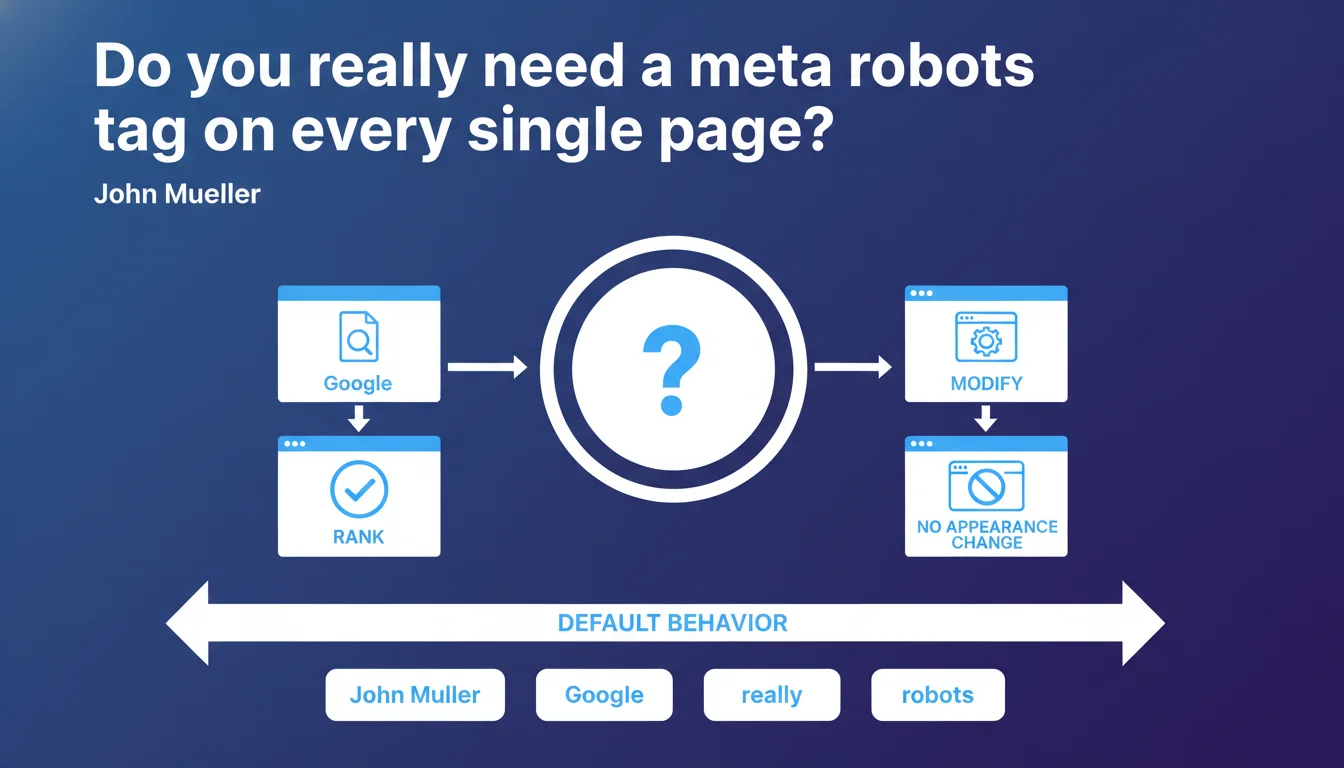
The meta robots tag is not mandatory for Google to index and rank your pages. It only serves to modify the default appearance or behavior of a page in search results. If you don't want to change the standard behavior, you can skip it entirely.
What you need to understand
What does Google consider as "default" behavior?
Google crawls, indexes, and displays your pages according to standard rules: following links, indexing content, displaying an automatically generated snippet. No meta robots tag is necessary for this process to work.
The meta robots tag becomes useful only when you want to modify this behavior: block indexation (noindex), prevent link following (nofollow), control snippet display (nosnippet, max-snippet), or forbid caching (noarchive).
Why do some sites add this tag systematically?
Many CMS platforms and frameworks automatically generate a <meta name="robots" content="index, follow"> tag on all pages. This is completely redundant since it's already Google's default behavior.
This practice often stems from misunderstanding or inherited habits. Some SEO professionals mistakenly think that explicitly specifying "index, follow" reinforces the signal. In reality, it adds nothing whatsoever — and unnecessarily clutters your HTML code.
In what cases does this tag become essential?
The meta robots tag is mandatory in three scenarios:
- You want to block a page from being indexed (noindex) while keeping it accessible to users
- You wish to control snippet display (nosnippet, max-snippet:X, max-image-preview)
- You need to prevent link following without touching robots.txt or adding rel="nofollow" to every individual link
- You must prevent caching of sensitive pages (noarchive)
SEO Expert opinion
Is this statement consistent with practices observed in the field?
Absolutely. We have observed for years that sites with no meta robots tag at all are perfectly indexed and ranked. Google has never required this tag for crawling or ranking.
What's surprising is how many sites continue to generate redundant index, follow tags — likely out of reflex or lack of cleanup of legacy code. Some SEO audits still recommend adding these tags "as a precaution," which has no technical foundation.
What nuances should be added to this statement?
Mueller talks about "ranking" and "appearance in results," but we must distinguish between two very different uses of the meta robots tag.
On one side, indexation directives (noindex, nofollow) — here, the tag is a strategic tool for controlling crawl budget and indexable surface area. On the other, display directives (nosnippet, max-snippet) — there, it's about how search results appear and managing featured snippets.
Confusing the two leads to mistakes: for example, adding noindex to a page you want to rank, or forgetting to restrict snippets on pages containing sensitive data. [To verify]: Google doesn't always clearly specify how these directives interact with each other in case of conflict.
In what cases does this rule not apply?
If you manage a site with restricted access zones, staging pages, or intentional duplicate content (regional variants, A/B tests), the meta robots tag becomes your first line of defense against unwanted indexation.
Another exception: e-commerce sites with navigation filters often generate thousands of parameterized URLs. Here, combining noindex, follow on filtered pages allows you to preserve crawl budget while letting Googlebot follow links to product pages.
Practical impact and recommendations
What should you do concretely with this information?
First step: audit your code. Identify all pages carrying a <meta name="robots" content="index, follow"> tag. If this is the case across your entire site, you can safely remove them — they serve no purpose.
Keep only the meta robots tags that actually modify the behavior: noindex on login pages, noarchive on sensitive content, max-snippet on articles where you don't want Google to display too much text.
What mistakes should you avoid at all costs?
Don't confuse the meta robots tag with your robots.txt file. The robots.txt file blocks crawling, the meta robots tag controls indexation and display. Blocking a page in robots.txt prevents Google from reading the noindex tag — result: the page can still appear in search results (without a snippet).
Another classic pitfall: deploying a global noindex "as a precaution" during a migration, then forgetting to remove it. Or worse, having a conflict between a meta tag index and an HTTP header X-Robots-Tag: noindex — the noindex always wins.
How do you verify your site is correctly configured?
- Crawl your site with Screaming Frog or a similar tool to list all meta robots tags
- Identify pages with explicit
index, followand remove these redundant tags - Verify that your strategic pages (product sheets, blog articles) have neither noindex nor a blocking X-Robots-Tag header
- Check that your low-value pages (filters, internal search, thank you pages) properly carry a noindex
- Test snippet display in Search Console to adjust max-snippet if necessary
- Document your indexation strategy in a shared dashboard with the development team
❓ Frequently Asked Questions
Puis-je supprimer toutes mes balises meta robots "index, follow" sans risque ?
Quelle est la différence entre noindex en balise meta et en en-tête HTTP ?
Le robots.txt peut-il remplacer la balise meta robots noindex ?
Est-ce que max-snippet impacte le taux de clic dans les résultats ?
Comment savoir si une page est bloquée par erreur ?
🎥 From the same video 3
Other SEO insights extracted from this same Google Search Central video · published on 20/09/2022
🎥 Watch the full video on YouTube →
💬 Comments (0)
Be the first to comment.