
Official statement
What you need to understand
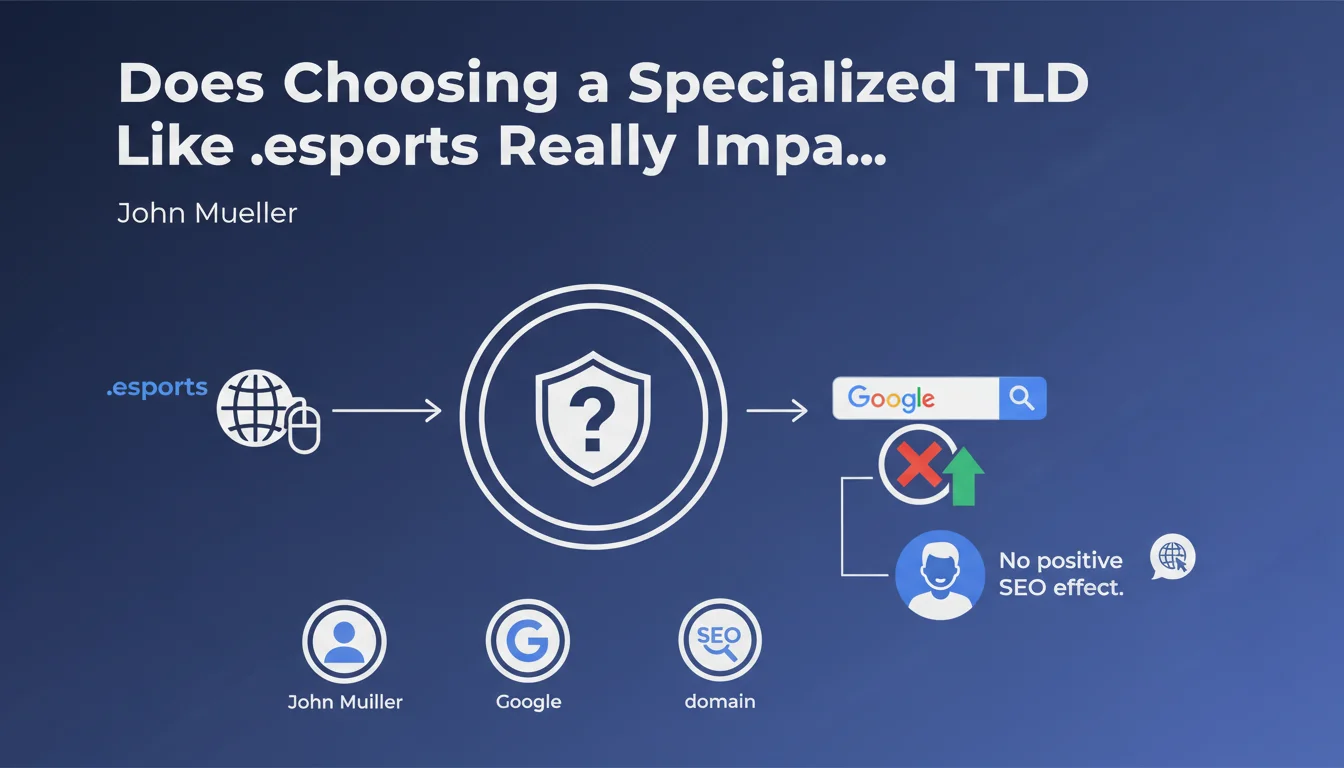
Google has just clarified its position regarding specialized top-level domains like .esports. Contrary to some popular beliefs, using a thematic TLD does not confer any direct algorithmic advantage.
This statement follows Google's ongoing messaging that all TLDs are treated equally by the algorithm. Whether you use a .com, .fr, .esports, or .xyz, the search engine does not apply any relevance bonus based solely on the extension.
John Mueller was responding to a claim on social media suggesting that a specialized TLD could improve rankings for esports-related queries. This misconception stems from a confusion between apparent semantic matching and actual ranking signals.
- Specialized TLDs offer no direct algorithmic advantage
- Google treats all top-level domains equivalently
- Content relevance takes precedence over domain extension
- TLD choice remains a marketing and branding decision, not an SEO one
SEO Expert opinion
This position from Google is perfectly consistent with the field observations we've been making for years. Many sites on exotic or specialized TLDs perform excellently, while others on classic .com domains struggle to rank.
However, an important nuance deserves to be highlighted: while the TLD is not a direct ranking factor, it can influence certain behavioral signals indirectly. An unusual or little-known TLD can affect click-through rates in the SERPs if users don't trust the extension, or conversely create a curiosity effect.
Caution with geolocated TLDs: This rule applies to generic TLDs. ccTLDs (country-code extensions like .fr, .de) still send a strong geographic signal to Google and influence local search rankings.
The real value of a specialized TLD lies in branding and memorability. An esports site on a .esports domain can benefit from better brand recognition, which will positively impact branded searches and direct traffic, two indirect signals for SEO.
Practical impact and recommendations
Following this official clarification, here are the concrete actions to integrate into your SEO strategy:
- Never justify a domain change solely to obtain a specialized TLD
- Focus your resources on content optimization rather than domain extension
- Choose your TLD based on branding, availability, and budget criteria, not SEO
- If launching a new project, prioritize a recognized and reassuring TLD for your target audience
- Invest in brand awareness that will generate positive indirect signals
- For international sites, use a strategy of subdomains or subdirectories with a neutral TLD instead
- Avoid domain migrations motivated by SEO myths about TLDs
In summary: TLD choice should be guided by marketing considerations and availability, not by hopes of non-existent SEO advantages. Focus on the fundamentals: quality content, user experience, and authority.
Implementing an effective and balanced SEO strategy requires distinguishing real ranking factors from misconceptions. These technical decisions, combined with optimizing the many other SEO levers, can quickly become complex to orchestrate. For businesses looking to maximize their visibility without spreading their efforts thin, guidance from an experienced SEO agency enables prioritizing high-impact actions and avoiding false leads that consume time and resources without tangible results.
💬 Comments (0)
Be the first to comment.