
Official statement
What you need to understand
What is Google's official position on duplicate content in legal pages?
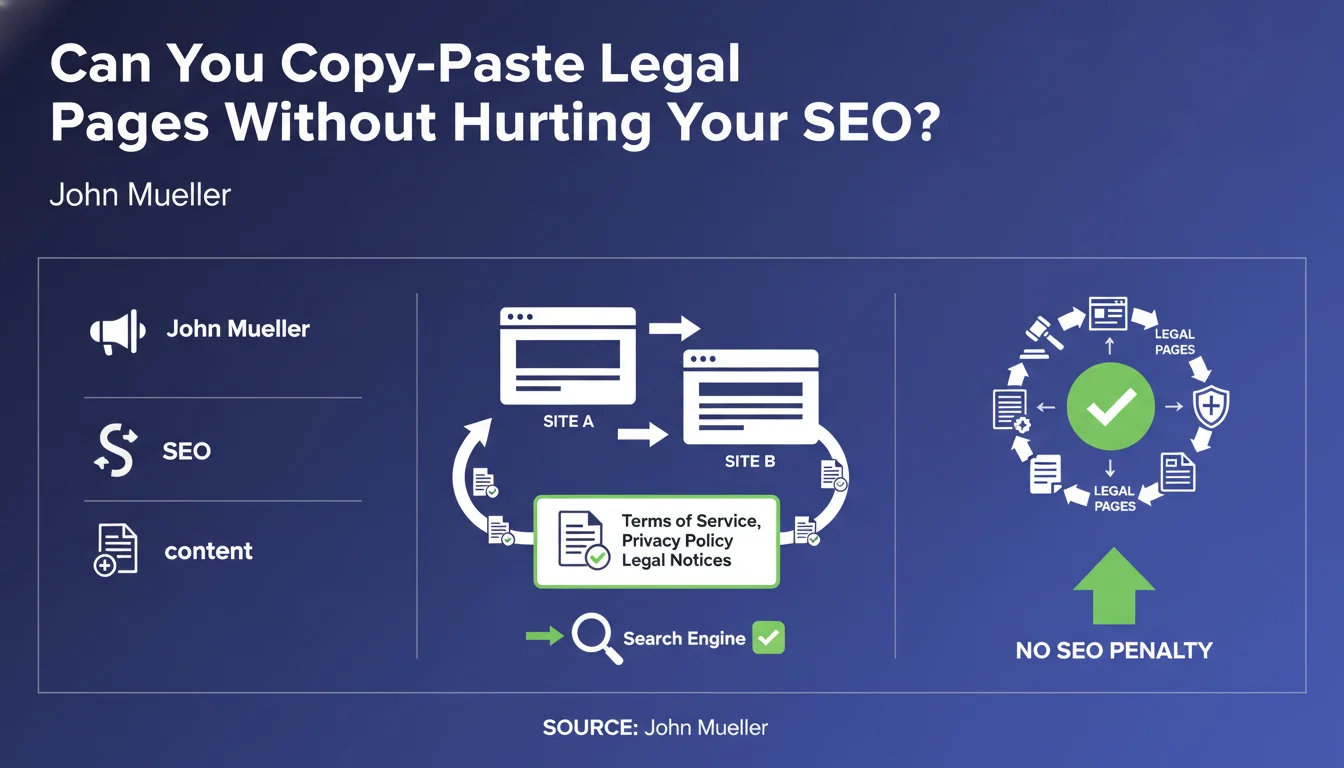
Google does not penalize content duplication on administrative pages such as Terms of Service, Terms of Sale or legal notices. John Mueller confirmed that the search engine understands the standardized nature of these texts.
This tolerance is explained by the fact that these pages fulfill legal obligations and often use similar legal language from one site to another. Google does not consider this as an attempt at manipulation.
Why are these pages treated differently from editorial content?
Legal pages have a utilitarian and regulatory function, not a referencing purpose. Google distinguishes between content intended to inform users and content intended to rank in search results.
These pages rarely appear in main search results and are generally not indexed as priority content. Their duplication therefore does not affect the overall SEO performance of the site.
What are the limits of this tolerance?
- The tolerance only concerns mandatory administrative pages (Terms of Service, Terms of Sale, legal notices, privacy policy)
- The content must be used for its legitimate legal function, not to create page volume
- Copying from a third-party site without authorization remains a copyright violation
- This rule never applies to main editorial or commercial content
SEO Expert opinion
Is this statement consistent with field observations?
After 15 years of practice, I confirm that sites with duplicated Terms of Service do not suffer any algorithmic penalty. Google has sophisticated mechanisms to identify these pages and treat them differently.
We even observe that Google often does not deeply index these pages. They appear in the index but with minimal treatment, which confirms their special status in the algorithm.
What important nuances should be added to this rule?
The distinction between administrative page and commercial content can be blurry. For example, a "Shipping Conditions" page contains legal aspects but also differentiating marketing information.
For these hybrid pages, I recommend customizing the content as much as possible. Even if Google tolerates pure duplication, unique content strengthens user trust and can become a commercial argument.
In what cases might this rule not apply?
If you create dozens of pages supposedly "legal" with duplicated content to artificially inflate the number of indexed pages, Google could see this as manipulation. Consistency and legitimacy remain essential.
Similarly, in certain regulated sectors (finance, health), Google applies stricter E-E-A-T criteria. A medical site with Terms of Service copied from a lifestyle blog could raise credibility questions.
Practical impact and recommendations
What should you do concretely for your legal pages?
For standard sites, you can use existing Terms of Service templates or consult your legal advisor without SEO concerns. The essential thing is that these texts are legally valid and adapted to your activity.
Add a noindex tag on these pages if you don't want them to appear in search results, although this is generally not necessary. Google already treats them with low priority.
- Use reliable legal templates for your Terms of Service, Terms of Sale and legal notices
- Verify that specific information (company name, address, business registration number) is properly customized
- Place these pages in the footer with discreet but accessible links
- Do not over-optimize these pages with SEO keywords
- Add a robots.txt or meta robots if you want to limit crawling of these pages
- Clearly distinguish purely legal pages from pages with commercial value
What common mistakes should you absolutely avoid?
Don't fall into the trap of creating multiple variants of legal pages with slightly modified content to generate indexable pages. This practice would be detected as manipulation.
Also avoid copying a competitor's legal pages without authorization. While Google doesn't penalize this, you expose yourself to legal action for copyright violation, especially if the text contains original formulations.
How can you optimize the overall architecture including these pages?
Integrate your legal pages into a clear architecture with a dedicated section. This reinforces the perception of professionalism and compliance, two indirect E-E-A-T factors.
For e-commerce sites or those with high legal stakes, consider having customized texts written by a lawyer. Even if duplication is tolerated, originality remains a competitive and legal advantage.
💬 Comments (0)
Be the first to comment.