
Official statement
What you need to understand
Google Tag Manager (GTM) is a powerful tool that allows you to deploy and modify tags on a website without direct technical intervention in the code. Some SEO practitioners have considered using it to test different tag configurations (meta descriptions, structured tags, etc.) in an agile manner.
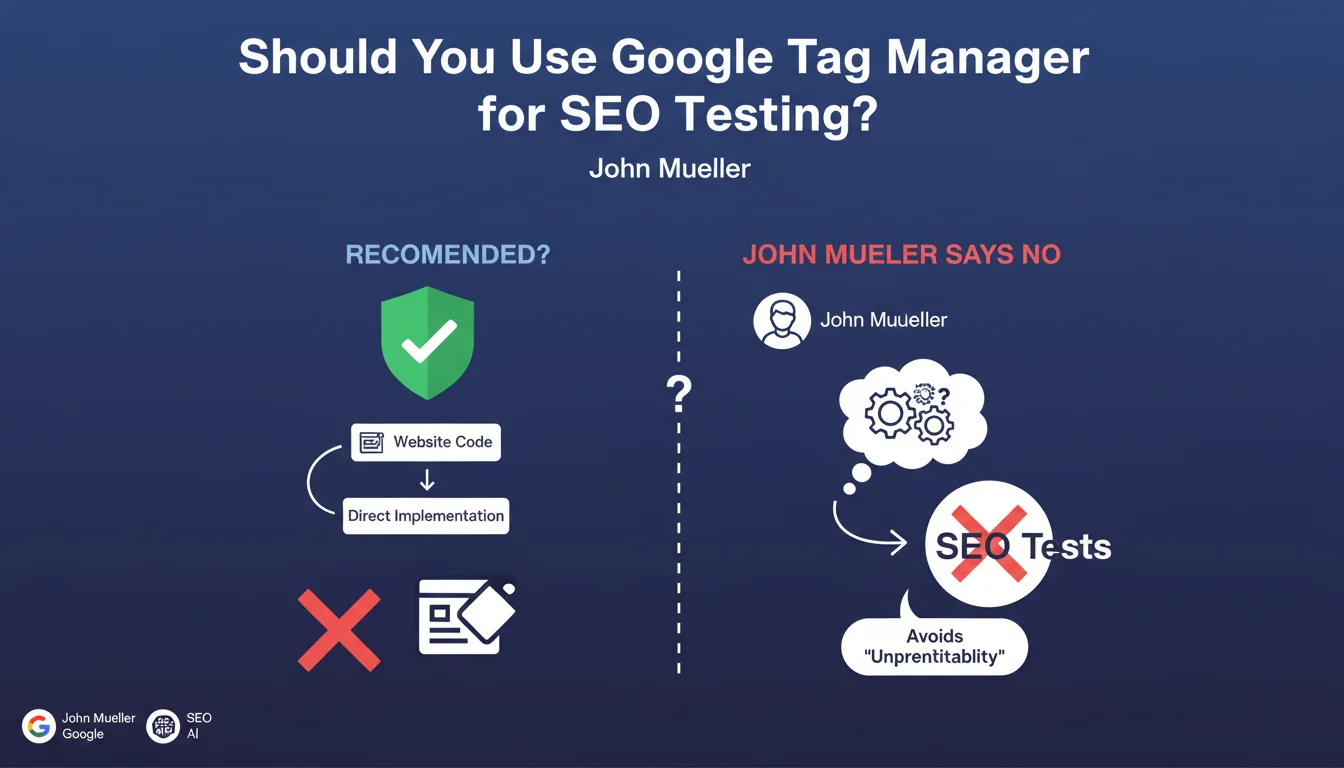
John Mueller from Google has publicly advised against this practice, citing a risk of unpredictability. Although the explanation remains unclear, this raises questions about how Googlebot interprets content loaded via JavaScript and dynamic modifications.
The main problem lies in the fact that GTM loads modifications after the initial page rendering. This can create a gap between what the user sees, what Googlebot sees during the first pass, and what appears after JavaScript execution.
- GTM modifies the DOM after the initial page load
- Frequent tag changes can disrupt quality signals
- Indexing can be inconsistent depending on the crawl timing
- A/B testing via GTM can create uncontrolled variants for search engines
- Google prefers stable and predictable HTML signals
SEO Expert opinion
This recommendation from Mueller is perfectly consistent with field observations. Sites using GTM to modify critical SEO elements do indeed experience unexplained fluctuations in their rankings. The search engine favors signal stability.
However, there are legitimate use cases for GTM in SEO: deploying complex structured data, tracking events to analyze behavior, or adding hreflang tags on multilingual architectures. The challenge is to distinguish critical elements (title, meta robots) from complementary elements.
The real limitation concerns dynamic SEO testing. Constantly modifying tags via GTM sends contradictory signals: Google may see a different version at each crawl, which damages the algorithmic trust in your site.
Practical impact and recommendations
- To avoid: Using GTM to modify title tags, meta descriptions, or canonical tags
- To avoid: Injecting main textual content or navigation links via GTM
- To avoid: Conducting SEO A/B tests with tag rotation via Tag Manager
- Acceptable: Deploying complementary schema.org structured data via GTM
- Acceptable: Adding tracking and analytics tags (not visible to the user)
- Recommended: Performing SEO tests directly in HTML code with versioning
- Recommended: Using staging environments to validate modifications before production
- Recommended: Documenting all SEO tags in your version control system (Git)
- Essential: Systematically verify server-side rendering of your critical tags
Implementing these recommendations often requires complex technical coordination between development, marketing, and SEO teams. Tag architecture, prioritization, and deployment schedule require in-depth expertise to avoid pitfalls. Many companies find that support from a specialized SEO agency allows them to structure these processes effectively, benefiting from strategic vision and personalized monitoring tailored to their specific technical context.
💬 Comments (0)
Be the first to comment.