
Official statement
What you need to understand
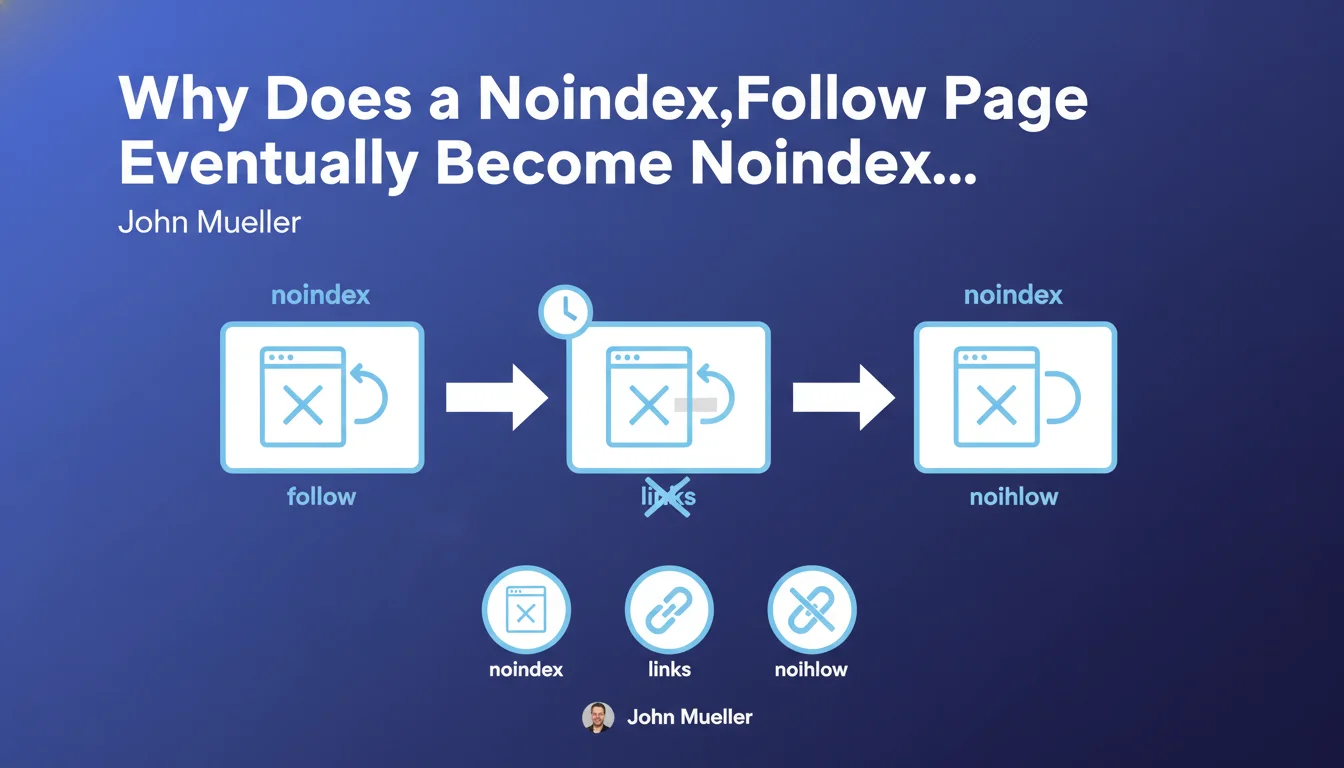
Google has clarified a lesser-known aspect of robots meta directive behavior: a page marked with noindex,follow will not remain in this state indefinitely. Over time, it will be treated as a noindex,nofollow page.
The logic is simple: once a page is deindexed following the noindex directive, Google stops crawling it regularly. Since crawl resources are limited, the search engine no longer sees the point in following links from a page that no longer exists in its index.
In practical terms, this means that the outbound links from this page will progressively lose their ability to pass PageRank or authority to target pages. This can have significant consequences on your internal link architecture.
- A noindex,follow directive is temporarily respected, but not indefinitely
- Deindexed pages are crawled less and less frequently
- Links on these pages stop being followed after a certain period
- This behavior applies regardless of the follow value specified
SEO Expert opinion
This clarification from Google is consistent with the field observations we have been making for years. In practice, we do indeed notice that pages in noindex are progressively abandoned by Googlebot, with increasingly spaced crawl intervals.
An important nuance: the timeline of this transition varies considerably. On sites with significant crawl budget and strong authority, pages in noindex,follow can continue to pass link equity for several months. On lower priority sites, this transition can be almost immediate.
This directive nonetheless remains useful for transitional situations: staging pages, temporary content to deindex, or pages undergoing redesign that you wish to temporarily remove from the index.
Practical impact and recommendations
- Audit your noindex pages: identify all pages with this directive and check whether they serve as relays in your internal linking structure
- Reorganize your link architecture: if important pages receive links only from noindex pages, create alternative pathways
- Avoid noindex for hub pages: never put pages that serve to distribute PageRank to other important sections in noindex
- Favor alternative solutions: to exclude content without breaking the link structure, use canonical tags, URL parameters in Search Console, or the robots.txt file depending on the situation
- Document your choices: keep a record of noindex pages with the reason and date, to anticipate medium-term effects
- Monitor crawl behavior: in Search Console, track the visit frequency of noindex pages to detect when Google stops crawling them
💬 Comments (0)
Be the first to comment.