
Official statement
What you need to understand
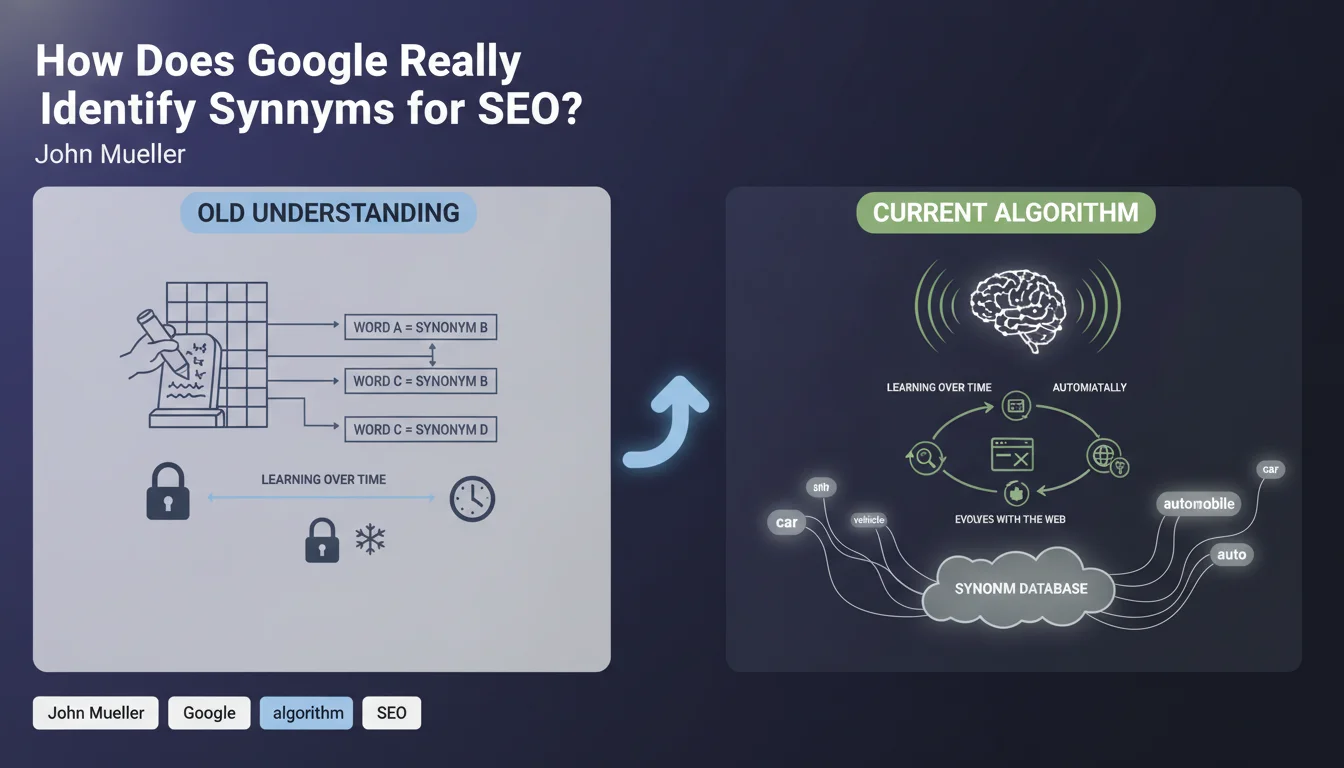
Google has confirmed that synonym identification does not rely on dictionaries pre-established by humans. Instead, the search engine uses continuous automatic learning that constantly evolves with the Web.
Unlike a fixed database, the algorithm learns semantic relationships between words dynamically. This means that the synonyms recognized today may differ from those of six months ago, based on the evolution of language on the Internet.
This machine learning-based approach allows Google to adapt to neologisms, linguistic evolutions, and usage contexts specific to each industry sector.
- Synonyms are detected automatically, not through predefined tables
- Learning is continuous and adapts to Web evolutions
- Semantic relationships vary over time and according to contexts
- Machine learning enables advanced contextual understanding
SEO Expert opinion
This statement is totally consistent with what we observe in the field. SEO professionals regularly notice that Google understands very industry-specific synonyms, sometimes even technical jargon that few traditional dictionaries reference.
The important nuance to add concerns contextual variability. Google doesn't treat all synonyms the same way: certain terms are interchangeable in one context but not in another. For example, "car" and "automobile" are synonyms, but "BMW" and "car" are not synonyms in the same way.
In highly specialized or emerging sectors, the algorithm may have less training data available, which can temporarily limit its understanding of niche synonyms.
Practical impact and recommendations
- Enrich your lexical field by writing naturally about your topic rather than forcing artificial synonyms
- Use industry-specific vocabulary from your sector: Google will learn and understand it contextually
- Analyze real queries from your users via Search Console to identify the natural variations they use
- Create evolving content that you update regularly to integrate new ways of talking about your domain
- Don't over-optimize by forcibly inserting synonyms: prioritize content fluidity and relevance
- Monitor linguistic trends in your sector and adapt your vocabulary accordingly
- Work on semantic depth: address related concepts, usage variations, and associated terms
Implementing an evolving semantic strategy requires constant monitoring and a fine understanding of Google's learning mechanisms. This complexity, combined with performance analysis and continuous vocabulary adjustment, represents a significant investment in time and expertise. For businesses looking to maximize their visibility without mobilizing substantial internal resources, support from a specialized SEO agency can prove particularly relevant to benefit from a structured approach and accumulated experience across different industry sectors.
💬 Comments (0)
Be the first to comment.