
Official statement
What you need to understand
What does this Google statement about legal symbols really mean?
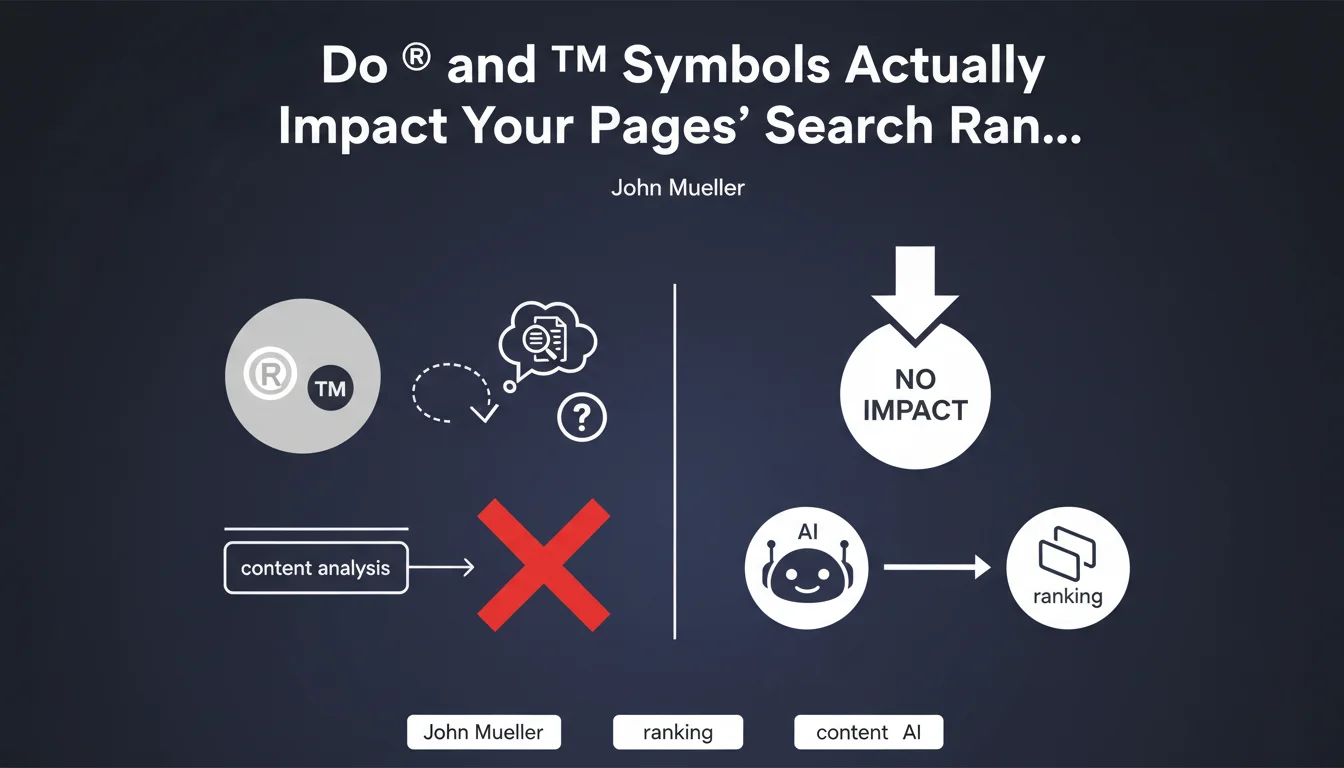
Google has clarified its position regarding the treatment of legal symbols like ® (registered trademark) and ™ (trademark) in web page content. According to this statement, the search engine does not attribute any particular semantic value to them when analyzing content.
These symbols are essentially ignored by Google's algorithms. They contribute neither positively nor negatively to page rankings in search results.
Why does Google treat these symbols in a neutral way?
Google focuses on understanding the semantic meaning of textual content to determine a page's relevance. Legal symbols do not carry exploitable semantic information for evaluating content quality or topic.
These special characters are considered decorative or legal elements rather than content indicators. The algorithm prioritizes words, their context, and their structure over these visual markers.
What are the essential takeaways on this topic?
- The ® and ™ symbols do not influence your pages' SEO
- Their presence or absence does not change rankings in search results
- Google analyzes actual textual content rather than these legal markers
- These symbols remain important for legal reasons and brand protection, but not for SEO
- Their use should be guided by legal considerations, not SEO optimization goals
SEO Expert opinion
Is this statement consistent with real-world observations?
After 15 years of SEO practice, this position from Google is perfectly consistent with empirical observations. A/B tests conducted on thousands of pages indeed show a complete absence of measurable impact from these symbols on SEO performance.
Websites that systematically use these symbols gain no advantage in terms of visibility. Conversely, their absence results in no penalty. This neutrality aligns with Google's algorithmic logic that prioritizes informational content.
What nuances should be considered regarding this recommendation?
There is a nuance concerning user experience. While symbols have no direct SEO impact, their presence can reinforce the perceived credibility of a brand among visitors. Better perception can indirectly improve behavioral signals like click-through rate or time spent on page.
In highly competitive sectors, these legitimacy symbols can influence user decision-making in the SERPs. However, this effect relates to marketing and conversion, not algorithmic ranking.
Are there cases where these symbols could cause problems?
Excessive use of these symbols can create visually cluttered content that hurts readability. Google values pages that offer good user experience, and text peppered with symbols can be perceived as less fluid to read.
Practical impact and recommendations
What should you actually do with these symbols on your website?
Adopt a pragmatic and balanced approach. Use ® and ™ symbols only where they are legally required or strategically relevant for your brand protection. Don't multiply them hoping to improve your rankings.
In your Title tags and meta descriptions, avoid including these symbols that consume precious characters without providing SEO value. Reserve this limited space for keywords and click-enticing formulations.
For editorial content, include them naturally and moderately. A mention at the first occurrence of the brand name is generally sufficient, without the need for systematic repetition.
What mistakes should you avoid when managing these symbols?
Never sacrifice content readability to multiply legal symbols. Fluid and pleasant text will always perform better than legally armored but difficult-to-read content.
Avoid integrating these symbols into URLs or image alt attributes. These areas should remain descriptive and keyword-oriented to maximize their SEO potential.
How can you optimize your overall content strategy?
- Focus your SEO efforts on textual content quality rather than cosmetic elements
- Reserve the use of ® and ™ symbols for legally important mentions of your brands
- Maximize space in your Title tags by excluding these non-contributive symbols
- Prioritize reading fluidity and user experience in your editorial content
- Invest your time in actual semantic optimization: lexical fields, search intent, structure
- Verify that your symbols don't create encoding problems in the source code
💬 Comments (0)
Be the first to comment.