
Official statement
What you need to understand
What is Google's official position on reviews and surveys?
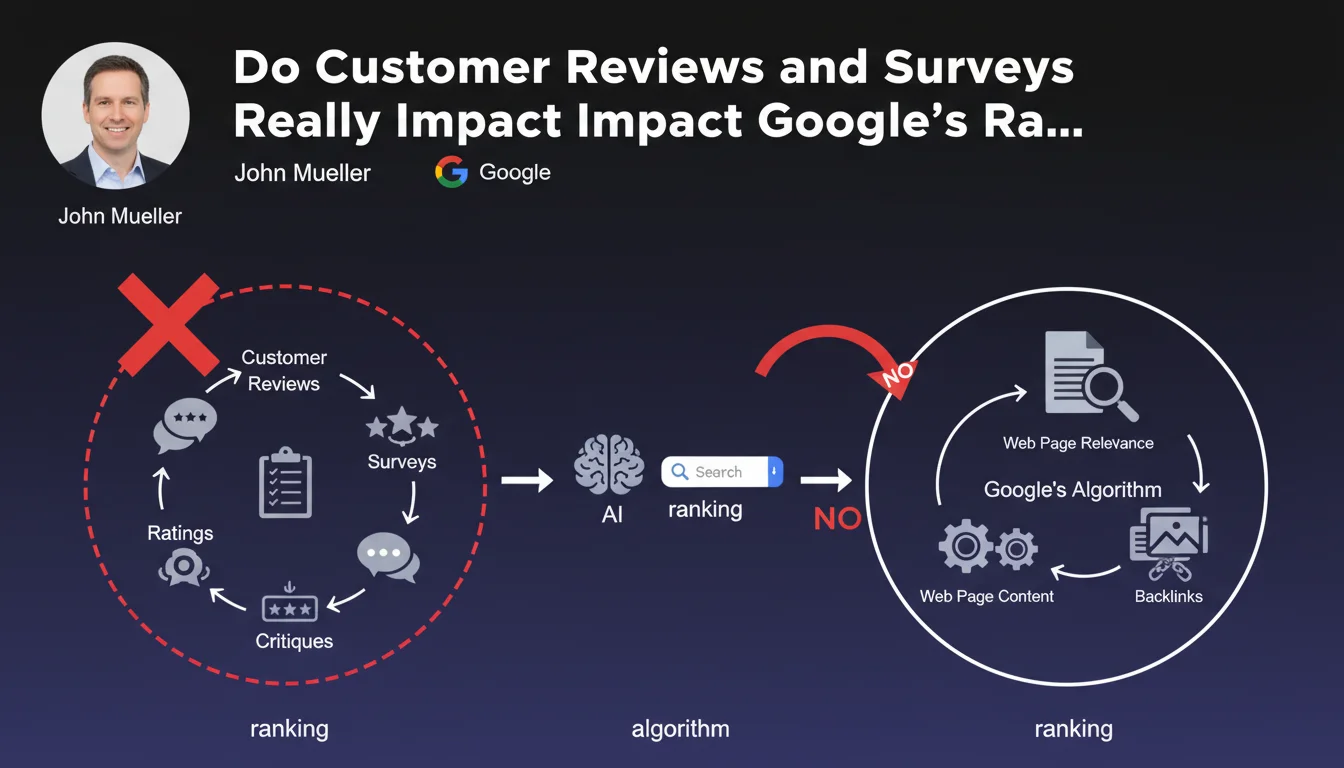
Google has clearly stated that data from surveys, reviews, ratings, or critiques is not used by its main algorithm to evaluate a web page's relevance for a given query. This means that a page with hundreds of positive reviews won't achieve better organic ranking for that reason alone.
This position may seem counterintuitive for SEO practitioners accustomed to valuing social signals and social proof. Yet it reflects the clear separation between classic ranking algorithms and specialized systems like local SEO.
Why doesn't Google factor this data into its main algorithm?
The main reason is both technical and qualitative. Reviews and surveys are easily manipulated, making them unreliable signals for an algorithm seeking to measure the objective quality of content. Google favors more robust criteria such as content quality, domain authority, and semantic relevance.
Additionally, this data is often heterogeneous and difficult to standardize: different formats, multiple sources, varied contexts. Integrating it into the main algorithm would unnecessarily complicate the system without providing measurable value.
Does this rule apply everywhere without exception?
No, and this is crucial to understand. Google has explicitly mentioned a major exception for local SEO. Reviews left on Google My Business do indeed play a role in ranking local results in the Knowledge Panel and Local Pack.
This nuance is fundamental: the main algorithm and local algorithm work differently. For geolocated searches, the quantity, quality, and freshness of Google reviews constitute an officially recognized ranking factor.
- Main algorithm: reviews and surveys are not ranking factors
- Local SEO: Google My Business reviews directly influence positioning
- Reviews can indirectly impact click-through rate and therefore performance
- Social proof remains important for conversion and user experience
- Review rich snippets can improve SERP visibility without impacting ranking
SEO Expert opinion
Is this statement consistent with what we observe in the field?
After 15 years of experience, I confirm that Google's position is perfectly consistent with empirical observations. We've tested pages with and without review systems, and no direct correlation with organic ranking has been found in classic natural results.
However, there is a significant indirect effect. Pages displaying positive reviews often generate higher click-through rates in SERPs thanks to stars displayed via rich snippets. This better CTR can, over time, send positive signals to Google about user satisfaction.
What important nuances should be added to this statement?
The first nuance concerns user-generated content. While ratings themselves don't count, the text of reviews constitutes additional content that semantically enriches the page. Hundreds of detailed reviews can improve thematic coverage and long-tail SEO.
The second nuance relates to behavioral signals. A page with excellent reviews converts better, retains visitors longer, and generates less bounce. These engagement metrics can influence ranking even if raw ratings don't.
In what cases does this rule have limitations or exceptions?
Beyond the already-mentioned local SEO, certain situations create interesting gray areas. For e-commerce sites, third-party review platforms (Trustpilot, Verified Reviews) can generate backlinks and brand mentions that do impact SEO.
Moreover, in sensitive sectors like health or finance, Google is placing increasing importance on E-E-A-T signals. In this context, reviews from recognized experts (even if not algorithmically processed like regular reviews) can contribute to establishing a site's authority.
Practical impact and recommendations
What should you actually do with review systems on your site?
Absolutely continue collecting and displaying reviews, but for the right reasons. Their primary value lies in conversion, user trust, and SERP display via rich snippets. Properly implement schema.org markup to maximize chances of obtaining stars in search results.
For local SEO, focus your efforts on Google My Business. Actively encourage your customers to leave detailed reviews and systematically respond to each one. The freshness and volume of Google reviews are powerful levers for the Local Pack.
What common mistakes should you absolutely avoid?
The main mistake would be to neglect reviews on the grounds that they don't impact organic SEO. Their influence on CTR, engagement, and conversion is massive. Don't fall into the trap of fake reviews either, which can trigger manual penalties and destroy your reputation.
Another frequent error: implementing schema.org markup incorrectly. Poorly configured structured data can prevent stars from displaying in SERPs or, worse, generate manual actions from Google for markup spam.
How can you optimize your review strategy to maximize overall SEO impact?
Adopt a holistic approach that recognizes the multiple benefits of reviews. Create a systematic post-purchase collection process, integrate reviews into your product pages to enrich content, and use customer feedback to improve your descriptions.
For local businesses, develop an aggressive but authentic Google My Business review acquisition strategy. Train your teams to solicit reviews at the right time, facilitate the process with short links, and monitor your online reputation daily.
- Implement schema.org markup (Review, AggregateRating) to display stars in SERPs
- Validate markup with Google's Rich Results Test tool
- Create an automated post-purchase review collection process via email
- For local SEO: absolutely prioritize Google My Business reviews
- Systematically respond to all reviews, both positive and negative
- Integrate text reviews on product pages to enrich semantic content
- Monitor volume and average rating to quickly detect anomalies
- Absolutely avoid fake reviews or review exchange systems
- Use customer feedback to improve descriptions and content
- Create optimized landing pages that naturally integrate testimonials
💬 Comments (0)
Be the first to comment.