
Official statement
What you need to understand
What Does Google Actually Say About the Role of Negative Reviews in Local SEO?
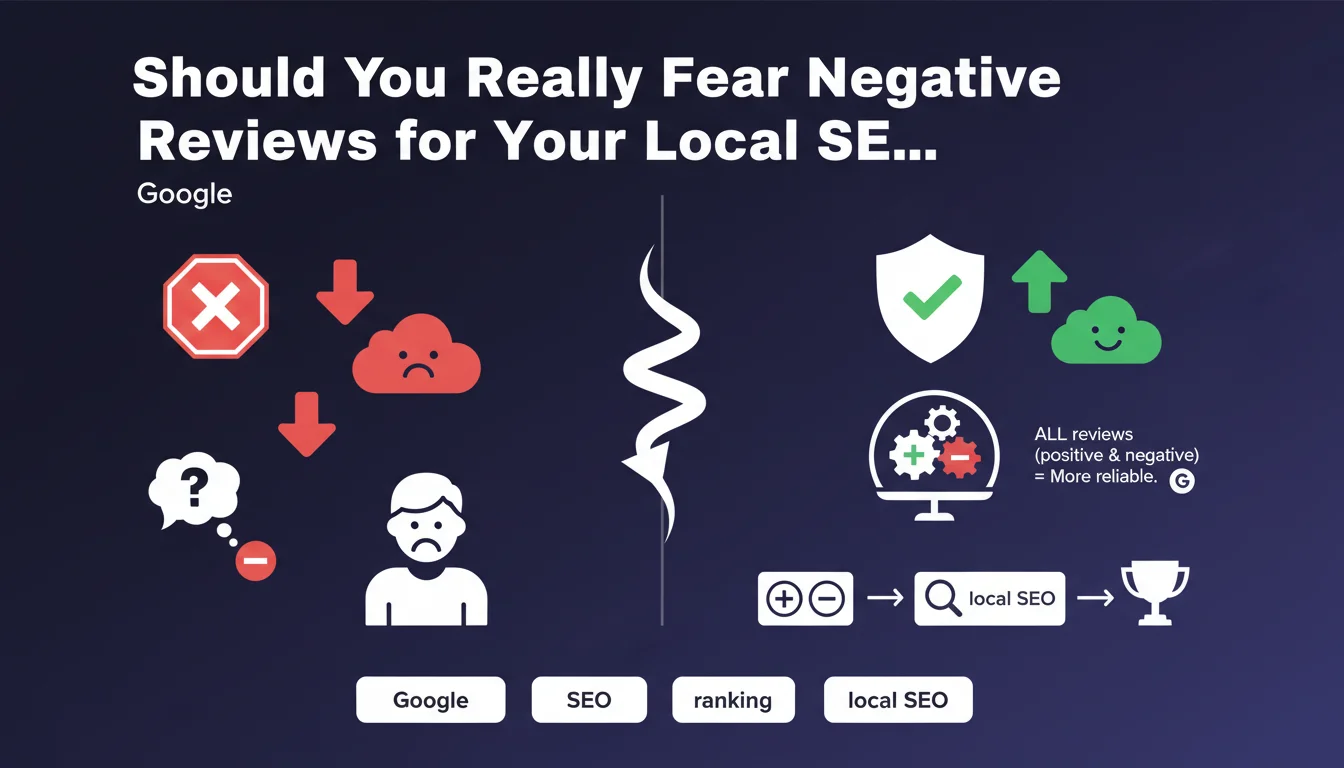
Google has recently clarified its position regarding customer reviews displayed on Google Business Profile listings. According to this update, the algorithm takes into account all reviews, whether positive or negative.
Even more surprisingly, Google states that a profile presenting a mix of positive and negative reviews appears more authentic and therefore more trustworthy in the eyes of the algorithm. This approach aims to promote transparency and discourage manipulation.
Why Does Google Prioritize Review Quantity Over Average Rating?
The volume of reviews constitutes a signal of popularity and actual business activity. An establishment with 200 reviews at 4.3/5 will generally rank better than a competitor with 15 reviews at 5/5.
This logic is explained by the difficulty of manipulating a large number of authentic reviews. Google therefore values businesses that naturally generate customer feedback, a sign of sustained activity and genuine interaction with clientele.
What Are the Key Criteria Google Evaluates in Customer Reviews?
- Total review volume: primary ranking factor in local SEO
- Recency of reviews: recent reviews signal ongoing activity
- Consistency: a steady flow of reviews appears more natural than a sudden spike
- Rating diversity: a realistic mix strengthens credibility
- Responses to reviews: owner engagement is a positive signal
- Length and content: detailed reviews have more value than generic ones
SEO Expert opinion
Is This Statement Consistent with Field Observations from SEO Practitioners?
Absolutely. Correlation analyses in local SEO have confirmed for years that the number of reviews takes precedence over average rating. Studies show that an establishment with a score of 4.2/5 and 300 reviews regularly outperforms a competitor at 4.8/5 with only 50 reviews.
This statement formalizes what experts have been observing empirically. It also legitimizes a more transparent approach to review management, where a few negative reviews should not be perceived as catastrophic but rather as opportunities for visible improvement.
What Nuances Should Be Applied to This General Rule?
While volume takes priority, average rating remains important for two reasons. First, it directly influences users' click-through rate in search results. Second, a rating that's too low (below 3.5/5) can trigger algorithmic penalties.
Review freshness also plays a crucial role. An establishment with 500 reviews but no feedback for 6 months will send an inactivity signal to Google. The ideal remains a regular flow of recent reviews, even if they're not all glowing.
In What Cases Does This Rule Not Fully Apply?
For ultra-sensitive sectors (healthcare, financial services, security), average rating weighs more heavily than in other domains. Users are more reluctant to choose a service provider with a rating below 4/5, even with substantial volume.
Similarly, in areas with high local competition, top results often display both high volume AND excellent ratings. In this context, focusing solely on quantity without monitoring quality becomes insufficient to reach the top 3 of the Local Pack.
Practical impact and recommendations
What Should You Actually Do to Optimize Your Review Strategy?
Focus on the regular acquisition of authentic reviews rather than pursuing the perfect rating. Implement a systematic process to solicit feedback after each transaction or service.
Integrate strategic touchpoints: follow-up emails, QR codes at point of sale, direct links in your signatures. The goal is to make the process as easy as possible for your satisfied customers who constitute your natural pool of positive reviews.
Respond to all reviews, particularly negative ones. A professional and constructive response transforms a negative review into a demonstration of your customer commitment. Google values this level of interaction in its local ranking algorithm.
What Absolute Mistakes Should You Avoid Regarding Customer Reviews?
- Never buy fake reviews: Google detects suspicious patterns and can remove your listing
- Avoid artificial spikes: solicit reviews progressively and naturally
- Don't ignore negative reviews: lack of response is perceived negatively by both the algorithm and users
- Don't only encourage satisfied customers: this creates a review profile that appears suspicious to Google
- Avoid generic wording: encourage your customers to leave detailed and personalized reviews
- Don't neglect temporal diversity: maintain a steady flow rather than sporadic campaigns
How Can You Set Up a High-Performing Review Management System?
Use monitoring tools to receive real-time alerts for new reviews. This allows you to react quickly, especially to negative feedback that requires immediate attention.
Establish customizable response templates for different types of reviews. This speeds up your response time while maintaining communication quality. Train your team on the importance of reviews for your local visibility.
Regularly analyze the keywords and recurring themes in your reviews. These insights help you identify your strengths to highlight and concrete areas for improvement.
💬 Comments (0)
Be the first to comment.