
Official statement
What you need to understand
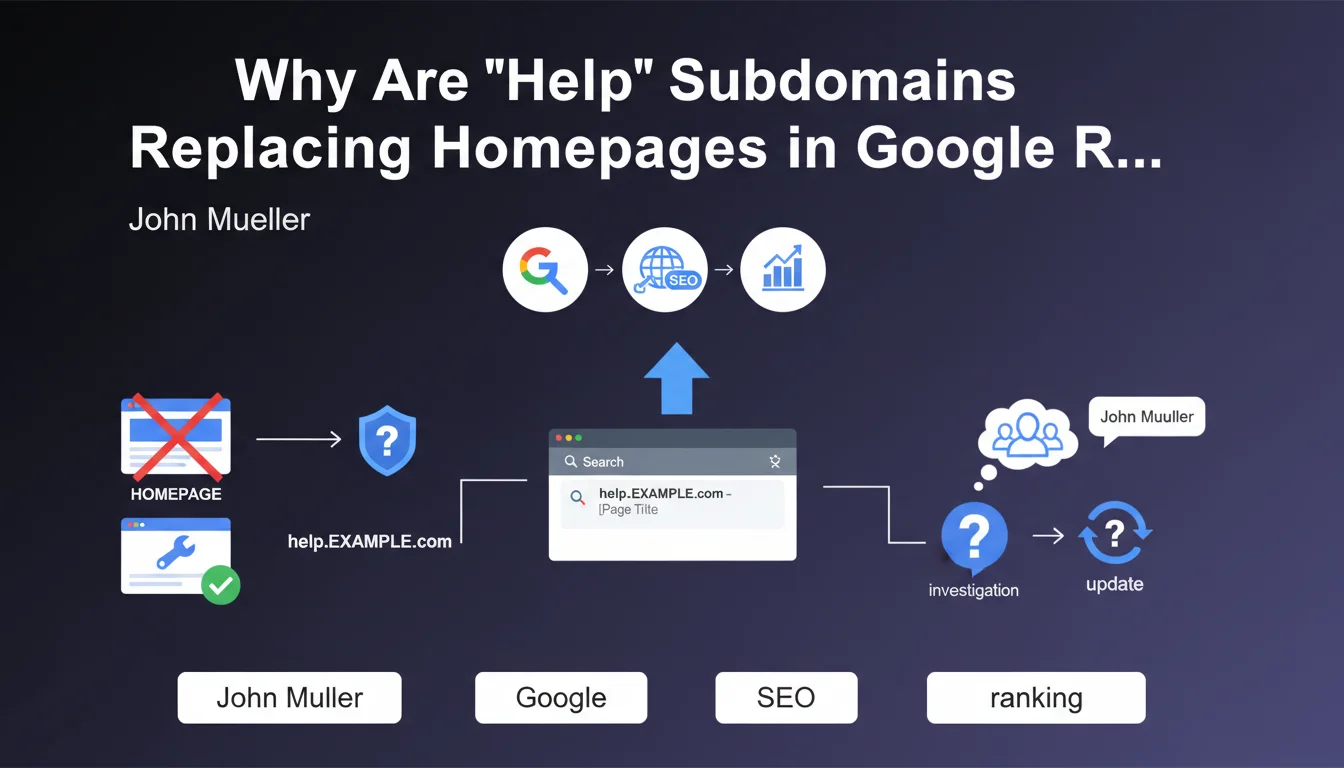
Google has identified an unusual ranking bug primarily affecting adult sites. The problem manifests itself through abnormal behavior: the help subdomain (help.) appears in search results in place of the site's main homepage.
This malfunction is not isolated and seems to affect multiple sites simultaneously, though in a geographically uneven manner. Some regions are reporting this issue while others observe no anomalies, which suggests a gradual rollout or a localized algorithmic bug.
John Mueller confirmed that the Google team is actively investigating this situation, indicating that this is a recognized technical issue on Google's end and not a penalty or intentional algorithm change.
- A ranking bug is affecting the normal hierarchy of pages in the SERPs
- Help subdomains are taking the place of main pages
- The problem affects multiple sites but varies by region
- Google acknowledges the problem and is working on a fix
- This is a technical malfunction, not a penalty
SEO Expert opinion
This type of bug reveals the complexity of Google's subdomain management. Even though the algorithm generally treats subdomains as semi-independent entities, conflicting signals can sometimes disrupt the normal hierarchy. This may be related to popularity or authority signals being temporarily misinterpreted.
What's particularly interesting is that this specifically affects adult sites. These sites often operate in an algorithmic gray zone where Google applies specific filters and rules. It's possible that recent adjustments to these filters created unexpected side effects on subdomain prioritization.
The geographic variability of the problem also suggests that Google is testing or deploying algorithmic changes progressively, a common practice but one that can create temporary inconsistencies that are difficult for SEO professionals to diagnose.
Practical impact and recommendations
- Check your subdomain architecture: Regularly audit how your different subdomains appear in search results for your brand
- Strengthen main domain signals: Ensure that your homepage receives sufficient internal links and authority signals compared to secondary subdomains
- Use canonical tags correctly: Verify that your subdomains aren't sending contradictory signals that could confuse the algorithm
- Monitor multi-region SERPs: If you operate internationally, test your rankings from different locations to detect geographic variations
- Document anomalies: If you notice this type of problem, keep dated screenshots and Search Console reports to facilitate diagnosis
- Don't panic immediately: If a secondary subdomain temporarily appears in place of your main page, wait a few days before undertaking major structural changes
- Optimize your link structure: Strengthen internal linking pointing to your main domain to clarify your site's hierarchy
💬 Comments (0)
Be the first to comment.