
Official statement
What you need to understand
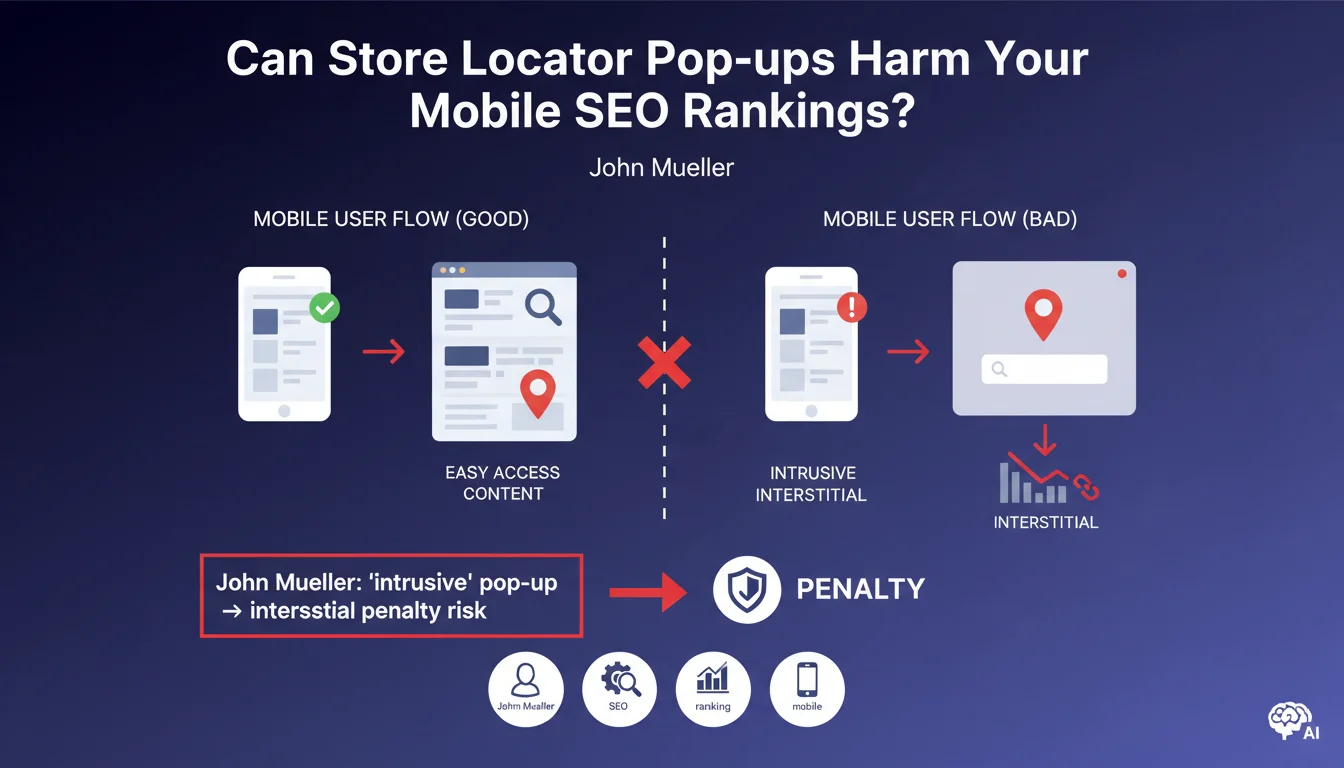
Google has clarified its position regarding store locator pop-ups that appear immediately when a mobile user arrives on a site. These windows inviting users to choose the nearest store can be considered intrusive interstitials.
Since January 2017, Google has applied an algorithmic penalty against sites that display interstitial content that is difficult to close or that hides the main content. Store locator pop-ups, even if they seem useful, may fall into this category.
The problem lies in the mobile user experience: a visitor who arrives on your site via search results expects to immediately access the content they were looking for. A pop-up that blocks access degrades this experience.
- Store locator pop-ups can trigger an interstitial penalty
- The impact specifically manifests on the mobile version of the site
- The penalty affects ranking in mobile search results
- Pop-ups that appear immediately upon arrival are most at risk
SEO Expert opinion
This position from Google is perfectly consistent with its Mobile-First philosophy and its objective of improving user experience. In practice, we indeed observe sites with intrusive store locators that struggle to maintain their mobile positions.
An important nuance: Google does not penalize all localization systems. Small discreet banners at the top or bottom of the page, easily closable, generally pose no problem. Similarly, mechanisms triggered by voluntary user action (clicking a "Find a store" button) are acceptable.
The real challenge for retailers with physical networks is to find the balance between commercial conversion and SEO compliance. A poorly implemented store locator can be costly in terms of organic visibility.
Practical impact and recommendations
- Immediately audit your mobile version to identify any localization pop-up that automatically displays upon arrival
- Replace intrusive pop-ups with discreet banners (sticky header/footer) that are easily closable
- Implement geolocation only after voluntary user action (clicking "Find a store")
- Use persistent icons (location pin) that are always visible but non-intrusive
- Test with Google's Mobile-Friendly tool in Search Console to verify that no problematic interstitials are detected
- Monitor your mobile performance in Search Console after any store locator changes
- Favor dedicated localization pages accessible through clear navigation rather than pop-ups
- Implement schema.org LocalBusiness markup to improve local visibility without resorting to pop-ups
Strategic recommendation: Redesigning a localization system requires a comprehensive approach that balances UX, conversions, and SEO compliance. Mobile architecture must be rethought, user journeys adjusted, and the impact on organic performance precisely measured.
These optimizations often involve complex technical decisions and delicate strategic trade-offs. To ensure optimal implementation that preserves both your SEO visibility and your business objectives, support from a specialized SEO agency can prove valuable for navigating these constraints and deploying a custom solution tailored to your specific context.
💬 Comments (0)
Be the first to comment.