
Official statement
What you need to understand
What does this statement about Google's memory really mean?
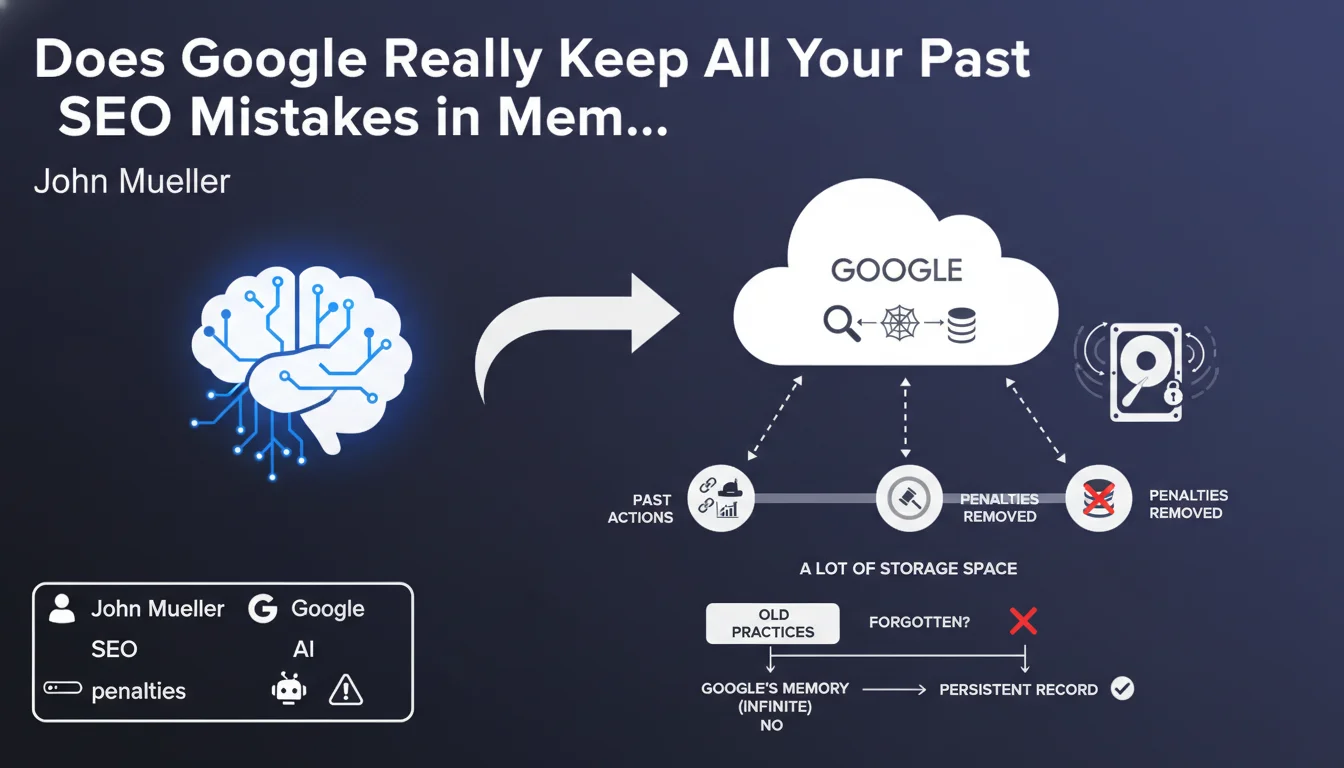
John Mueller confirmed that Google has virtually unlimited storage capacity to preserve the history of websites. Contrary to popular belief, the search engine doesn't erase traces of past practices.
This means that all manipulation attempts, even old ones, remain in Google's databases. Even when a manual penalty is lifted, the history of violations remains accessible.
- Google indefinitely preserves the complete history of a website
- Old manipulation practices remain visible in their systems
- Lifting a penalty doesn't erase the history of violations
- This memory potentially influences the trust granted to the site
Why does Google keep this historical information?
This preservation allows Google to build a trust profile for each website. The algorithm can thus identify behavioral patterns over the long term.
A site with a history of manipulation, even corrected, could be monitored more closely than a site with a historically impeccable behavior. This memory also helps detect repeat offenses.
Which practices remain particularly memorized by Google?
Spam attempts and artificial link schemes are particularly significant. Google keeps traces of link networks, cloaking, massive duplicate content.
Manual penalties, even removed, leave a lasting imprint. Link disavowal actions, brutal structure modifications, and domain changes are also archived.
SEO Expert opinion
Does this statement match what we observe in the field?
My 15 years of experience fully confirm this position. I've observed sites that, years after a Penguin penalty, still encounter disproportionate difficulties during link building attempts.
A site with a clean history generally recovers much faster after a technical issue than a site with a troubled past. The notion of "trust" indeed seems linked to the complete history.
What nuances should be added to this statement?
If Google keeps everything, it doesn't mean that everything carries the same weight in the current algorithm. Old practices may be weighted differently depending on their age.
A site that made mistakes 5 years ago but has been maintaining exemplary behavior for 3 years can progressively regain trust. Positive consistency probably matters more than the impossible erasure of the past.
In which cases can this memory ultimately prove neutral?
For sites that have suffered negative SEO attacks clearly identified and disavowed, Google seems capable of contextualizing the history. The search engine distinguishes voluntary actions from external attacks.
Ownership changes documented via Google Search Console can also allow a certain reset of the trust level, although the technical history remains present.
Practical impact and recommendations
What should you do concretely facing this reality?
The absolute priority is to build an impeccable history starting now. Every SEO decision must be thought out for the long term, not for quick gains.
If your site has a problematic past, document all your corrective actions in Search Console. Show Google a clear and lasting change in practices.
- Audit the complete history of your domain before any SEO strategy
- Check the history of an expired domain before purchasing it (Archive.org, Wayback Machine)
- Document all your corrective actions in Google Search Console
- Systematically prioritize white-hat practices, even if they take more time
- Proactively clean your link profile to avoid any future ambiguity
- Keep your own archives of SEO actions to trace your evolution
What mistakes should you absolutely avoid to preserve your history?
Never attempt to quickly manipulate your ranking with borderline techniques. The negative impact on your Google history will last for years, well beyond the temporary benefit.
Also avoid brutal and undocumented changes. Any major modification (migration, redesign, structure change) must be planned and tracked in Search Console.
Never buy a domain without a thorough historical audit. A domain name with a bad past can handicap your project for years.
How can you check and improve your site's historical reputation?
Use Google Search Console to review the history of manual actions and reported issues. Analyze your site's archives via Archive.org to understand its evolution.
Examine your historical link profile with tools like Ahrefs or Majestic by activating the temporal view. Identify suspicious periods and document the corrections made.
💬 Comments (0)
Be the first to comment.