
Official statement
What you need to understand
What is Google's current capability to analyze podcasts?
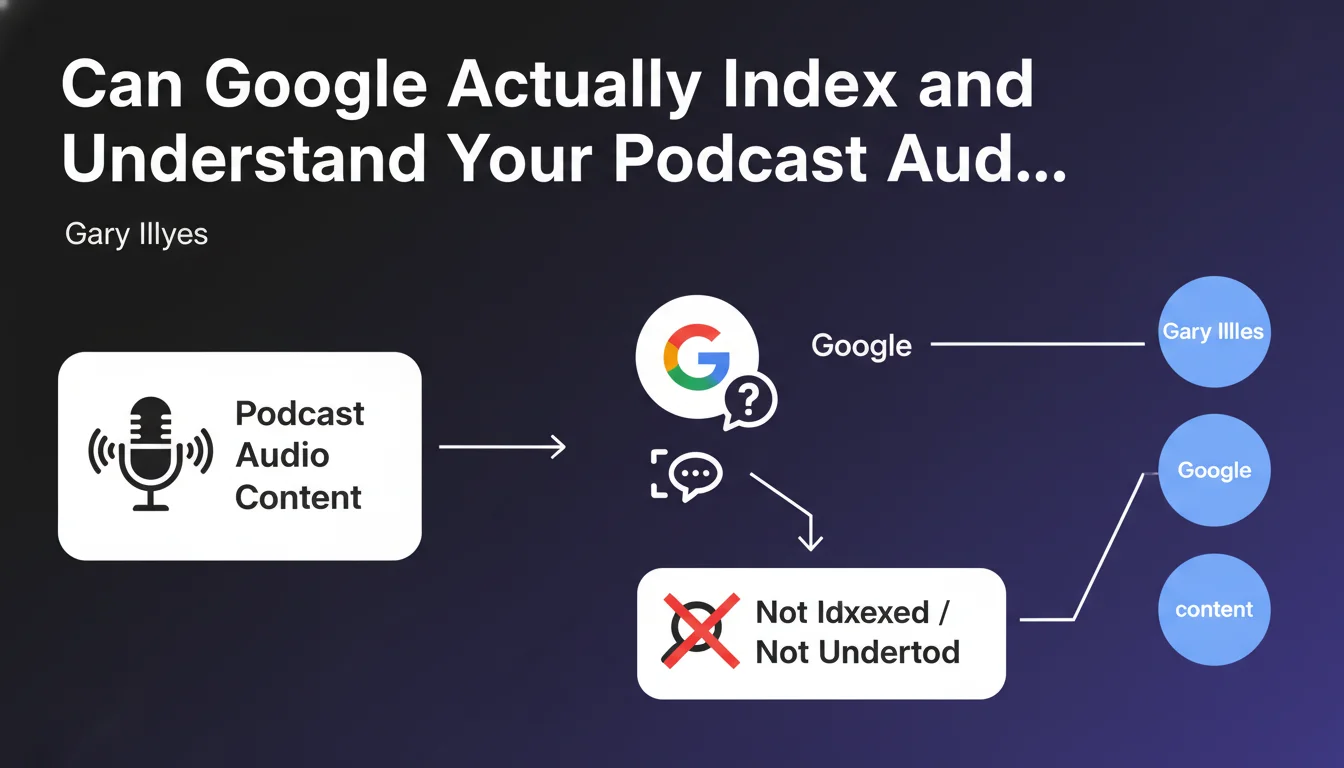
Google has officially confirmed that its search engine does not currently have a voice recognition system to analyze the audio content of podcasts embedded on websites. Unlike text files, images, or videos with transcriptions, pure audio files remain opaque to Google's algorithms.
This technical limitation means that all the spoken content in your podcasts is invisible to the indexing bot. Google cannot understand the words spoken, evaluate the quality of the audio content, or associate it with relevant search queries.
Why does this limitation create problems for SEO?
Podcasts represent a rapidly growing content format, with enormous potential for capturing a qualified audience. However, without audio reading capability, Google cannot value this content in its organic search results.
Your podcast episodes, no matter how rich and informative they may be, contribute absolutely nothing to your natural search rankings if they remain only in audio format. You're missing out on major opportunities for visibility and organic traffic.
What elements can Google analyze on a podcast page?
- The page title and meta description tags associated with the podcast
- Introduction texts and written descriptions accompanying the audio player
- Text transcriptions if they are present on the page
- Structured data tags Schema.org specific to podcasts
- Comments and user interactions in text format
- Standard technical elements: loading time, responsive design, HTML structure
SEO Expert opinion
Does this statement align with real-world observations?
Absolutely. Tests and observations conducted on thousands of sites with podcasts confirm that only textual elements generate organic traffic. Pages with only an audio player and minimal title achieve consistently poor SEO performance.
On the other hand, sites that invest in complete transcriptions see spectacular visibility gains. Some episodes can rank for dozens of long-tail keywords thanks to the full text, while the audio version alone would remain invisible.
Should we expect this limitation to evolve soon?
Google obviously has the necessary voice recognition technology, as proven by Google Assistant or YouTube (which automatically transcribes videos). However, the current absence seems to be a strategic and technical choice rather than an impossibility.
Massive audio processing would require colossal server resources for uncertain ROI. In the medium term, an evolution is possible, but no official signal announces it. It's therefore better to act now rather than wait for a hypothetical update.
Do audio files have an indirect impact on SEO?
Yes, but only through behavioral signals. A captivating podcast can increase time spent on the page, reduce bounce rate, and generate positive engagement signals. These UX metrics indirectly influence search rankings.
Additionally, a good podcast naturally generates word-of-mouth, social shares, and backlinks to your page. These off-page factors contribute to your overall authority, even if the audio content itself remains invisible to Google.
Practical impact and recommendations
What should you actually do to optimize your podcasts?
The most effective solution remains the full transcription of your episodes. Publish the complete text directly on the page hosting the audio player. This approach maximizes your crawl surface and allows ranking on a multitude of queries.
Beyond raw transcription, structure the content with headings, paragraphs, and bullet lists. Add an SEO-optimized introduction summarizing the key points. Enrich with internal links to other relevant content on your site.
Implement Schema.org structured data specific to PodcastEpisode and PodcastSeries types. This helps Google better understand the nature of the content and can generate rich snippets in search results.
What critical mistakes should you absolutely avoid?
- Never publish only an audio player without any substantial textual content
- Avoid unreviewed automatic transcriptions, often riddled with errors that harm credibility
- Don't hide transcriptions behind tabs or accordions closed by default (less valued content)
- Don't simply duplicate show notes from your podcast host without SEO optimization
- Avoid neglecting metadata: page title, meta description, optimized H1/H2 tags
- Don't forget to optimize loading speed, especially if you're hosting heavy audio files
How can you verify and measure the effectiveness of your podcast SEO strategy?
Use Google Search Console to identify which episodes generate organic traffic and on which queries. Analyze pages with transcriptions versus those without text to measure the performance gap.
Monitor the indexing rate of your podcast pages and any error messages. Verify that your structured data is correctly detected via Google's rich results testing tool.
Measure engagement metrics: time on page, bounce rate, interactions. Compare them between episodes to identify the most successful formats and topics, then adjust your editorial strategy accordingly.
💬 Comments (0)
Be the first to comment.