
Official statement
What you need to understand
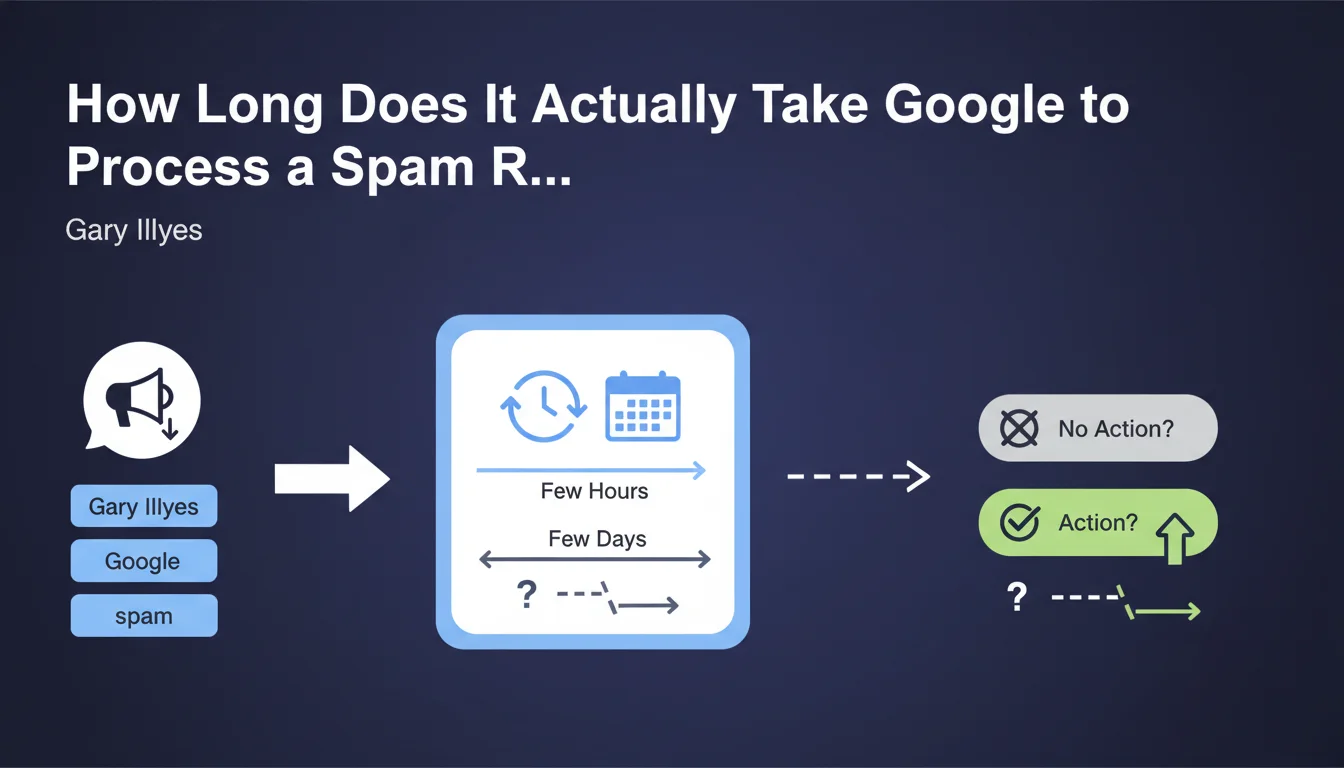
Google has clarified its position regarding spam reports and their use by SEO professionals. Contrary to what many might think, it's not necessary to have absolute certainty that a practice constitutes spam before reporting it to Google's teams.
This statement acknowledges a field reality: Google's guidelines are not always 100% transparent, and certain practices fall into a gray area. A report can serve as an indicator for Google to conduct its own investigation.
The spam report thus becomes a reporting tool rather than a formal denunciation. Google uses this information as input data to identify suspicious patterns and refine its detection algorithms.
- "Uncertain" spam reports are accepted and can be useful
- Google will conduct its own investigation following the report
- This doesn't mean you should systematically report everything that seems suspicious
- The intention is to help Google identify borderline practices
- The context and quality of the report remain important
SEO Expert opinion
This position is consistent with the evolution of Google's approach in recent years. The search engine implicitly recognizes that its own rules can be subject to interpretation and that the SEO community can help it detect emerging tactics.
Nevertheless, important nuances should be noted. This openness should not be interpreted as encouragement to massively report your competitors. Abusive use could discredit your future reports and create unnecessary noise in the system.
In practice, this approach works better for large-scale manipulation schemes: suspicious link networks, mass-generated automated content, or sophisticated cloaking tactics. For aggressive but isolated optimizations, the impact will likely be limited.
Practical impact and recommendations
- Document suspicious practices with concrete evidence (screenshots, URLs, observed patterns)
- Prioritize reporting systematic schemes rather than isolated optimizations
- Use spam reports for borderline cases where you have legitimate doubts, not to harm competition
- Focus your reports on practices that clearly degrade user experience
- Avoid massive or automated reporting that could be counterproductive
- Keep track of your reports to observe whether Google takes action following your submissions
- Never consider spam reporting as an offensive SEO strategy to demote competitors
- Focus first on improving your own site rather than on systematic reporting
Competitive monitoring and spam detection require in-depth expertise to distinguish legitimate practices from actual manipulation. Analyzing suspicious backlinks, identifying site networks, or evaluating content quality requires sharp technical skills. For businesses looking to maintain a healthy competitive environment while developing their own visibility ethically, guidance from a specialized SEO agency can prove valuable for navigating these gray areas and making the right strategic decisions.
💬 Comments (0)
Be the first to comment.