
Official statement
What you need to understand
What does this statement actually mean for AMP sites?
Google clarifies a recurring technical question regarding the indexing of AMP pages. Contrary to what many believe, it is not necessary to create a separate XML sitemap for your AMP pages.
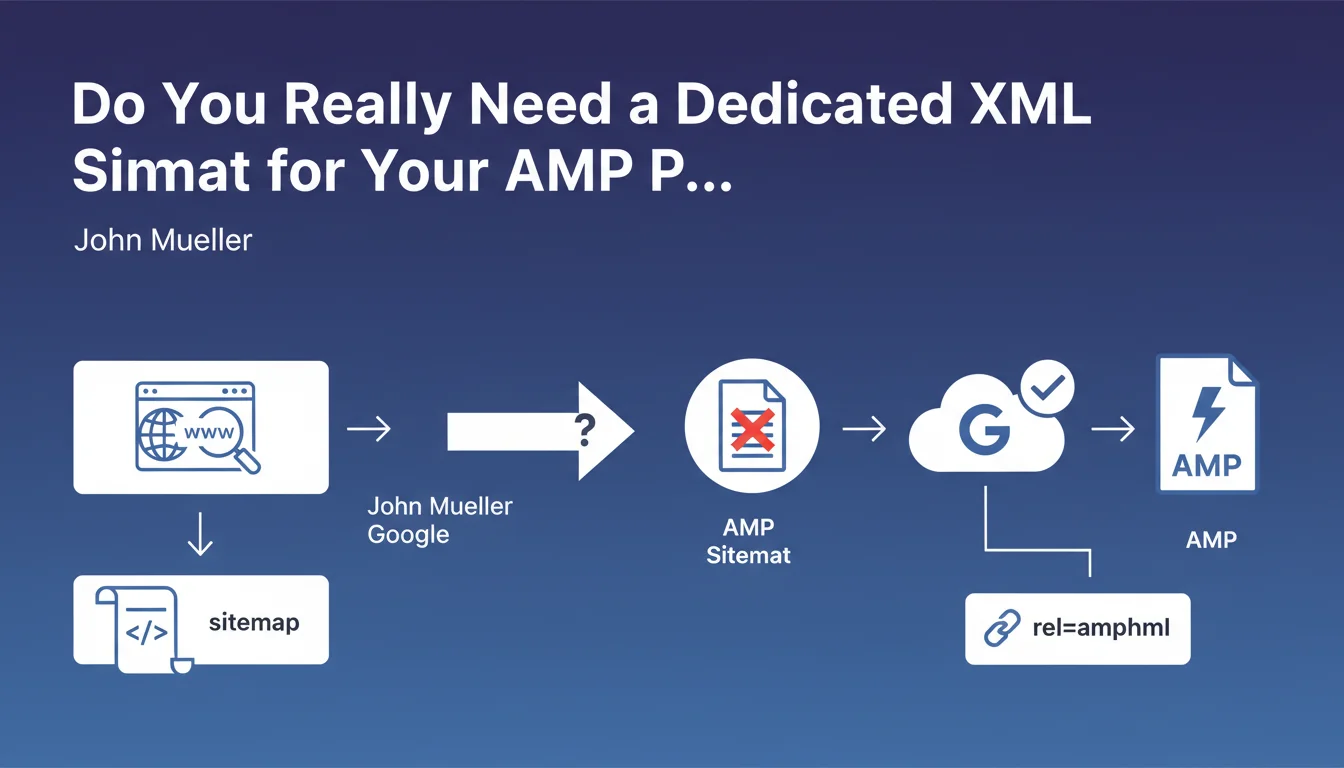
The search engine automatically discovers AMP versions thanks to the rel="amphtml" tag present in the HTML code of your canonical pages. This tag establishes the link between the standard version and the AMP version of the same page.
How does Google discover AMP pages without a dedicated sitemap?
The process is simple: Google crawls your classic HTML page listed in your standard sitemap. During this exploration, the bot detects the rel="amphtml" tag that points to the AMP version.
This automatic discovery works bidirectionally. The AMP page also contains a rel="canonical" tag that points to the standard version, thus creating a clear relationship between the two versions.
Why is this clarification important for SEO?
This statement eliminates an unnecessary workload for webmasters. Many were creating and maintaining separate AMP sitemaps out of an abundance of caution, thus multiplying the files to manage.
It also simplifies the technical architecture of the site and reduces the risk of configuration errors. A single well-structured sitemap is sufficient for all your content.
- Only one XML sitemap is necessary to index both classic and AMP pages
- The rel="amphtml" tag allows Google to automatically discover AMP versions
- This approach simplifies the technical maintenance of the site
- The bidirectional relationship (canonical + amphtml) ensures a clear understanding of the structure
SEO Expert opinion
Is this statement consistent with practices observed in the field?
After 15 years of experience, I confirm that this statement perfectly reflects what we observe in technical audits. Sites with a single sitemap including canonical pages index just as well as those with separate AMP sitemaps.
Google has always favored natural discovery through internal links and relationships between pages. The sitemap is a complementary tool, not the primary indexing mechanism.
What nuances should be added to this recommendation?
While this approach works for the majority of sites, certain special cases deserve attention. Sites with thousands of AMP pages can sometimes benefit from a dedicated sitemap to facilitate monitoring in Search Console.
Similarly, if you encounter indexing problems specific to AMP pages, a separate sitemap can serve as a diagnostic tool. But this remains the exception, not the rule.
In what cases could this simplified approach cause problems?
Sites with complex dynamic generation of AMP pages can sometimes create AMP versions that are not properly linked. In this case, an AMP sitemap can serve as a temporary safety net.
Multilingual or multi-regional sites with AMP also require special attention. The complexity of hreflang tags combined with AMP relationships may justify a more structured organization through specific sitemaps, at least for monitoring purposes.
Practical impact and recommendations
What should you actually do on your site?
If you are currently maintaining separate AMP sitemaps, you can safely remove them. Focus on a single XML sitemap containing your canonical pages.
Verify that each standard HTML page contains the rel="amphtml" tag pointing to its AMP version. Also ensure that each AMP page has the rel="canonical" tag pointing to the standard version.
Use Search Console to monitor the indexing of your AMP pages through the specific report. Google will automatically notify you of detected configuration problems.
What errors should you absolutely avoid?
Never remove the rel tags thinking that the sitemap will be enough. These tags are the primary discovery mechanism; the sitemap is only a complement.
Avoid creating complex redirect chains between canonical and AMP versions. Google must be able to establish the relationship directly through the tags, without intermediaries.
- Keep a single XML sitemap listing your canonical pages
- Verify the presence of rel="amphtml" on all your standard pages with an AMP version
- Check that each AMP page contains rel="canonical" pointing to the standard version
- Test your AMP URLs with the URL Inspection tool in Search Console
- Remove existing dedicated AMP sitemaps to simplify your infrastructure
- Document your configuration for future technical updates
- Monitor the AMP report in Search Console for a few weeks after modifications
How can you verify that your configuration is optimal?
Use Google's AMP test tool to validate the technical structure of your pages. Also verify through a "View Source" that the rel tags are present in the initial source code.
Analyze server logs to confirm that Googlebot is indeed crawling your AMP pages after exploring the canonical versions. The delay between the two crawls will give you an indication of the effectiveness of your configuration.
💬 Comments (0)
Be the first to comment.