
Official statement
What you need to understand
How does Google behave when faced with an inaccessible site?
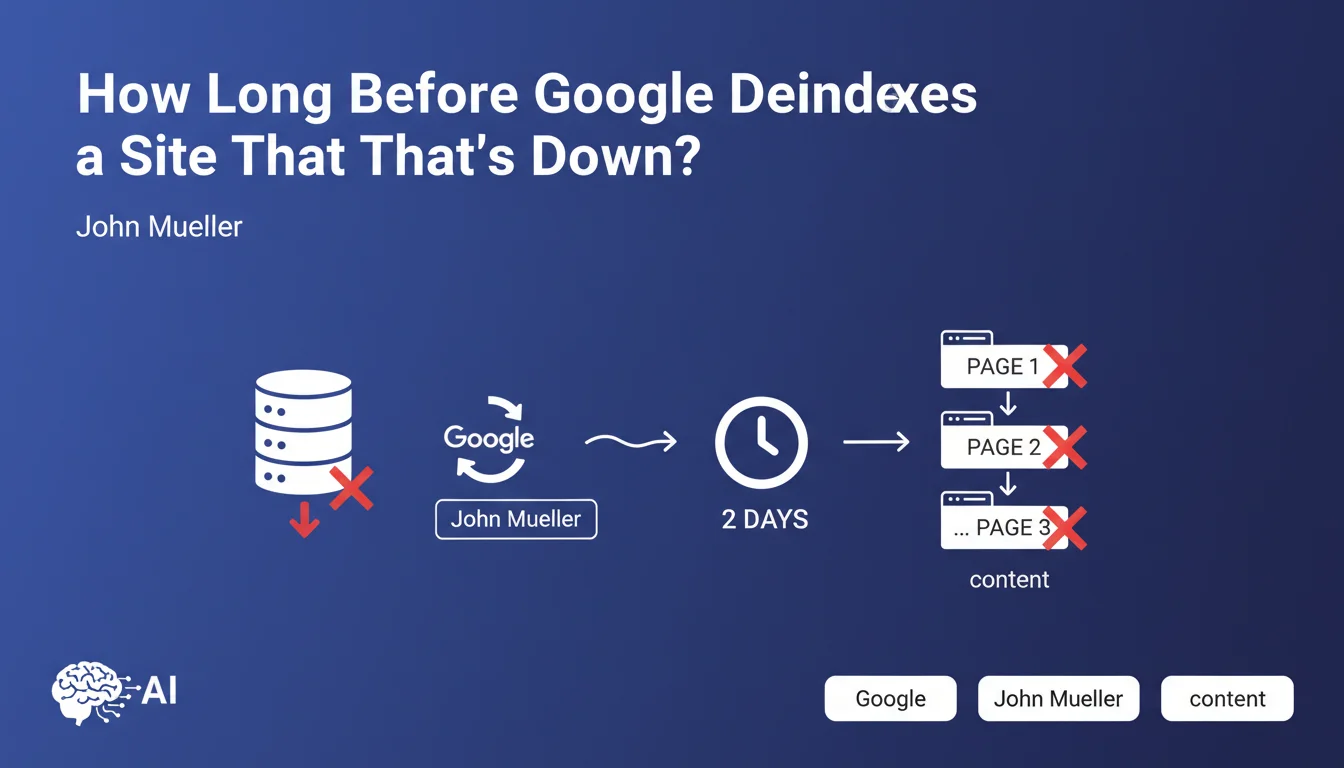
When a website becomes inaccessible (500 error, 502 error, timeout, etc.), Google does not immediately proceed with deindexation. The search engine tests page access multiple times to verify whether it's a temporary or permanent outage.
After 2 days of unavailability, Googlebot begins deindexing content progressively. This deindexation occurs page by page rather than globally, which means some pages may remain indexed longer than others.
Why does Google wait 2 days before deindexing?
This grace period allows Google to differentiate technical maintenance from permanent closure. An outage of a few hours will therefore normally have no impact on your rankings.
However, beyond 48 hours, the search engine considers that the content is no longer available to users and begins the process of progressive removal from the index. This approach protects user experience by avoiding serving inaccessible results.
How does Google distinguish a temporary outage from a permanent problem?
Google recommends using the 503 HTTP code (Service Unavailable) accompanied by the Retry-After header to explicitly signal temporary maintenance. This combination tells the search engine when to return to crawl the site.
- An outage of a few hours has no impact on indexation
- After 2 days, deindexation begins progressively
- The process occurs page by page, not across the entire site simultaneously
- The 503 code with Retry-After is the best practice for maintenance
- Once the site is restored, pages are recrawled and reindexed, but this takes time
SEO Expert opinion
Does this 2-day rule apply uniformly to all sites?
Based on my observations across several hundred sites, this 2-day timeframe is not an absolute rule. It varies depending on the site's usual crawl frequency and authority. A site crawled multiple times per day (news media, major e-commerce site) may see certain pages deindexed more quickly.
Conversely, a site with limited crawl budget or low authority may benefit from a longer delay before deindexation. I've observed cases where infrequently visited sites remained partially indexed after 4-5 days of downtime.
Is the 503 code really sufficient to protect indexation?
While the 503 code with Retry-After is indeed the technical best practice, its effectiveness depends on the duration specified. A Retry-After of 24 hours will be respected, but beyond 48-72 hours, I've observed deindexations despite the correct code.
In my experience, for scheduled long-duration maintenance, it's preferable to implement a lightweight HTML maintenance page with 503 code, rather than a brutal server error. This maintains a positive signal to Google and better preserves indexation.
What factors influence reindexation speed after an outage?
Your site's crawl budget is the determining factor. A site with a reliability history and strong authority will recover faster than a site with a history of frequent outages. Google adjusts its crawl frequency based on observed stability.
I've also found that submitting an updated sitemap and using the URL inspection tool in Search Console significantly accelerates reindexation of strategic pages. Prioritizing the most important URLs can cut recovery time in half.
Practical impact and recommendations
What should you put in place before an outage occurs?
Prevention is your best ally. Implement a monitoring system that alerts you instantly in case of unavailability. Every minute counts within the 48-hour window.
Prepare in advance a professional maintenance page that returns a 503 code with the Retry-After header properly configured. This page must be lightweight (less than 50KB), responsive, and clearly explain the situation to visitors.
How should you react effectively during an unexpected outage?
If your site goes down, your absolute priority is to restore service within 48 hours. Beyond this timeframe, you enter the risk zone for your natural search rankings.
Immediately configure the 503 code if not already done, rather than leaving 500 errors or timeouts. Communicate via your social networks to inform your audience and limit the impact on your brand image.
What actions should you take after site restoration?
As soon as your site is restored, immediately check your indexation status in Search Console. Use the URL inspection tool to request priority indexation of your strategic pages (homepage, main categories, best-sellers).
Submit an updated XML sitemap with a recent lastmod date to signal to Google that your content is available again. Monitor your indexation daily for 2 weeks to measure recovery speed.
- Implement 24/7 monitoring with SMS/email alerts
- Prepare a maintenance page with 503 code and Retry-After
- Document an emergency procedure for your technical team
- Maintain professional-quality hosting with guaranteed SLA
- Regularly test your disaster recovery plan
- Backup your indexation status monthly via Search Console
- Configure automatic 503 redirects in case of critical server load
- After restoration: URL inspection and priority sitemap submission
- Monitor indexation evolution for at least 14 days
A site outage is never trivial for your search rankings. While Google tolerates a few hours of unavailability, the critical 48-hour threshold can trigger progressive deindexation whose recovery will take several weeks.
Implementing a robust technical infrastructure with monitoring, professional maintenance page, and documented emergency procedures is essential. These technical aspects, combined with an optimized post-outage recovery strategy, require specialized expertise.
For sites with critical business stakes, support from a specialized SEO agency helps secure these often-underestimated technical aspects. An infrastructure audit and implementation of custom protocols can save you considerable traffic and revenue losses during unforeseen incidents.
💬 Comments (0)
Be the first to comment.